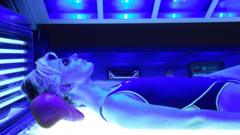
The hum is the first thing you remember.
It starts as a low, electrical thrumming behind your ears, right before the heavy acrylic lid clicks shut and the ceiling erupts into a blinding, violet-white glare. For ten minutes, the freezing rain beating against the high street window disappears. You are no longer in a dreary, damp Tuesday afternoon in November. You are lying on a warm bed of humming glass, breathing in the distinct, metallic scent of ozone and coconut-scented accelerator lotion, watching the tiny beads of sweat form along your collarbone. For a more detailed analysis into this area, we recommend: this related article.
I know that hum intimately. Ten years ago, it was my favorite weekly ritual.
Back then, stepping into a high-street tanning salon felt like buying an affordable ticket to summer. It was sold to me—and to millions of others—not as a medical gamble, but as self-care. A mood booster. A way to banish the winter blues, clear up a stubborn patch of acne, and walk into a Friday night party looking healthy, rested, and vibrant. The posters on the salon walls didn't look like warnings; they looked like holiday brochures. They promised a "base tan" to protect my pale skin before a beach trip. They boasted about Vitamin D. They made the whole experience feel as benign as getting a haircut or a manicure. For additional information on this development, detailed reporting is available on Mayo Clinic.
That illusion is precisely why the Advertising Standards Authority (ASA) just stepped in with a blunt, uncompromising hammer.
In a series of sweeping rulings and fresh enforcement notices, the UK's advertising watchdog issued a stark directive to the indoor tanning industry: stop downplaying the cancer risk. Stop hiding behind wellness buzzwords. Stop pretending that lying inside a box of concentrated ultraviolet radiation is a harmless path to health and beauty.
When a regulator has to publicly remind businesses not to obscure the fact that their product causes a potentially fatal disease, you know something has gone deeply wrong with how we talk about risk.
The Lie of the "Healthy" Glow
To understand why the watchdog had to bare its teeth, you have to look at the quiet, seductive language that crept into salon marketing over the last few years.
Consider a hypothetical scenario that plays out every day across social media feeds and shopfront windows. Meet Chloe, a twenty-four-year-old marketing assistant scrolling through Instagram on a gray Sunday evening. She’s tired, pale, and dreading the commute. Up pops a sponsored post from a local tanning studio. The graphic is sleek, bathed in warm terracotta and gold tones. It doesn't scream fry your DNA. Instead, it whispers about "boosting your Vitamin D levels," "preparing your skin for the sun," and "enhancing your natural radiance."
Every single one of those claims is a masterclass in selective truth, and every single one of them is dangerous.
Let’s look at the science without the marketing gloss. Sunbeds do not replicate a gentle spring morning. They emit concentrated doses of ultraviolet (UV) radiation—specifically UVA and UVB rays—that can be up to ten to fifteen times stronger than the midday Mediterranean sun. When you lie under those tubes, your skin isn't absorbing health. It is mounting an emergency defense.
Think of a suntan not as a sign of vitality, but as a microscopic scar. When UV rays penetrate your skin cells, they scramble the DNA inside. Your body, recognizing an active attack, frantically produces melanin—the dark pigment that gives you that coveted bronze color—to act as a biological umbrella, shielding the cell's nucleus from further genetic damage. A tan is literally your skin screaming for cover.
Yet, for decades, the industry successfully reframed that distress signal as the ultimate marker of wellness. And when consumers began waking up to the dangers of skin cancer, the messaging simply shifted. If they couldn't sell vanity alone, they would sell health.
When Watchdogs Bare Their Teeth
The ASA's intervention didn't happen in a vacuum. It was triggered by a wave of complaints and proactive monitoring that revealed a troubling pattern: tanning salons were actively diluting the gravity of melanoma risk while overstating unproven health benefits.
In one notable crackdown, the watchdog banned social media ads and posters that implied sunbeds were a safe, regulated way to get Vitamin D, or that a "base tan" offered meaningful protection against sunburn abroad. Let’s dismantle both of those myths right now, because they are the exact hooks that kept me paying ten pounds a session in my twenties.
First, the Vitamin D argument. Yes, UVB rays trigger Vitamin D synthesis in human skin. However, most modern sunbeds emit primarily UVA radiation—the long-wave rays that penetrate deep into the dermis, causing premature aging and profound cellular damage, while doing almost nothing to generate Vitamin D. Even if you use a bed with higher UVB output, the amount of radiation required to produce a modest spike in Vitamin D is vastly outweighed by the carcinogenic damage inflicted in the process. Public health bodies, including the NHS and Cancer Research UK, are unequivocal on this point: you can get all the Vitamin D you need safely from a ten-pence daily supplement and oily fish, without ever stepping foot near an ultraviolet tube.
Second, the "pre-holiday base tan." This is perhaps the most persistent piece of folklore in beauty culture. The logic feels intuitive: build up a little color at home so you don't burn in Spain. In reality, a sunbed tan provides a Sun Protection Factor (SPF) of roughly 2 to 4. That is practically zero protection. Worse, it creates a false sense of security. You arrive at the beach feeling armored, skip the high-factor sunscreen, and end up burning anyway—compounding the UV damage you already paid for back home.
The watchdog’s message to sunbed operators is simple. You cannot make medical claims you cannot back up. You cannot cherry-pick data to make a Group 1 carcinogen look like a wellness supplement.
A Group 1 Carcinogen in a Strip Mall
Pause on that phrase for a second.
Group 1 carcinogen.
In 2009, the World Health Organization’s International Agency for Research on Cancer (IARC) moved UV-emitting tanning devices into its highest cancer risk category. That puts sunbeds in the exact same epidemiological bracket as tobacco smoke, asbestos, and plutonium.
Read that again. Not "possibly carcinogenic." Not "hazardous in extreme excess." Proven, beyond a shadow of a scientific doubt, to cause cancer in humans.
The statistics attached to that classification are sobering, even if they rarely make it onto the glossy flyers handed out on high streets. According to data compiled by Cancer Research UK, using a sunbed for the first time before the age of 35 increases your risk of developing melanoma—the deadliest form of skin cancer—by nearly 60 percent. In the UK alone, indoor tanning is estimated to cause hundreds of new melanoma cases and around a hundred deaths every single year.
And yet, walk down almost any high street in Britain, and you will see neon signs glowing pink and blue behind frosted glass. Unlike cigarettes, which are locked away behind blank gray cupboard doors and wrapped in graphic images of diseased organs, sunbeds remain strangely normalized. They sit comfortably beside nail bars and coffee shops.
Why? Because the consequences are invisible. For years.
The Delayed Fuse
If touching a sunbed burned your hand the way touching a hot stove does, the industry would collapse overnight. Our brains are wired to respond to immediate, visceral threats. We flinch from fire; we recoil from sharp edges.
Ultraviolet radiation plays a much longer, quieter game. It operates on a delayed fuse.
To see how this works, imagine your skin’s DNA as a vast, intricate library of instruction manuals, telling your cells when to grow, when to divide, and when to die. Every time you step into a tanning booth, those UV rays act like stray sparks flying through the aisles. Most of the time, your body’s cellular librarians rush in, put out the small fires, and repair the scorched pages. You walk out of the salon looking golden, feeling great, completely unaware of the frantic cleanup happening beneath the surface.
But over dozens of sessions, the librarians get overwhelmed. A scorched page gets missed. A critical instruction—the genetic brake pedal that tells a pigment-producing melanocyte cell to stop dividing—gets permanently erased.
That single damaged cell might sit quietly in your shoulder or your calf for five, ten, or twenty years. It doesn't hurt. It doesn't itch. You forget about the tanning salons of your youth. You grow up, change jobs, maybe have children. Then, one morning in the shower, you notice a mole that looks slightly jagged, a little darker on one side, maybe the size of a pencil eraser.
By the time that delayed fuse reaches the powder keg, the damage was done a decade ago.
I learned this lesson not through a textbook, but in a cold, fluorescent-lit dermatology clinic three years ago. The dermatologist didn't lecture me. He didn't need to. He simply held up a dermatoscope—a small magnifying lens with a polarized light—to a flat, unassuming brown spot on my upper back, right where the tanning bed acrylic used to press against my skin.
"This needs to come out today," he said, his voice entirely devoid of drama.
The biopsy came back as severe dysplasia—a pre-cancerous lesion caught right on the precipice of becoming invasive melanoma. I walked away with a two-inch scar, a stern directive to wear SPF 50 every single day of the year, and a profound sense of how easily I had traded long-term safety for a temporary glow. I was lucky. Thousands of people sitting in those exact same clinic chairs every month are not.
The Economics of Insecurity
If the science is settled and the risks are catastrophic, why do sunbed firms still fight so hard to soften their messaging?
Follow the money. The indoor tanning industry is a multi-million-pound enterprise built almost entirely on repeat custom. A single session does very little; to maintain an artificial tan, a customer has to keep coming back, week after week, month after month. It is a subscription model powered by seasonal insecurity.
When winter sets in and social media feeds remain saturated with filtered, sun-kissed influencers, the pressure to look tanned doesn't go away. Tanning salons know that if they lead with honest, unvarnished medical warnings—if their ads prominently stated, This device significantly increases your risk of fatal skin cancer—their foot traffic would plummet.
So, they lean into ambiguity. They use words like "safe tanning," "controlled UV," and "smart beds." They train staff to talk about skin types and gradual exposure, creating an illusion of medical precision. When you walk into a salon and someone asks you to fill out a quick questionnaire about your eye color and how easily you burn, it feels clinical. It feels like a safeguard.
In reality, there is no such thing as a safe UV tan. The "controlled" environment of a sunbed simply means the radiation is delivered consistently and intensely—which is precisely why it is so effective at triggering melanin production, and so effective at mutating DNA.
The ASA’s crackdown is an attempt to strip away that clinical theater. Watchdogs are looking closely at everything from influencer partnerships on TikTok to local Google ads, making it clear that omitting risk or implying health benefits violates basic advertising codes. In the UK, under the Sunbeds (Regulation) Act 2010, it is already illegal for anyone under eighteen to use a sunbed. Now, regulators are closing the loophole on how the industry markets to adults—especially young adults in their late teens and twenties, who remain the industry's most lucrative demographic.
Stepping Out of the Box
It is easy to feel cynical when reading about corporate watchdogs and regulatory fines. A ruling from an advertising authority doesn't physically unplug a single sunbed. It doesn't stop someone from walking off the street, handing over their debit card, and closing that acrylic lid.
What it does do is break the spell.
Truth matters in how we weigh our choices. Adults are allowed to take risks—we drink alcohol, we eat ultra-processed food, we drive fast cars. Nobody is arguing that people lack the agency to make decisions about their own bodies. But agency only works when the information on the table is honest. You cannot make a rational choice if the person selling you the product is actively hiding the price tag.
For too long, the price tag of a sunbed session was hidden behind promises of winter wellness and effortless beauty. When regulators force tanning companies to drop the pseudoscience and confront the reality of melanoma, they hand power back to the consumer.
And the truth is, we don't even need the gamble anymore. Look at the sheer sophistication of modern sunless tanning—the mousses, the gradual lotions, the custom spray tans that deliver the exact same warm, golden undertone without mutating a single strand of DNA. You can buy the illusion of a Mediterranean holiday in a bottle for fifteen pounds, apply it in your bathroom in ten minutes, and wake up glowing, knowing your cells spent the night resting instead of fighting for their lives.
The next time you walk past one of those frosted shopfronts on a gray afternoon, pause for a second and look past the neon glow. Listen to the faint, rhythmic hum vibrating through the glass.
It sounds like summer. It feels like warmth. Just remember what it actually costs to step inside.