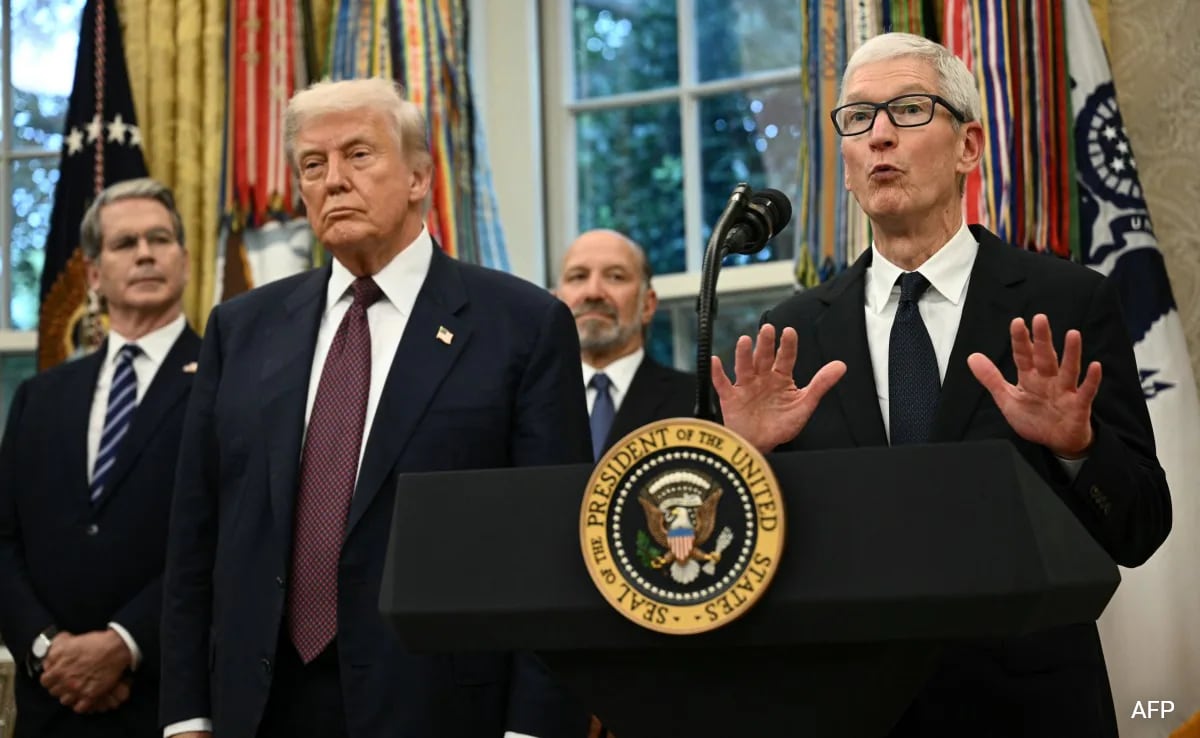
Donald Trump’s recent claims that Apple CEO Tim Cook called him to complain about European legal pressures highlight a power dynamic that most of Silicon Valley tries to hide. While other tech titans bicker publicly or retreat into partisan corners, Cook has mastered a specific, quiet brand of diplomacy that treats the former president not just as a political figure, but as a high-stakes account manager. The revelation that Cook reached out to discuss billions in fines from the European Union is not an admission of weakness. It is a calculated survival tactic. Cook understands that for a company with a market cap frequently flirting with $3.5 trillion, the loudest voice in the room is often the most useful tool, regardless of whether you agree with what that voice is saying.
The Geography of Supply Chains and Political Cover
Apple occupies a unique and dangerous position in the global economy. Unlike software-heavy firms like Meta or Alphabet, Apple’s heart beats in the factories of China and its lungs breathe in the retail markets of the United States. This physical reality makes the company exceptionally vulnerable to trade wars and tariffs. During the first Trump administration, Cook did not join the chorus of tech executives issuing performative press releases. He went to dinner. He showed up at the White House. He walked the floors of a Texas manufacturing plant with the president, even though the "new" Mac Pro being assembled there had been in production for years. You might also find this related coverage interesting: The Brutal Truth About India’s Trade Strategy After the US Supreme Court Chevron Ruling.
The goal was simple: exemptions. Cook needed to ensure that the iPhone, the most profitable consumer product in history, stayed off the tariff lists that were strangling other hardware manufacturers. He succeeded by framing Apple’s success as American success. When Trump boasts that Cook called him to "kiss my a**," he is describing a transaction. Cook provides the ego-stroke; Trump provides the regulatory shield. It is a cold, binary exchange.
The European Front and the Enemy of My Enemy
The specific focus of the recent communication—EU regulatory pressure—reveals a shift in Apple’s defensive strategy. For years, the European Commission has been the primary antagonist for Big Tech, levying massive fines over tax arrangements in Ireland and forcing the opening of the tightly guarded App Store ecosystem. By bringing these grievances to Trump, Cook is tapping into a specific brand of economic nationalism. As reported in detailed articles by Investopedia, the implications are notable.
The logic is straightforward. If the EU hits Apple with a $14 billion tax bill, that is capital leaving an American company and entering European coffers. Cook knows that framing this as an "attack on an American icon" resonates with Trump’s "America First" rhetoric. It’s an attempt to turn a technical legal dispute into a geopolitical trade war, with the U.S. government acting as Apple’s ultimate defense attorney.
The Silicon Valley Divergence
To understand why Cook’s approach is so effective, you have to look at the wreckage of his peers’ political strategies. Mark Zuckerberg spent years being hauled before committees, attempting to play both sides and ending up liked by neither. Elon Musk has swung wildly into the role of a political operative, tethering his companies' brands to his personal ideology. Cook, by contrast, remains a ghost. He does not tweet his grievances. He does not endorse candidates. He maintains a relationship with the current administration while keeping the door wide open for the next one.
This is the "Cook Doctrine." It is the realization that the CEO of Apple is essentially the head of a small state. Like any head of state, his primary duty is the stability and prosperity of his territory. If that requires listening to a rambling monologue about "kissing a**," Cook will do it without blinking. He isn’t looking for a friend; he’s looking for a veto.
Why the EU is Winning the Regulatory War
Despite Cook’s lobbying, the reality on the ground is changing. The Digital Markets Act (DMA) in Europe is not a suggestion; it is a fundamental restructuring of how Apple does business. For the first time, the "walled garden" has holes in it. Users in the EU can now use third-party app stores and alternative payment systems. This isn’t just a legal headache; it’s a threat to the 30% commission Apple takes on digital goods—a revenue stream that is almost pure profit.
Trump’s rhetoric about protecting Apple from "the socialists in Europe" makes for a good headline, but it does little to change the law in Brussels. However, it does create a domestic environment where Apple is seen as a victim of foreign overreach rather than a domestic monopoly. That distinction is vital for Apple’s ongoing battles with the Department of Justice at home. If you can convince the American public and its leaders that you are the home team being bullied abroad, you gain significant leverage against antitrust regulators in Washington.
The Risk of the Trump Association
There is, of course, a massive downside to this strategy. Apple’s brand is built on a carefully curated image of progressive values, privacy, and high-minded design. Publicly associating with a polarizing figure like Trump risks alienating a significant portion of its customer base and its workforce. Employees at Apple Park are not known for their conservative leanings.
Yet, Cook has calculated that the risk of a 25% tariff on Chinese-made iPhones is far greater than the risk of a few angry tweets or internal Slack messages. He is a supply chain expert by trade, and supply chains do not care about feelings. They care about the cost of goods sold. If maintaining a direct line to Trump prevents a disruption in the flow of millions of devices from Shenzhen to San Francisco, Cook considers it a win.
The Private Conversation versus the Public Post
One must also consider the source of the "kissing a**" narrative. Trump is a master of hyperbole, often translating a standard professional greeting into a total surrender by his counterpart. It is highly unlikely that Cook, a man who chooses his words with the precision of a watchmaker, actually used that language. But Cook doesn’t correct the record. He doesn’t issue a "well, actually" statement. He lets the former president have the win in the court of public opinion because the only win Cook cares about happens behind closed doors in the Oval Office or at Mar-a-Lago.
This silence is his superpower. By allowing Trump to claim victory, Cook gets exactly what he wants: access. When the next trade representative is appointed, or the next tax bill is drafted, Apple will have a seat at the table because the man at the top believes he has already won.
The Future of Corporate Diplomacy
The Apple-Trump relationship is a blueprint for the future of the American corporation in a fractured political world. We are moving away from an era where companies could remain truly neutral. In this new era, the most successful leaders will be those who can navigate radical volatility with a poker face.
Cook is not a partisan. He is a pragmatist. He donated to Hillary Clinton in 2016 and has worked closely with the Biden administration on environmental initiatives and domestic chip manufacturing. He is playing a game of total coverage. While the media focuses on the colorful language of a social media post, the real story is the quiet, relentless movement of Apple’s interests through the machinery of government.
The company is currently facing its most significant legal challenges in decades. From the DOJ’s massive antitrust suit to the EU’s relentless fines, the "walled garden" is under siege. In this context, a phone call to a man who might be the next president isn’t just a courtesy—it’s a necessity. If you are the CEO of a company that is essentially a pillar of the American economy, you don't have the luxury of choosing your allies based on personal taste. You choose them based on their ability to move the needle.
Apple’s reliance on this type of personal diplomacy also highlights a weakness in our current system. When the rules of global trade and domestic regulation can be influenced by a single phone call or a weekend visit to a golf course, the predictability that businesses crave is replaced by whim. Cook is simply adapting to the environment he was given. He didn't create the rules of the "transactional presidency," but he is currently the person playing it most effectively.
The next few years will determine if this strategy holds. As the EU ramps up its enforcement and the U.S. enters another high-stakes election cycle, the pressure on Apple will only increase. Cook will keep taking the calls. He will keep making the trips. And he will keep letting others brag about the "kissing" while he walks away with the exemptions.
Success in the modern business world isn't about being liked. It is about being indispensable. Tim Cook has made Apple indispensable to the American narrative, and in doing so, he has made himself the one person every politician, regardless of their party, feels compelled to answer to. The phone works both ways.
Grab the nearest iPhone and look at it. It is not just a piece of glass and aluminum. It is a physical manifestation of a decade of political maneuvering, tax avoidance, and supply chain wizardry. Every time Trump speaks about Cook, he is inadvertently confirming that Apple is too big to ignore and too integrated into the national identity to fail. That is exactly where Tim Cook wants to be.
The strategy is clear: be the person they have to call, then make sure you're the one who hangs up first.