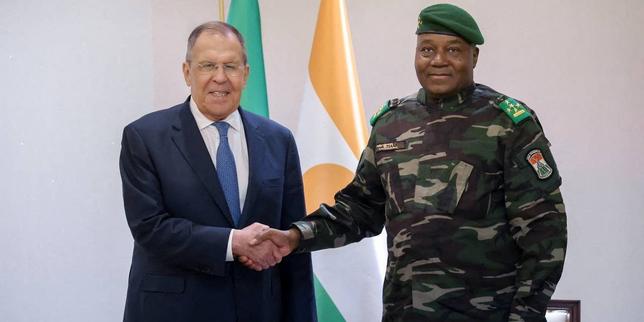
The restructuring of the geopolitical architecture in the Sahel is operating on a deliberate, transactional mechanism. Russian Foreign Minister Sergey Lavrov’s ministerial summit with the Confederation of Sahel States (AES)—comprising Niger, Mali, and Burkina Faso—in Niamey solidifies a structural pivot away from Western security frameworks. While conventional reporting characterizes this shift through the lens of ideological alignment or "anti-colonial" rhetoric, an objective analysis reveals a highly calculated trade: the exchange of immediate sovereign regime survival for asymmetric access to strategic natural resources.
The exit of these states from the Economic Community of West African States (ECOWAS) and the termination of Western military missions created a security vacuum. Russia’s strategy does not rely on deep capital investment or long-term infrastructure development; its financial constraints preclude such an approach. Instead, Moscow has deployed an optimized "security-for-resources" model that provides targeted military stability to ruling juntas while extracting high-value mineral concessions. Understanding the mechanics of this framework requires breaking down the operational pillars, economic cost functions, and structural bottlenecks of this new regional paradigm.
The Three Pillars of the Russia-AES Security Architecture
The expanded cooperation framework formalized in Niamey rests on three distinct operational pillars designed to replace Western counter-terrorism models with an integrated sovereign defense structure.
- Tactical Material Influx: Unlike Western military aid, which frequently paired equipment transfers with strict human rights compliance and governance oversight, the Russian material supply chain operates without political conditionalities. It focuses on high-impact assets: combat helicopters, drones, small arms, and advanced surveillance technology calibrated for counter-insurgency warfare in arid terrain.
- Asymmetric Military Training and Specialization: The framework shifts from generalized infantry training to specialized asymmetric warfare. Russian state-backed military instructors, acting under formalized defense ministry frameworks rather than ambiguous private military structures, provide direct tactical optimization for domestic forces. This includes direct operational integration in high-threat sectors and the training of personnel within Moscow’s specialized defense academies.
- Institutional Intelligence and Force Multiplication: A central objective of the Quadripartite format is supporting the creation of a unified AES joint force. Russia acts as the external coordinator, providing satellite reconnaissance, electronic warfare capabilities, and localized counter-intelligence support to shield the ruling military leadership from both internal coups and cross-border insurgent offensives.
The Resource Cost Function: The Math Behind the Alliance
The true driver of this geopolitical alignment is an economic barter mechanism born out of necessity. The Russian Federation, managing severe international sanctions and the financial drain of sustained conventional warfare in Europe, cannot offer large-scale liquidity, sovereign loans, or major infrastructure capital. The AES states, similarly isolated from Western capital markets and regional financial institutions, lack the liquid reserves to purchase advanced defense systems outright.
To bypass this dual liquidity constraint, the partnership relies on a resource-for-security swap. The cost function of Russia's military intervention is offset directly by mining concessions and extraction rights granted by the host nations.
[Russian Military Input: Weapons + Instructors + Intelligence]
                         │
                         ▼
        [Sovereign Protection for Juntas]
                         │
                         ▼
[AES Concessions: Gold (Mali/Burkina Faso) + Uranium (Niger)]
In Mali and Burkina Faso, this translates into direct access to established and prospective gold mining operations. In Niger, the strategic asset is uranium, where the withdrawal of French extraction entities has left proven reserves open for reallocation. By shifting the payment mechanism from fiat currency to raw commodity extraction, both parties insulate themselves from Western financial sanctions, banking restrictions, and tracking mechanisms.
Structural Bottlenecks and Strategic Risks
Despite the immediate tactical utility of the Russia-AES framework, the sustainability of the model is constrained by significant structural friction points.
The first limitation is the tension between symbolic solidarity and operational capacity. While Russia can effectively secure government installations, capital cities, and specific mining nodes, its troop density and logistical footprint are insufficient to suppress deeply entrenched jihadist insurgencies across the vast, porous borders of the wider Sahel.
The second limitation is the economic imbalance of a purely extractive model. Because the partnership provides minimal funding for local infrastructure, agricultural modernization, or manufacturing, the underlying socio-economic drivers of instability—youth unemployment, rural marginalization, and climate-induced resource scarcity—remain unaddressed. The long-term risk for the AES juntas is that military assistance can preserve the state structure at the center but fails to pacify the periphery, creating a permanent state of low-intensity conflict.
The Multipolar Diplomatic Play
Beyond the immediate theater of the Sahel, Moscow is using the AES framework to assemble an aligned diplomatic bloc within international forums. The invitation extended by Lavrov on behalf of Vladimir Putin for the AES heads of state to attend the upcoming Russia-Africa Summit in Moscow underscores this strategy.
By coordinating votes and policy positions at the United Nations, Russia secures vital diplomatic insulation from Global South partners. Concurrently, the AES states utilize Russian backing to neutralize Western diplomatic pressure regarding democratic transitions and human rights reports, leveraging the concept of a multipolar world order to legitimize their governance structures.
The strategic trajectory for Western policymakers requires abandoning the assumption that the AES juntas can be pressured back into legacy security arrangements via sanctions or diplomatic isolation. The Russian framework is structurally integrated into the host nations' survival strategies. To counter this influence, external actors must develop alternative frameworks that offer competitive security assurances while providing tangible economic development models that go beyond raw commodity extraction.