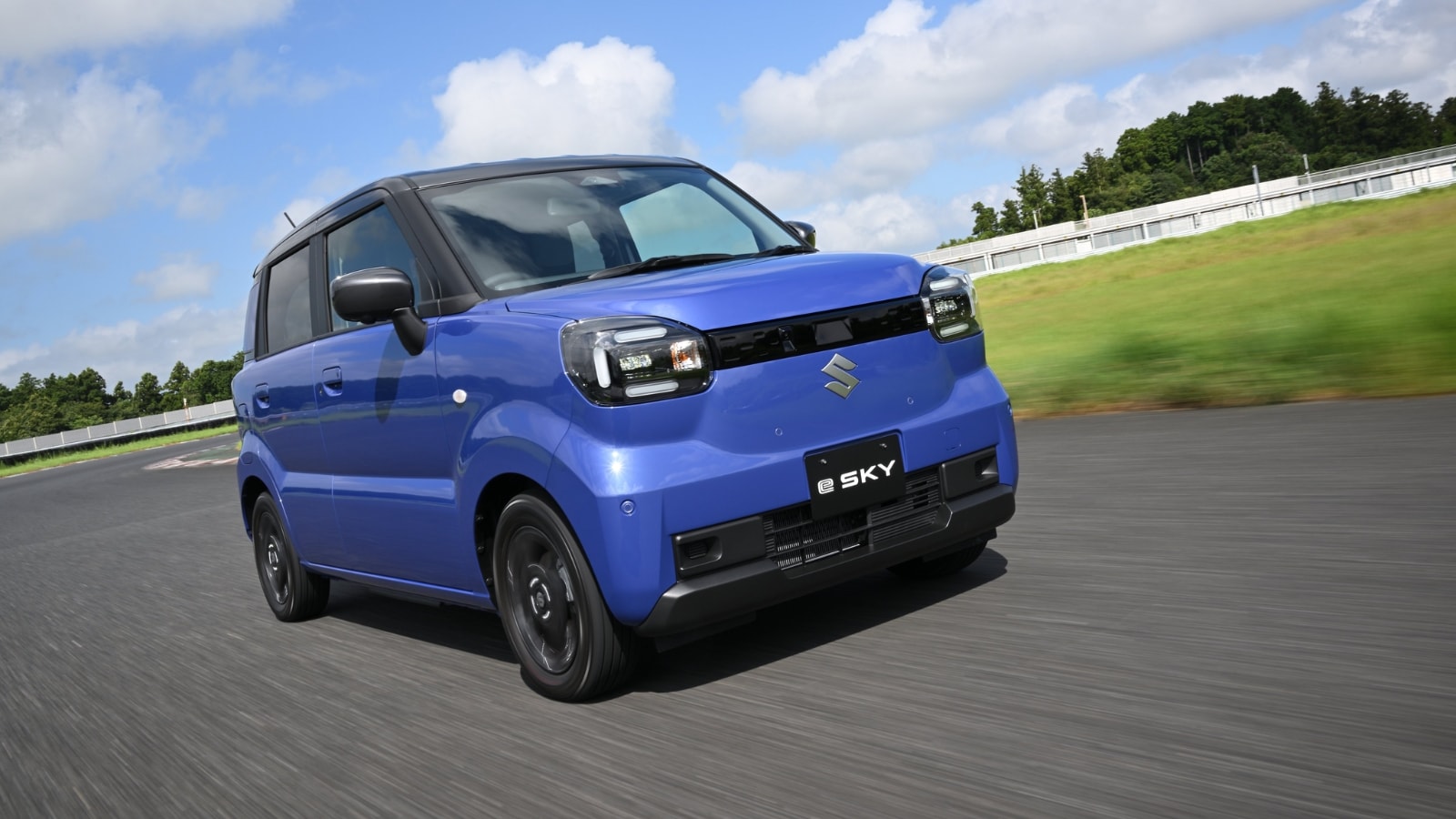
The economics of urban mobility have long been dictated by a fundamental compromise: reduce the physical footprint to navigate dense infrastructure, or scale up battery capacity to achieve viable driving ranges. Suzuki has bypassed this constraint with the production-spec e Sky. By engineering an electric vehicle strictly within Japan's rigid kei car dimensional envelope while extracting a 310-kilometer range from a compact 26-kWh lithium iron phosphate battery, the manufacturer has established a new benchmark for mass-to-energy efficiency.
This development forces a systemic reevaluation of how light passenger electric vehicles are designed. Rather than relying on brute-force energy storage, the vehicle achieves an energy consumption profile of roughly 97 Wh/km. Understanding the viability of this platform requires deconstructing its physical constraints, mass optimization strategies, and operational trade-offs.
The Dimensional Boundary Conditions
Japan's kei car classification imposes strict regulatory ceilings on physical dimensions. Vehicles must not exceed 3,395 millimeters in length, 1,475 millimeters in width, and 2,000 millimeters in height. For decades, these limits forced internal combustion engine platforms into boxy, high-aspect-ratio profiles designed to maximize interior volume within a restricted footprint.
Transitioning this architecture to an electric powertrain introduces severe load penalties. Batteries carry high mass relative to their energy density. When pack weight scales linearly to chase extended range figures, structural reinforcement requirements trigger a compounding mass spiral.
Suzuki circumvented this trap by treating the structural envelope as a fixed volume matrix. The e Sky measures 3,395mm long, 1,475mm wide, and 1,625mm high, utilizing a 2,460mm wheelbase. By maintaining a kerb weight of 1,030 kilograms, the engineering team kept dynamic inertial loads low enough to prevent the degradation of suspension longevity and tire wear characteristics typically observed in heavier battery-electric vehicles.
The Mass-to-Energy Optimization Loop
Achieving 310 kilometers of range from a 26-kWh battery pack requires an obsessive focus on parasitic load reduction and rolling resistance management. Standard electric vehicles often compensate for high drag coefficients and heavy chassis weights by installing large-capacity packs exceeding 60 kWh. That approach inflates vehicle acquisition costs and places unnecessary strain on raw material supply chains.
The e Sky relies on three distinct efficiency mechanisms:
- Thermal Management Efficiency: Integration of a heat pump prevents high-draw resistive heating systems from draining the low-voltage auxiliary and main traction circuits during low-temperature operation.
- Kinetic Recovery Architecture: The inclusion of an Easy Drive Pedal function optimizes regenerative braking capture rates in stop-and-go urban environments, transforming kinetic energy back into storable chemical energy efficiently.
- Aerodynamic Volume Control: The squared-off tallboy silhouette, while seemingly unoptimized for highway speeds, minimizes frontal area cross-sections while maintaining interior ergonomics at low urban operating velocities where aerodynamic drag is secondary to rolling resistance.
This configuration shifts the design philosophy from range anxiety mitigation via raw storage capacity to consumption minimization via systemic lightweighting.
Operational Constraints and Market Limitations
Despite its engineering efficiency, the platform operates under clear thermodynamic and regulatory boundaries. The 26-kWh LFP battery profile inherently limits ultra-fast long-distance touring capabilities. The vehicle is engineered explicitly for high-density metropolitan distribution and daily commuter loops.
Furthermore, export viability remains constrained by international safety standards and consumer expectations outside of dense Asian urban centers. The single-motor configuration and modest output limits acceleration profiles at highway velocities. The vehicle is optimized for environments where average speeds rarely exceed 60 kilometers per hour, meaning its exceptional efficiency metrics degrade when subjected to sustained high-speed freeway cycles.
Strategic Market Deployment
Suzuki's execution demonstrates that micro-EV profitability relies on restraint rather than excess. By refusing to inflate the battery footprint, the manufacturer protects unit margins while delivering a utility profile that matches actual urban driving telemetry. Market entry in autumn 2026 will test whether urban consumers outside Japan are willing to adopt strict physical minimalism in exchange for drastically lower operating costs and simplified urban maneuverability.
Prioritize supply chain allocations toward localized LFP cell sourcing to insulate the production cost structure from nickel and cobalt price volatility, while preparing manufacturing tooling for rapid scaling across adjacent high-density Asian markets where traditional multi-segment electric vehicles remain cost-prohibitive.