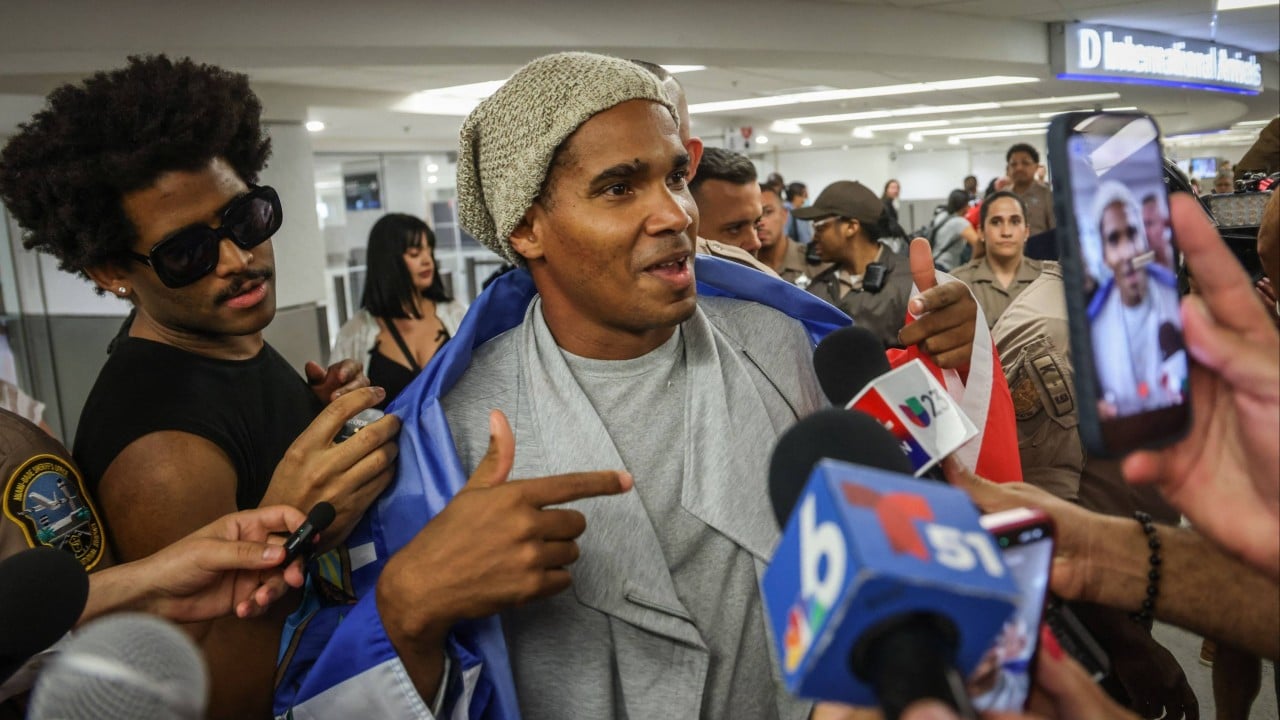
The arrival of Cuban dissident artist Luis Manuel Otero Alcántara in the United States establishes a critical case study in the mechanics of authoritarian containment. State-engineered exile operates not as a failure of domestic control, but as a deliberate execution of an asymmetric governance model designed to neutralize high-yield political opposition. By transitioning a high-profile dissident from domestic incarceration to international displacement, the Cuban state minimizes long-term domestic friction while capitalizing on the predictable operational degradation that occurs when an activist is decoupled from their geographic base.
Understanding this dynamic requires moving past emotional narratives of personal freedom and analyzing the structural frameworks that govern state security apparatuses and independent civil movements. The survival of domestic resistance networks depends on understanding the specific mechanisms used to suppress them, particularly the calculated trade-off between domestic detention and forced migration.
The Asymmetric Friction of Dissident Artistry
To understand why Otero Alcántara, a co-founder of the San Isidro Movement (MSI), became a primary target of the state security architecture, one must analyze the operational economics of independent art within a closed political system. Standard political opposition groups often rely on formalized structures, manifestos, and explicit party lines, making them highly vulnerable to legal infiltration and institutional decapitation. Independent art collectives operate under an entirely different structural dynamic.
Dissident art acts as a low-cost, high-visibility disruption vector. The input costs are minimal—often requiring nothing more than digital access, performance space, and domestic materials—yet the output generates disproportionate international and domestic attention. This creates an extreme imbalance in operational friction.
The structural advantages of this model rely on specific operational characteristics:
- Decentralized Ideology: Unlike traditional political factions, art-driven opposition does not require rigid adherence to a centralized platform. It permits diverse demographics to coalesce around a shared aesthetic or localized grievance without demanding formal membership.
- Low Bureaucratic Footprint: Because these movements lack formal offices, bank accounts, or hierarchical command structures, standard state methods of financial strangulation and regulatory suppression prove ineffective.
- Exploitation of Hyper-Connectivity: Performance art is explicitly designed for digital amplification. A single localized action can be captured via mobile telephony and broadcast to global audiences within minutes, bypassing state-controlled telecommunications monopolies through peer-to-peer distribution networks.
The Cuban state’s historical response to this phenomenon relies on Decrees 349 and 373, regulatory frameworks designed to criminalize independent artistic production. When these legal frameworks failed to deter the San Isidro Movement, the state resorted to physical containment. The five-year prison sentence handed to Otero Alcántara in 2022 following the July 11, 2021, nationwide protests reflects a calculated effort to increase the operational costs for the individual actor until the threshold of personal sustainability is crossed.
The Cost-Benefit Function of State Suppression
Authoritarian states face a dynamic optimization problem when managing high-profile political prisoners. Prolonged domestic imprisonment yields diminishing returns and introduces severe systemic vulnerabilities. The state must constantly calculate the equilibrium point between domestic deterrence and international liability.
[Domestic Imprisonment] -> High Reputational Friction & Martyrdom Risk
       |
       v (State Optimisation Process)
       |
[Forced Transnational Exile] -> Externalises Containment Costs & Degrades Dissident Network Ties
The domestic costs of indefinite detention follow an inflationary trajectory. A imprisoned dissident serves as a permanent focal point for domestic mobilization. Every hunger strike, medical emergency, or leaked audio recording from a maximum-security facility acts as a catalyst for localized protests and international diplomatic pressure. The prison cell becomes an operational hub that generates ongoing friction for the state’s internal security apparatus.
The external costs are equally measurable. Prolonged detention provides foreign governments with concrete leverage to maintain or tighten economic sanctions, complicates bilateral trade negotiations, and damages tourist-dependent revenue streams.
Exile solves this optimization problem by transferring the burden of containment to foreign nations. The state exchanges a volatile domestic liability for a stable, long-term international reality. The structural benefits of this strategy are distinct:
- Immediate De-escalation of Domestic Networks: Removing the leadership core creates an immediate vacuum within the domestic movement. Without a centralized symbolic figure around which to rally, localized networks experience rapid coordination decay.
- Neutralization of the Martyr Effect: Physical survival in a foreign democracy fundamentally alters the public perception of the dissident. The narrative shifts from immediate, active sacrifice to passive, long-distance commentary, reducing the emotional resonance that fuels grassroots mobilization.
- Externalization of Maintenance Costs: Once the dissident crosses international borders, the logistical burden of surveillance, physical security, and medical management shifts entirely to the host country and transnational non-governmental organizations.
The release of Otero Alcántara into US exile follows a historical pattern established during the Black Spring of 2003, where the Cuban government systematically bartered the release of political prisoners for their immediate relocation to Spain. The mechanism remains identical: leverage the human capital of political prisoners to ease immediate diplomatic pressure, then purge the domestic landscape of its most effective operational nodes.
The Diaspora Depreciation Curve
The primary strategic challenge facing any exiled political actor is the rapid depreciation of their operational efficacy. This phenomenon is not accidental; it is a structural certainty driven by geographic, social, and technological decoupling from the target population.
The operational utility of a domestic dissident decays according to a predictable trajectory once they enter exile. The first phase involves immediate access to international media platforms and high-level diplomatic forums. This brief spike in influence creates an illusion of expanded capability.
The second phase introduces structural bottlenecks that steadily erode this influence. The most critical vulnerability is the loss of immediate feedback loops. A domestic activist adapts their strategy based on daily interactions with the local population, experiencing the exact economic pressures, state crackdowns, and social shifts occurring on the ground. In exile, this nuanced understanding is replaced by secondary data streams—social media feeds, encrypted messages, and journalistic reports—which are vulnerable to noise, selection bias, and state disinformation campaigns.
The physical separation alters the underlying incentive structures. The local population often views the commentary of an exiled figure through a lens of skepticism. The risks faced by an activist inside Cuba—such as arbitrary detention, physical assault, and economic blacklisting—are fundamentally different from the challenges faced by an individual residing in a Western democracy. This disparity creates a credibility gap that limits the persuasive authority of the exiled actor.
The final structural limitation involves the diversion of operational focus. Exiled dissidents must navigate the immediate challenges of migration, including legal status acquisition, economic self-sufficiency, and integration into a new social order. The energy previously directed toward orchestrating domestic political actions is systematically consumed by the logistical realities of daily survival in a foreign environment.
Re-engineering Transnational Advocacy
For Otero Alcántara and the broader Cuban opposition network to remain relevant, they must re-engineer their operational model to counteract the diaspora depreciation curve. Relying on traditional methods—such as public rallies in exile enclaves, symbolic manifestos, and lobbying foreign legislatures—yields minimal structural impact on the internal mechanics of the Cuban state.
The strategy must shift toward building structural resilience within Cuba from the outside. Exiled actors must evolve into resource logistics nodes. Rather than attempting to lead movements from abroad, their function must be to secure and deploy the material resources required by domestic actors to maintain operations. This includes distributing secure communication hardware, funding decentralized mutual-aid networks, and providing digital security training to underground collectives.
Furthermore, the focus must transition from broad geopolitical rhetoric to targeted economic analysis. Exiled organizations must systematically map the financial networks of state-run conglomerates, such as GAESA, which controls large sectors of the Cuban economy. By providing international regulatory bodies with actionable data regarding sanctions evasion, supply chain vulnerabilities, and illicit financial flows, exiled networks can exert precise economic pressure that directly affects the state's capacity to fund its domestic security apparatus.
The long-term viability of the Cuban democratic movement depends on its ability to transform forced exile from a mechanism of state containment into a distributed network of asymmetric political warfare. If the opposition fails to adapt to this model, the exile of figures like Otero Alcántara will achieve precisely what the state security architecture intended: the permanent stabilization of domestic control through the systematic exportation of political dissent.