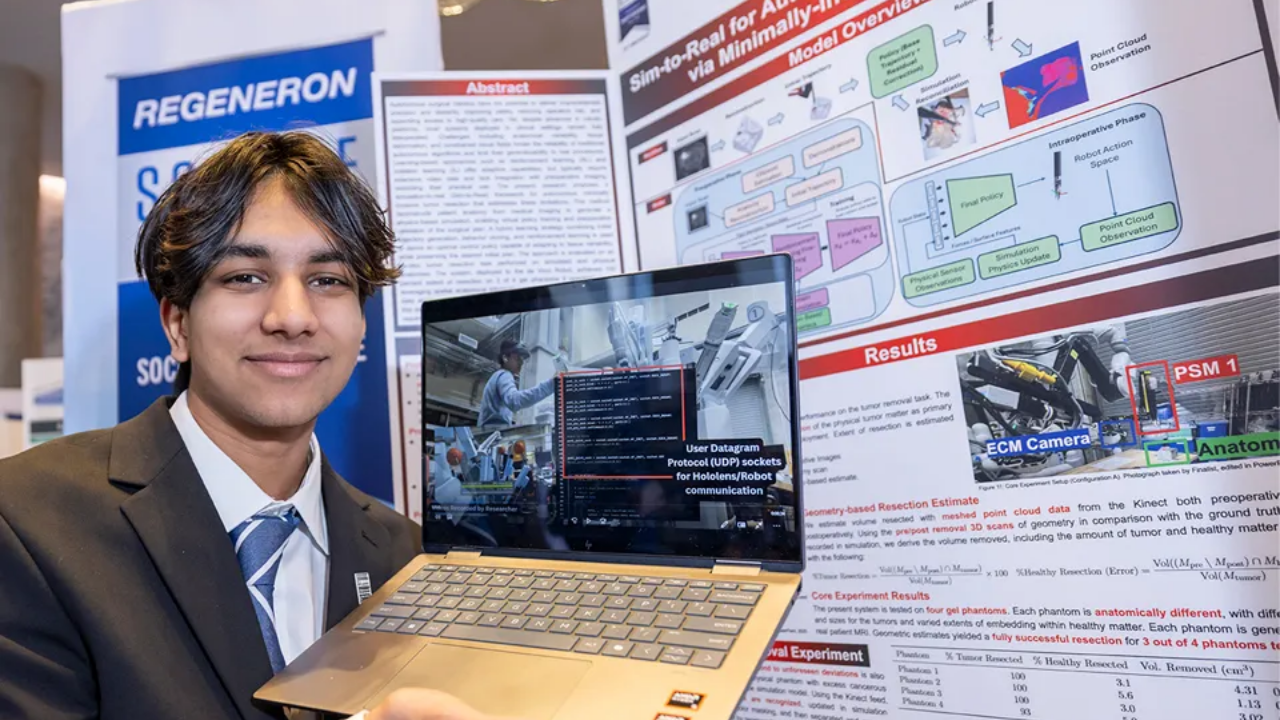
Surgical robotics has long operated under a strict operational constraint: high dexterity coupled with absolute human dependency. While master-slave platforms like the da Vinci surgical system allow clinicians to execute micro-dissections with tremor filtration and motion scaling, the machine itself lacks agency. Bridging this operational gap requires confronting the core mechanics of autonomy in soft-tissue environments. Recent work by high school researcher Rayhan Papar in developing a physics-based simulation framework for tumor resection highlights the structural hurdles and methodological design required to transition robotic control from virtual models to physical systems. Deconstructing this framework exposes the fundamental variables governing autonomous surgical execution.
The Kinematic and Dynamic Variables of Soft Tissue
Teaching a machine to remove a tumor independently is fundamentally different from programming an industrial robotic arm on a manufacturing line. Industrial automation relies on rigid bodies, predictable trajectories, and invariant geometries. Inside the human body, the operational domain violates every single one of these assumptions.
The primary engineering challenges involve three distinct variables:
- Deformability: Soft tissues lack fixed geometric reference points. They stretch, compress, and shift in response to applied forces from robotic instruments.
- Visual Occlusion: The operative field within a minimally invasive cavity is restricted, dynamic, and frequently subject to fluid interference or bleeding.
- Boundary Instability: The interface between pathological tissue (the tumor) and healthy parenchyma is rarely binary; identifying clean margins requires real-time sensory feedback.
To address these variables without exposing biological subjects to unvalidated algorithms, roboticists employ a sim-to-real transfer architecture.
The Mechanics of Sim-to-Real Architecture
Directly training reinforcement learning agents or autonomous control loops on physical hardware is cost-prohibitive, slow, and dangerous. In medical robotics, the error budget is zero. The solution relies on constructing high-fidelity physics engines that simulate tissue mechanics prior to hardware deployment.
The simulation pipeline operates through explicit sequential phases:
- Anatomical Reconstruction: Medical imaging data (such as CT or MRI scans) are processed to build volumetric meshes representing patient-specific organ structures and embedded neoplasms.
- Finite Element Modeling: The simulation applies continuum mechanics—specifically finite element methods—to predict how soft tissues deform under tool-tissue interactions.
- Policy Training: The virtual robotic agent interacts within this synthetic environment, optimizing its cutting and retraction strategies to maximize tumor extraction while minimizing collateral damage to healthy tissue.
Once the control policy converges within the simulation, it is exported to the physical robotic platform. In Papar's implementation, this framework was evaluated on a physical da Vinci system using gel models, yielding complete tumor excision in three out of four experimental trials.
Interpreting Experimental Constraints
A three-out-of-success metric in a controlled laboratory setting requires strict contextualization. Gel models simulate the elastic modulus and general consistency of soft tissue, but they lack the physiological complexity of live biological systems. They do not simulate active perfusion, variable blood loss, respiration-induced organ drift, or unexpected anatomical anomalies.
Treating these early benchmarks as proof of clinical readiness introduces a severe category error. The gel-model validation does not signify that autonomous surgical agents are prepared for human operating rooms. Rather, it serves as a proof-of-concept for the transfer function between simulated optimization and hardware execution. The value lies not in the immediate clinical applicability of the algorithm, but in the validation of the training pipeline itself. As modular frameworks evolve, the bottleneck shifts from hardware design to the fidelity of computational tissue models and real-time sensory integration.
Prioritize refining physics engines to account for real-time viscoelastic tissue deformation before scaling hardware autonomy tests to ex-vivo biological models.