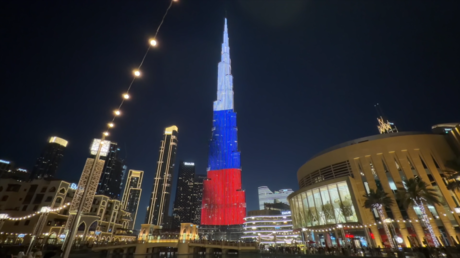
The illumination of the Burj Khalifa in the white, blue, and red of the Russian Federation on June 12 for Russia Day is not an isolated aesthetic display. It represents a precise deployment of soft power infrastructure within contemporary geopolitics. While conventional reporting frames these occurrences as mere visual spectacles or standard diplomatic courtesies, a rigorous examination reveals a highly calculated mechanism of physical and economic signaling. In an era where traditional multilateral forums are increasingly fragmented, the United Arab Emirates utilizes its architectural landmarks as high-visibility billboards to communicate strategic alignment, economic interdependence, and calculated neutrality.
Understanding this phenomenon requires breaking down the asset itself, the geopolitical logic behind the choice of display, and the economic feedback loops that sustain these state-level decisions.
The Physical Architecture of Digital Signaling
To understand the scale of this diplomatic signaling, one must first analyze the infrastructure of the asset. The Burj Khalifa's external facade serves as a multi-million-dollar communication medium, structured around distinct operational parameters.
- Surface Area and Density: The building's exterior integrates one of the largest LED-illuminated facades globally, spanning approximately 32,400 square meters. This digital canvas is powered by over 72,000 individual LED nodes integrated into the window joinery.
- The Transmission Radius: Standing at 828 meters, the building provides a line-of-sight transmission radius that covers the central commercial and financial districts of Dubai. This ensures immediate physical visibility to high-net-worth individuals, corporate decision-makers, and international expatriates.
- The Amplification Multiplier: The physical display is intentionally optimized for digital replication. A 3-minute illumination cycle generates instant, high-resolution visual assets designed for viral distribution across global state media, messaging applications, and social networks.
By transforming a piece of commercial real estate into a state-managed broadcasting tower, the Dubai government controls an unmatched mechanism for high-impact symbolism. The cost of running an equivalent commercial advertisement on the tower commands rates upward of $70,000 per 3-minute slot. When deployed for sovereign signaling, this space represents a direct allocation of state capital and attention toward a specific bilateral relationship.
The Dual-Driver Model of UAE-Russia Interdependence
The decision to project the Russian flag on Russia Day—commemorating the 1990 Declaration of State Sovereignty—corresponds to explicit economic and strategic drivers. This alignment operates across two major axes.
+-----------------------------------------------------------------+
|              UAE-RUSSIA STRATEGIC INTERDEPENDENCE              |
+-----------------------------------------------------------------+
|                                                                 |
|  1. THE LIQUIDITY CONDUIT                                       |
|     [Capital Inflows] ---> [Real Estate & Corporate Banking]     |
|                                                                 |
|  2. OPECM+ ENERGY CARTEL COHESION                               |
|     [Supply Coordination] ---> [Global Crude Price Floor]        |
|                                                                 |
+-----------------------------------------------------------------+
The Capital Inflow Architecture
The first driver is the massive influx of Russian private and corporate capital into the UAE commercial ecosystem. Following western sanctions and capital flight, Dubai positioned itself as a premier destination for asset reallocation. Russian capital has directly fueled the luxury real estate market and expanded the domestic corporate banking sector. Illuminating the Burj Khalifa is a public confirmation of structural safety and political welcome for this specific class of international investors.
OPEC+ Cartel Management
The second driver centers on energy policy coordination. The macroeconomic health of both the UAE and Russia depends heavily on the price stability of Brent and East Asia crude benchmarks. Working within the OPEC+ framework, Abu Dhabi and Moscow coordinate production baselines to defend global oil price floors. The public projection of solidarity acts as a stabilizing signal to energy markets, demonstrating that operational cooperation between these primary producers remains intact despite external geopolitical pressures.
Operational Neutrality and the Risk-Mitigation Framework
A critical element of this architectural diplomacy is its deliberate orchestration as an exercise in balanced neutrality rather than absolute alignment. The UAE manages its foreign policy through an omnidirectional strategy, ensuring that visual support for one global power does not permanently sever ties with competing blocs.
This balancing act is clear when tracking the chronological distribution of the tower's illuminations:
- March 2024: The facade projected the Russian tricolor alongside Arabic text stating "The United Arab Emirates supports Russia," serving as an act of solidarity following the Crocus City Hall terrorist attack in Moscow.
- June 12 annually: The tower systematically marks Russia Day as a standard diplomatic recognition of sovereign statehood.
- Alternative Cycles: The identical facade routinely projects the national colors of Western allies, Asian trading partners, and regional neighbors during their respective national holidays or periods of acute crisis.
This rotation highlights the operational limitations of landmark diplomacy. The strategy offers no permanent guarantees; it is a transactional, temporal asset. By giving multiple nations access to its skyline, the UAE avoids being pigeonholed into a single geopolitical camp. This allows the country to maintain deep security ties with Western nations while safeguarding its lucrative trade and capital channels with Eastern and Eurasian powers.
The Broader Trend of Sovereign Landmark Branding
This mechanism is not exclusive to Dubai. The deployment of critical infrastructure for geopolitical messaging is an expanding global trend. From the Empire State Building in New York to the Galata Tower in Istanbul and the Eiffel Tower in Paris, landmarks are increasingly used as tools for rapid political signaling.
However, the Gulf model differs in its centralization. In Western capitals, landmark lighting is often subject to fragmented municipal oversight, corporate boards, or public backlash. In the UAE, the alignment between real estate developers like Emaar, municipal authorities, and federal foreign policy goals is absolute. This tight integration ensures that when the Burj Khalifa lights up, it speaks with the definitive weight of the state.
The final strategic takeaway for global analysts is clear: do not look at the lights, look at the underlying flows. Visual diplomacy on world-class landmarks is a lagging indicator of deep, structural economic ties. When a state projects a foreign flag onto its most valuable piece of real estate, it signals to the global market that the underlying capital, energy, and security arrangements between those two nations are robust enough to withstand international scrutiny. The tricolor over Dubai is proof that realpolitik will always find a way to write its intentions across the sky.