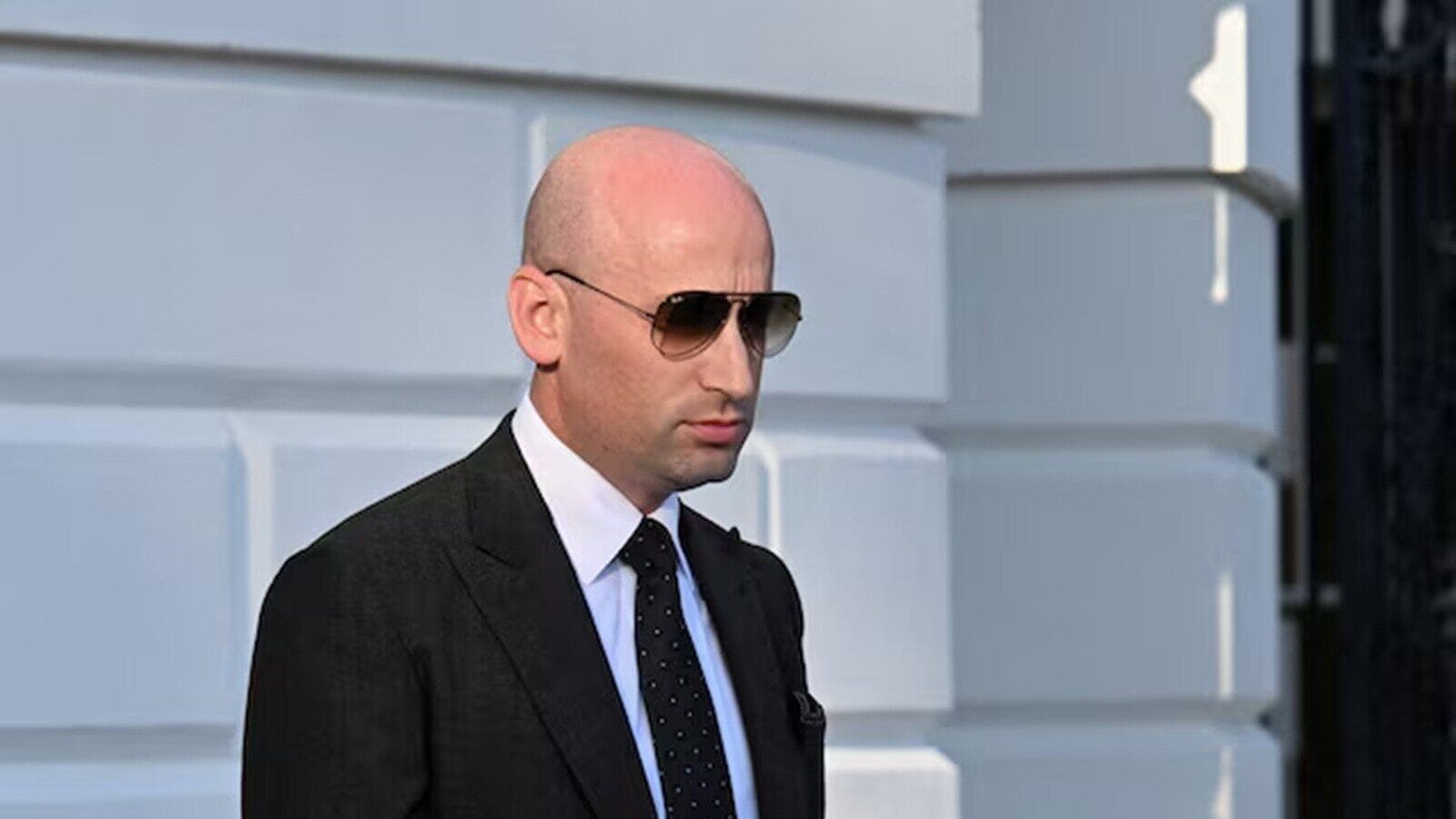
Silence.
In the corridors of the West Wing, where power is measured by the proximity of a desk to the Oval Office and the speed with which a rumor travels from the Roosevelt Room to the press briefing podium, silence is rarely an accident. Usually, it is a signal that the machinery of governance is shifting gears.
When news broke that Stephen Miller was stepping into the role of White House chief of staff to replace Susie Wiles, the reaction across Washington followed a familiar, predictable script. Pundits reached for their standard biographical bullet points. Critics recited his decade-long record on immigration enforcement. Supporters celebrated the elevation of a loyalist who has stood beside Donald Trump since the earliest, most chaotic days of the 2016 campaign.
Yet those surface-level summaries miss the real story. To understand what happens when Stephen Miller takes the helm of the White House staff, you have to look past the cable news chyrons and examine the specific, mechanical way power operates inside the executive branch.
Consider a hypothetical scenario that plays out every morning at 7:30 AM in the West Wing. Picture a mid-level policy advisor—let's call her Claire—walking down the narrow hallway past the Situation Room with a three-page memo on federal regulatory authority. Under one kind of chief of staff, Claire’s memo enters a filtering system designed around political viability, coalition management, and congressional headcounts. Under another kind of chief of staff, that exact same memo is evaluated entirely on ideological purity, executive speed, and administrative force.
That difference is not merely stylistic. It alters the trajectory of millions of lives, from families waiting in visa backlogs in Manila to federal civil servants sitting at desks in Arlington, Virginia.
Two Philosophies of the Gatekeeper
To appreciate the magnitude of the transition from Susie Wiles to Stephen Miller, it helps to examine the distinct archetypes of the modern White House chief of staff. Historically, the person holding that title acts as the president's primary gatekeeper, traffic cop, and reality check. Think of James Baker in the Reagan administration, or Leon Panetta under Bill Clinton. Their job was to manage the building so the president could manage the country.
Susie Wiles built her reputation in Florida and on the national campaign trail as an operator in that classic, disciplined mold. According to reporting from outlets like Politico, The New York Times, and The Washington Post, Wiles earned rare bipartisan respect in Washington for bringing structure to an operation often defined by improvisation. She preferred staying out of the spotlight, rarely gave interviews, and focused on logistics, discipline, and keeping competing factions from tearing the west side of the building apart.
Stephen Miller represents an entirely different theory of executive power.
Born in Santa Monica, California, in 1985, Miller did not rise through the traditional ranks of statehouse politics, corporate boardrooms, or campaign management. He came up through ideological combat. By the time he arrived at Duke University in the mid-2000s, he was already writing conservative columns and organizing campus debates that previewed the nationalist populist movement years before it conquered the Republican Party.
After graduating, he moved to Washington, working first for Representative Michele Bachmann, then Representative John Shadegg, and finally for Senator Jeff Sessions of Alabama. Those years in Sessions's office—specifically from 2009 to 2016—are the Rosetta Stone for understanding Miller's worldview. Working alongside Sessions, Miller helped craft the legislative and communications strategy that defeated bipartisan immigration reform bills in 2007 and 2013, arguing that large-scale immigration depressed wages for American workers and strained public resources.
When Miller joined Donald Trump’s campaign in January 2016 as a senior policy advisor, he brought something the real estate developer’s populist instincts lacked: a deep, granular knowledge of federal statutes, Senate procedure, and the levers of the administrative state.
The Machinery Behind the Rhetoric
If you have ever walked past the Eisenhower Executive Office Building at dusk, watching the light spill from tall, arched windows onto Pennsylvania Avenue, it is easy to view the federal government as an immovable stone monument. In reality, it runs on paper, legal interpretations, and obscure sub-paragraphs of the United States Code.
Few people in modern politics understand that paper trail better than Stephen Miller.
During the first Trump administration, Miller served as senior advisor to the president and director of speechwriting. While cabinet secretaries rotated in and out of office and four different chiefs of staff—Reince Priebus, John Kelly, Mick Mulvaney, and Mark Meadows—tried and often struggled to impose order on the West Wing, Miller remained a constant presence.
As documented by The New York Times, The Wall Street Journal, and Associated Press accounts of that era, Miller was the primary architect behind the administration's most sweeping and controversial domestic policies. He helped draft the initial executive orders restricting travel from several predominantly Muslim countries in early 2017. He pushed for the reduction of refugee admissions to historic lows. He was a central force behind the 2018 "zero tolerance" border enforcement policy that resulted in the separation of thousands of migrant children from their parents, as well as the later implementation of Title 42 public health expulsions during the COVID-19 pandemic.
To his critics, including civil rights organizations like the ACLU and former administration officials who later broke ranks, Miller’s approach demonstrated a willingness to test the outer limits of constitutional authority and human compassion in pursuit of hardline restrictionist goals. To his admirers, including conservative think tanks like the Heritage Foundation and America First Legal—the legal advocacy group Miller founded in 2021—he was the rare staffer who refused to let bureaucratic inertia or establishment caution dilute the president's campaign promises.
Notice the distinction in how he operates. Most political aides view the law as a boundary line telling them where they must stop. Miller views the law as a toolkit—a dense set of statutes waiting to be read creatively to see how far executive authority can be stretched.
Imagine a chess player who doesn't just memorize opening theory, but spends hours studying the rulebook to see if a pawn can legally be promoted under an obscure footnote. That metaphor captures how Miller approaches the federal bureaucracy. During his years outside government between 2021 and 2025, through America First Legal, he filed dozens of lawsuits challenging federal agencies, corporate diversity initiatives, and Biden administration immigration programs, effectively using the courts to rehearse the legal arguments he planned to deploy back inside the White House.
What Changes When the Ideologue Runs the Building
When a policy architect becomes chief of staff, the center of gravity in the entire federal government shifts.
Let's trace what that actually looks like in practice. A senior advisor like Miller previously had to compete for the president’s ear against other senior officials—economic advisors worried about market reactions, defense officials concerned about diplomatic fallout, or legislative directors warning about losing moderate votes on Capitol Hill.
The chief of staff controls the schedule. The chief of staff decides who gets into the Oval Office, which executive orders land on the Resolute Desk for signature, and which agency heads get backed up when they clash with career civil servants.
Consider the ripple effects across three distinct arenas of government:
First, the pace of executive action. Under a traditional chief of staff, controversial executive orders undergo weeks of interagency review—vetted by the Office of Management and Budget, the Department of Justice's Office of Legal Counsel, and relevant cabinet departments to anticipate court challenges and operational bottlenecks. Miller has long argued that traditional interagency review is where bold presidential initiatives go to die. With him controlling the paper flow, executive directives on border enforcement, federal workforce restructuring, and regulatory rollbacks are far more likely to move directly from drafting to signature at breakneck speed.
Second, the relationship with the federal workforce. Across agencies like the Department of Homeland Security, the Department of Justice, and the State Department, career officials serve across administrations of both parties. According to reporting by Reuters and The Washington Post on Miller’s return to the White House as deputy chief of staff for policy prior to this elevation, he has consistently viewed segments of the permanent civil service as an obstacle to elected leadership. As chief of staff, his oversight of White House personnel and cabinet coordination gives him direct influence over hiring, vetting, and the enforcement of ideological alignment throughout the executive branch.
Third, the tone of national politics. Susie Wiles operated on the principle that the staff should remain invisible so the president could dominate the narrative. Miller, by contrast, has always been a combative public messenger, comfortable sparring on Sunday morning talk shows and framing policy disputes in stark, existential terms. Even if his new administrative duties pull him behind the curtain more often, his instincts shape how the White House communicates with Congress, the press, and the public.
The Human Weight of Administrative Decisions
It is easy, when analyzing Washington power shifts, to treat them like a board game—moving pieces around a map, counting winners and losers inside the Beltway. I have spent years watching policy debates unfold in briefing rooms and hearing halls, and the hardest thing to convey to someone outside that bubble is how quiet the violence of bureaucracy can be.
There are no sirens when a policy memo changes a rule in the Federal Register. There is just a clerk updating a database, a consular officer stamping a denial, or a local sheriff receiving a new federal guidance document.
Think back to 2017 and 2018, when the first wave of Miller-backed policies took effect. In airports from Dulles to LAX, families stood behind velvet ropes holding bouquets of wilted flowers, refreshing airline apps while relatives were detained in secondary screening rooms. Along the southern border, federal judges later ordered the government to track down and reunite families separated under a policy that had been rolled out faster than the tracking systems needed to manage it.
At the same time, look at the other side of the ledger—the communities that fueled Miller’s rise and the voters who demanded his elevation. In small manufacturing towns across Ohio and Pennsylvania, or border counties in South Texas struggling with overwhelmed shelters and strained local budgets, millions of Americans looked at Washington and felt ignored by polite, consensus-driven politicians. To those voters, Wiles represented competence, while Miller represents conviction—a guarantee that the promises made at campaign rallies won't be watered down in D.C. cocktail parties.
Both realities exist simultaneously. That tension is the fuel driving modern American politics, and Stephen Miller sits directly at the ignition switch.
The Unanswered Question
Still, history offers a sobering warning for anyone who assumes that consolidating ideological control inside the West Wing guarantees smooth execution.
The job of White House chief of staff is notorious for chewing up even the most skilled operators. It requires managing an endless torrent of crises that have nothing to do with a staffer's core passion—foreign wars, natural disasters, debt ceiling standoffs, congressional scandals, and sudden market downturns. When a hurricane hits the Gulf Coast or a banking crisis erupts on a Sunday night, ideological purity does not clear roads or stabilize credit markets. Logistics, coalition-building, and calm triage do.
Susie Wiles excelled at absorbing friction so the administration could function. Stephen Miller has spent his entire career generating friction to force change.
Whether a man who built his influence by relentlessly pushing the envelope can successfully manage the sprawling, unruly apparatus of the entire executive branch remains an open question. Washington is full of brilliant tacticians who discovered too late that running the building is entirely different from driving the agenda.
Late at night, long after the press corps has packed up its cameras and the tourists have cleared away from the North Lawn fence, a single set of lights usually stays burning on the ground floor of the West Wing. Inside that corner office sits the person who decides what the president sees first thing in the morning—and what gets left off the desk altogether.


