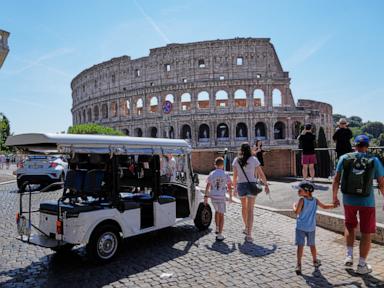
Municipal infrastructure inherently creates winners and losers based on vehicle footprint, speed, and regulatory classification. When a transportation mode emerges outside the predictive capacity of municipal zoning codes, it creates an immediate economic and spatial vacuum. Rome's historic center faces this exact friction point with the proliferation of commercial golf carts. These low-speed electric vehicles occupy a regulatory gray area, exposing the structural limitations of Italy’s highway code and the friction between hyper-tourism and municipal management.
The Three Variables Driving the Adoption Curve
The rapid expansion of golf cart tours across the ancient fabric of Rome is not an accident of taste, but the result of three distinct logistical pressures operating simultaneously. If you enjoyed this post, you might want to look at: this related article.
Spatial Economy and Footprint Optimization
Traditional tourist transport relies on internal combustion coaches and vans. These vehicles require substantial turning radii and generate high particulate emissions, making them primary targets for clean-air zones and street closures. Golf carts present a micro-mobility footprint. They fit into narrow alleys designed for medieval foot traffic and ancient carts, bypassing physical barriers that block larger commercial units.
The Cost Function of Pedestrian Fatigue
The spatial layout of central Rome separates major monuments by distances that exceed casual walking thresholds during high-temperature months. Traversing the irregular basalt cobblestones requires high physical expenditure. Commercial golf carts lower the friction of distance, allowing operators to aggregate high-yield sightseeing packages that compress a two-day walking itinerary into a few hours. For another perspective on this story, see the latest coverage from Travel + Leisure.
Regulatory Arbitrage
The primary driver of the commercial explosion is the ease of exploiting legislative loopholes. Under Article 59 of Italy’s highway code, certain vehicles are categorized as non-typical. Operators register these units with municipal authorities, triggering a mandatory thirty-day review window. During this administrative lag, the vehicles operate legally. When rejections occur, operators resubmit applications, effectively resetting the compliance clock and maintaining continuous market presence.
The Systemic Costs of Uncapped Micro-Mobility
While individual operators capture the economic rent of efficient tourist transport, the aggregate cost shifts directly onto the municipal infrastructure and local populace.
[Unregulated Fleet Growth]
       │
       ▼
[Spatial Saturation on Cobblestone Corridors]
       │
       ▼
[Velocity Suppression of Public Transit & Taxis] ──► [Escalating Political Backlash]
Flow Impedance and Bottleneck Creation
The velocity of a transportation network depends on uniform flow characteristics. Golf carts operate at low speeds, creating artificial bottlenecks when clustered in convoys along critical corridors like Via del Tritone or near the Bocca della Verità. Because municipal authorities lack the enforcement capacity to monitor every narrow alley, these vehicles frequently utilize bus lanes and pedestrian zones, reducing the operational efficiency of public transit systems and traditional taxi fleets.
Enforcement Asymmetry
Municipal policing resources are finite. When financial police and traffic officers attempt to audit operators, they encounter an enforcement bottleneck. Verifying the legal status of hundreds of dispersed carts requires intensive labor hours per vehicle stop. Consequently, enforcement efforts target easy points of friction—such as issuing steep fines for unlicensed tour guiding or impounding vehicles temporarily—while the macro-volume of active carts remains largely unaffected.
The Overtourism Multiplier
Critics argue that golf carts act as an accelerant for hyper-tourism. By lowering the physical barrier to entry for dense sightseeing, the carts increase the density of human foot traffic dropped simultaneously at high-value historical nodes. This concentrates wear and tear on sensitive cultural monuments without contributing proportionally to municipal maintenance budgets.
Strategic Interventions for Municipal Control
Solving the structural failure of urban micro-mobility requires moving away from reactive enforcement toward systemic market design.
1. Centralize Regional Licensing Authority
Municipal transport departments must possess direct jurisdictional authority over passenger transport licensing without intermediate regional delays. Consolidating authority eliminates the thirty-day application reset loop, allowing the city to issue immediate, binding prohibitions on unregistered commercial units.
2. Implement Fixed-Cap Tenders
Uncapped market entry guarantees congestion. The municipality must replace open registration with a capped tender model, restricting the total number of active commercial permits to a defensible threshold—such as one hundred units—allocated via competitive auction. This creates a fiscal feedback loop where operating rights directly fund infrastructure upkeep.
3. Geofenced Route Mandates
Commercial golf carts should no longer operate as free-roaming agents within the historic center. By integrating mandatory GPS geofencing, regulators can restrict fleets to designated perimeter routes or specific architectural circuits, preserving pedestrian-only arteries and preventing the saturation of narrow historical choke points.
Strategic Action
Municipal leadership must bypass protracted court challenges against individual operators by altering the baseline classification rules at the national legislative level. The immediate operational play involves revoking the provisional thirty-day grace period for non-typical commercial transport renewals. Concurrently, the city should issue an emergency municipal decree establishing a hard quantitative ceiling on fleet sizes, tied to mandatory GPS tracking and commercial taxation. Until supply is structurally rationed through tenders rather than contested case-by-case rejections, the economic incentives for unregulated expansion will continue to overwhelm municipal enforcement capacity.