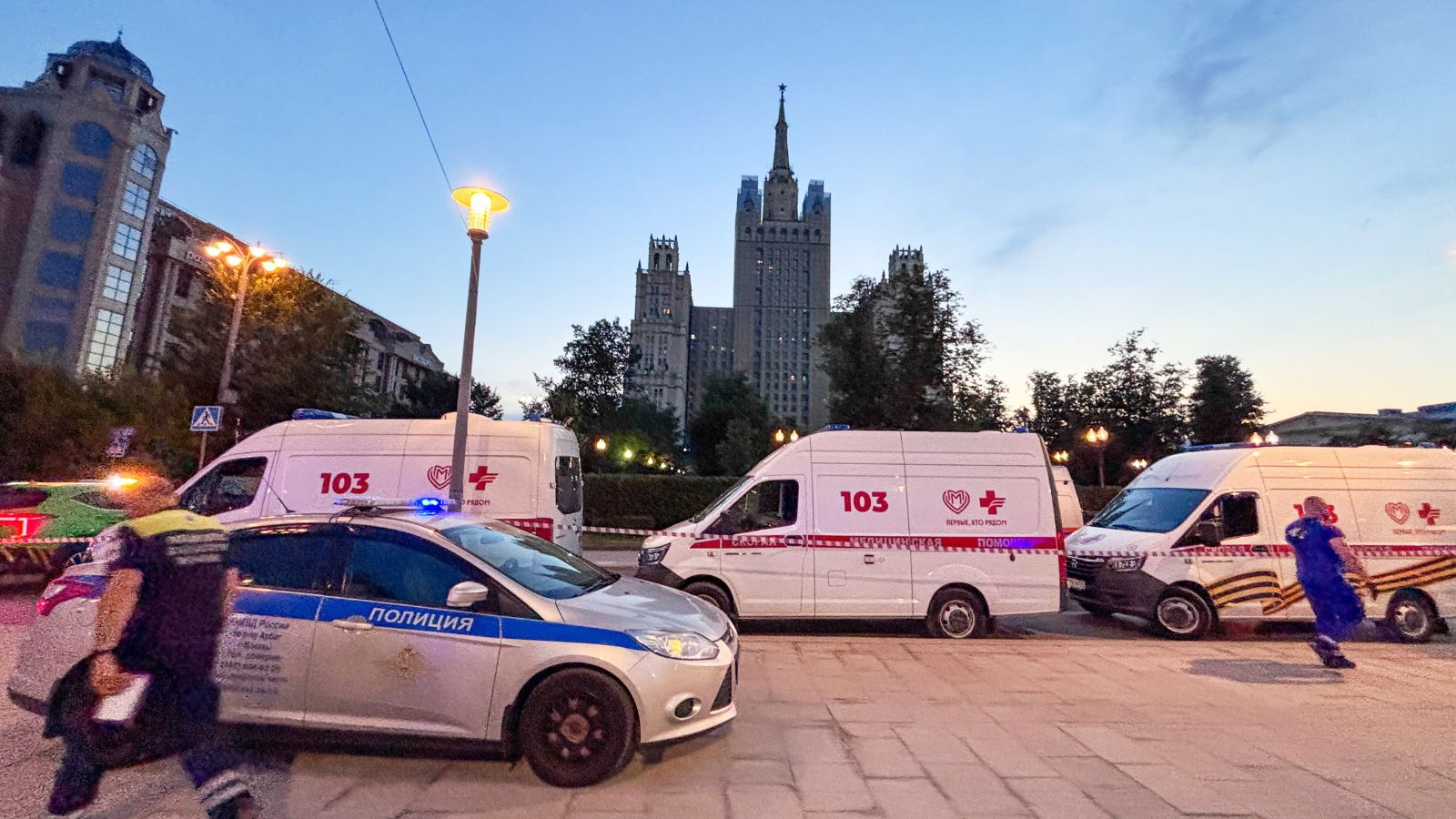
Structural Vulnerability in High Density Urban Venues
Security architecture relies on redundancy, spatial filtering, and rapid threat detection. When a detonation occurs in a semi-public threshold space—such as the perimeter of a commercial dining establishment outside Moscow—the failure points span both physical security parameters and emergency response latency. Three dead and twenty-one injured represent the immediate casualties of a localized kinetic event, but the systemic implications expose deep vulnerabilities in urban civilian zone protection.
The incident forces a re-examination of how semi-enclosed public spaces handle kinetic threats. Unlike hard targets with dedicated screening checkpoints, dining establishments and adjacent thoroughfares operate on an open-access model. This architecture maximizes commercial throughput while minimizing security friction, creating a structural trade-off between hospitality efficiency and risk mitigation. Meanwhile, you can read related events here: Where Two Continents Collide At The Edge Of Europe.
The Three Vectors of Kinetic Vulnerability
Analyzing an explosive event outside a commercial venue requires isolating the mechanisms of failure into distinct operational categories. Each vector represents a critical juncture where intervention could have altered the structural outcome.
Spatial Liminality and Perimeter Defenses
The zone immediately exterior to a commercial venue functions as a transition space. It lacks the hardened barriers of state infrastructure while remaining exposed to public access corridors. To understand the full picture, check out the detailed report by Reuters.
- Hardened Architecture Absenteeism: Standard commercial zoning does not mandate blast-mitigating glass, reinforced masonry, or vehicle-exclusion bollards for standalone restaurants.
- Surveillance Blind Spots: Exterior perimeter coverage frequently suffers from resolution degradation, occlusions caused by outdoor seating structures, and a lack of integrated thermal or acoustic sensors.
- Access Control Friction: Implementing bag checks or metal detectors at a restaurant entrance destroys the commercial value proposition, forcing operators to rely on passive observation rather than active screening.
Kinetic Energy Dispersion and Material Impact
An explosive device detonated in an uncontained or semi-contained exterior environment behaves according to fluid dynamics and shockwave physics. The casualty rate of three fatalities and twenty-one injuries is a direct function of energy dispersion and local environmental geometry.
- Overpressure and Reflected Waves: Urban canyons—streets flanked by rigid structures—amplify blast overpressures through wave reflection, compounding structural and biological damage far beyond the immediate point of origin.
- Secondary Fragmentation: Plate glass windows, unreinforced signage, and outdoor furniture convert into high-velocity shrapnel. A significant percentage of the twenty-one injuries stem from secondary fragmentation rather than primary blast trauma.
- Crowd Density Dynamics: Outdoor seating configurations maximize human density per square meter, ensuring that any kinetic release intersects with high concentration gradients of unshielded civilian bodies.
Emergency Response Latency and Triage Cascades
The interval between kinetic detonation and the stabilization of victims dictates the mortality curve.
- Communication Bottlenecks: Initial dispatch calls frequently suffer from panic-induced ambiguity, delaying the precise geolocalization of the incident for first responders.
- Trauma Care Bottlenecks: Pre-hospital tourniquet deployment and rapid hemorrhage control remain variable among civilian bystanders, relying instead on professional medical units arriving post-event.
- Triage Overload: Twenty-one injured individuals arriving simultaneously at regional medical facilities strain emergency department intake capacities, introducing secondary delays for critical care interventions.
The Economic and Operational Cost Function
Security optimization is fundamentally an economic equation balancing the cost of hardening against the expected loss of a catastrophic event. For standard commercial enterprises, the calculated probability of a targeted explosive attack is traditionally treated as a residual risk, resulting in systematic underinvestment in counter-measures.
When an incident occurs, the cost function shifts abruptly. The immediate financial impact encompasses property destruction, business interruption, and liability exposure. More broadly, consumer confidence erodes, triggering a localized contraction in foot traffic for surrounding hospitality venues. This secondary economic contagion demonstrates that physical security failures carry systemic commercial externalities that extend well beyond the immediate footprint of the blast.
Strategic Resource Reallocation
Mitigating future incidents of this classification requires shifting away from reactive policing toward distributed urban resilience. Relying solely on law enforcement interdiction post-facto addresses the symptom rather than the systemic vulnerability of soft targets.
Operators of high-density public spaces must integrate basic threat-awareness protocols into staff training, focusing on anomaly recognition and rapid egress management. Concurrently, municipal planning frameworks must incorporate perimeter safety standards that utilize aesthetic, non-intrusive architectural deterrents—such as integrated planters acting as structural vehicle barriers and blast-resistant glazing specifications for ground-floor facades. The objective is not to transform urban commerce into a fortress, but to raise the energy threshold required to successfully execute an attack while engineering the physical environment to minimize human casualty multipliers.