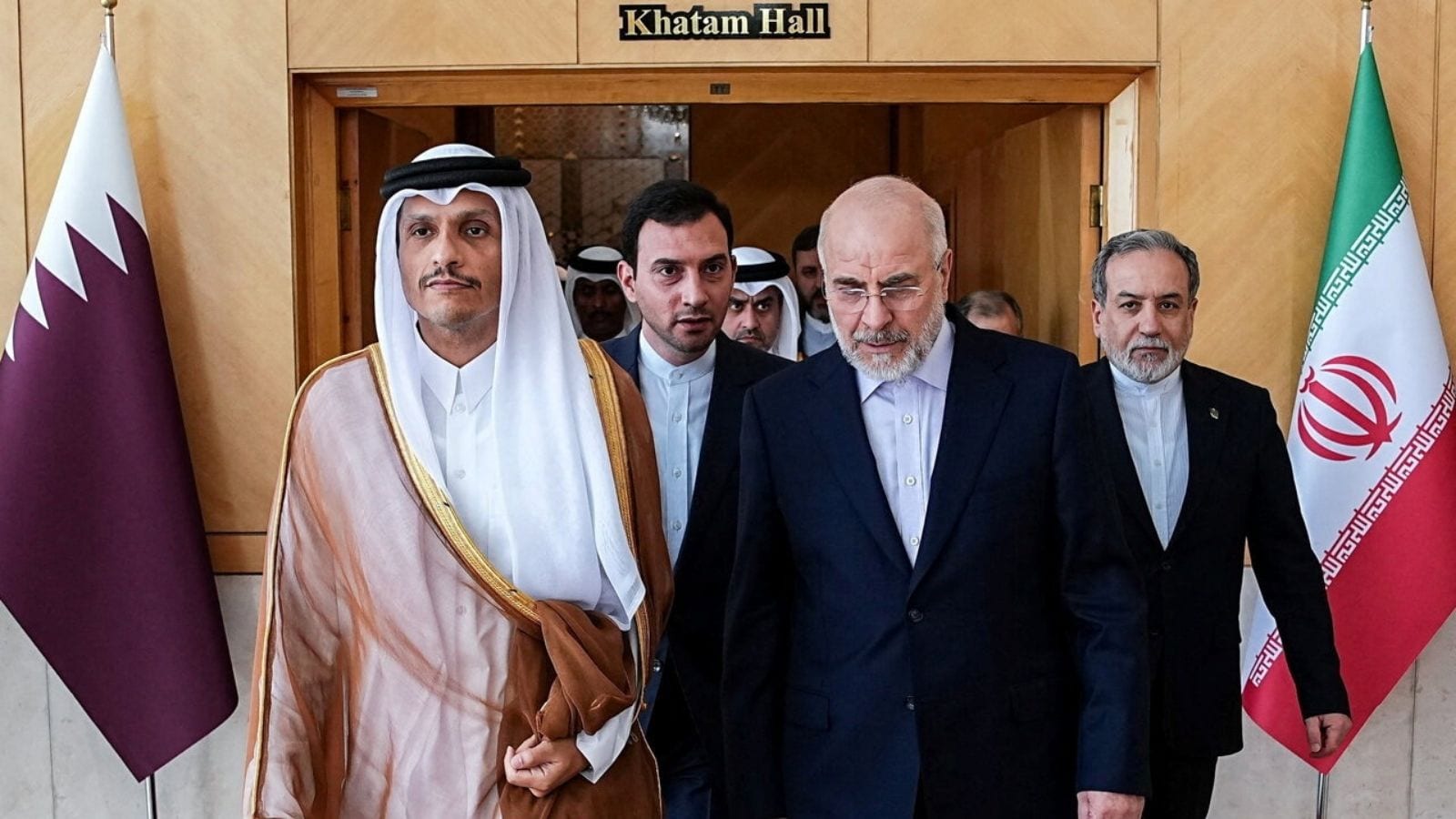
Geopolitical crisis management rarely breaks down due to a lack of communication channels; rather, it fails when the cost functions of the primary actors diverge past the point of immediate reconciliation. Six months into the military campaign launched by the United States and Israel against Iran, the architecture of regional stability has fractured. The visit of Qatari Prime Minister Sheikh Mohammed bin Abdulrahman Al Thani to Tehran represents a classic instance of transactional third-party mediation attempting to bridge an absolute structural chasm. While Washington asserts that economic containment will continue unchecked and denies active bilateral channels, intermediate actors like Qatar and Pakistan are forced to absorb the systemic shocks of a closed maritime corridor. Understanding why this diplomatic intervention faces steep headwinds requires examining the strategic calculus, economic constraints, and enforcement mechanisms governing both capitals.
The Cost Function of Economic Isolation
The primary lever deployed by the White House is economic attrition, framed as a strategy to force unconditional behavioral modification without requiring direct ground force commitments. Operation Economic Outcast seeks to deny the Iranian state access to international capital, maritime trade routes, and petroleum export markets. However, the economic model underpinning this strategy contains severe internal contradictions.
To achieve total compliance, a naval blockade requires secondary enforcement mechanisms that inevitably target third-party trade partners, including major economies in Asia. When an administration faces domestic political constraints—such as managing energy price fluctuations ahead of midterm congressional cycles—aggressive enforcement of petroleum blockades risks triggering inflationary pressures at home.
[Naval Blockade] --> [Suppressed Iranian Exports] --> [Strait of Hormuz Disruption] --> [Global Energy Price Volatility] --> [Domestic Political Pressure]
Tehran’s response function to this pressure has been institutional adaptation rather than capitulation. Having operated under various regimes of international sanctions since 1979, the Iranian administrative apparatus relies on decentralized networks and internal substitution. While the state apparatus has suffered severe fiscal damage—with Iranian officials estimating cumulative direct and indirect losses in the hundreds of billions—the regime retains centralized control over national security instruments and regional proxy networks. Consequently, economic deprivation has compressed state resources without altering the core incentives of the political elite.
The Geopolitical Economics of the Strait of Hormuz
The operational epicenter of the conflict is the Strait of Hormuz, a narrow maritime bottleneck through which a significant share of global energy supplies historically transited. The collapse of the June memorandum of understanding exposed the core incompatibility of the initial negotiating terms.
- The Washington Position: The waterway must remain an unhindered international commons governed by freedom of navigation principles, with maritime traffic moving without interference or security tolls.
- The Tehran Position: Control over the transit corridor serves as an asymmetric retaliatory mechanism. Iranian strategy links the reopening of the strait to the complete removal of port blockades, the lifting of financial sanctions, and structural compensation for wartime damages.
Traffic data illustrates the persistence of this friction. While Washington points to nominal vessel movements to argue that the corridor remains viable, actual transit volumes hover at a fraction of pre-war throughput. Insurance premiums, security hesitance among commercial fleet operators, and ongoing threat perceptions have effectively institutionalized a partial maritime embargo. This functional closure acts as an invisible tax on global energy markets, shifting the cost of the conflict onto net energy importers and regional Gulf states.
The Mediatory Mechanics of Doha
Qatar occupies a distinct structural position as a mediator possessing substantial financial reserves alongside acute regional vulnerability. The state-level economic impact of the war on Gulf economies is frequently underestimated; infrastructure damage, disruptions to liquefied natural gas production capacity, and necessary domestic budget contractions demonstrate that peripheral actors cannot insulate themselves from prolonged hostilities.
When Doha’s leadership engages in shuttle diplomacy between Washington and Tehran, the objective is the establishment of localized de-escalation protocols—such as joint administrative corridors or de-mining operations within the Gulf—rather than an immediate comprehensive peace settlement. These technical arrangements are designed to decouple freedom of navigation from the broader, intractable nuclear and regional security disputes.
Yet, third-party mediation is structurally limited by the absolute deficit of trust between the primary belligerents. Iranian security officials routinely cite historical precedent to argue that Western diplomatic frameworks lack long-term credibility, asserting that temporary compliance agreements are systematically leveraged to institutionalize unilateral advantages. Without a verifiable enforcement mechanism that guarantees reciprocal relief, intermediate proposals face immediate rejection by hardline factions within the Iranian political hierarchy.
Strategic Outlook and Regional Realities
The persistence of this diplomatic stalemate highlights the limits of coercive diplomacy when applied to resilient state structures. The theory that absolute economic isolation will independently generate internal regime collapse ignores the adaptive capacity of authoritarian security apparatuses. At the same time, maintaining an open-ended naval containment strategy imposes compounding costs on global supply chains and regional economies that relied on uninterrupted energy flows.
Resolution requires moving away from all-or-nothing postures toward incremental, verifiable functional agreements. The strategic priority for external mediators must focus exclusively on separating commercial navigation rights from broader geopolitical grievances, establishing localized safety guarantees for maritime transit independent of overarching sanctions relief. Until the framework accounts for the security dilemmas of both sides, high-level diplomatic interventions will remain trapped between Washington's insistence on unconditional surrender and Tehran's demand for structural parity.