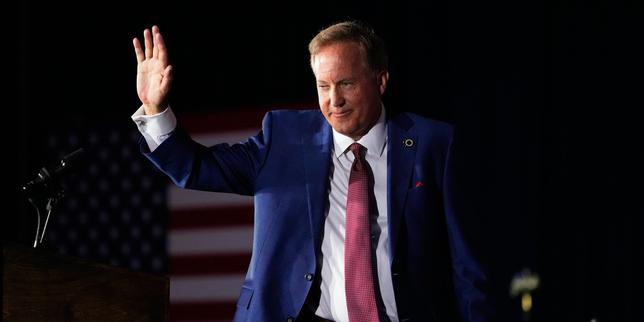
The defeat of four-term incumbent Senator John Cornyn by Texas Attorney General Ken Paxton in the May 2026 Republican primary runoff represents a fundamental structural realignment rather than a mere electoral upset. This outcome marks the first primary defeat of an incumbent U.S. senator from Texas since 1970. The 63.5% to 36.5% margin achieved by Paxton dismantles the conventional political calculus regarding the structural advantages of legislative incumbency, institutional fundraising, and historical voting alignment.
To evaluate this electoral shift, the race must be analyzed through two distinct mechanisms: the optimization of low-turnout runoff mechanics by ideological insurgencies, and the marginalization of traditional legislative records by symbolic enforcement. The data demonstrates that structural loyalty to a centralized national apparatus has completely superseded localized, output-oriented institutional power.
The Asymmetry of the Runoff Multiplier
The primary structural bottleneck for Cornyn lay in the specific mechanics of Texas election law. During the initial primary round on March 3, 2026, Cornyn narrowly led Paxton 42.0% to 40.5%. However, because neither candidate crossed the 50% threshold—largely due to a splintering of the anti-incumbent vote by a third-party campaign—the race advanced to a post-Memorial Day runoff.
This transition from a general primary to a runoff fundamentally alters the electorate's composition, operating via three specific variables:
- The Turnout Compression Factor: Runoff elections traditionally see a steep drop in raw voter numbers, filtering out casual or low-propensity voters and leaving a hyper-concentrated core of ideological activists.
- The Strategic Endorsement Pipeline: Following the first round, secondary anti-establishment candidates consolidated behind Paxton. This created an immediate transfer of base support that Cornyn’s establishment model could not replicate.
- The Late-Stage Capital Vector: While Cornyn held a massive financial advantage early in the cycle, the compressed timeline of a runoff diminishes the utility of broad broadcast media, shifting the advantage to high-engagement digital and grassroots mobilization networks.
This mechanical contraction favored Paxton’s multi-year strategy of cultivating the state’s high-propensity activist base. The smaller the voting pool became, the higher the concentration of voters who viewed Cornyn’s long institutional tenure not as an asset, but as evidence of institutional drift.
The Failure of the Legislative Loyalty Metric
The central paradox of Cornyn’s defeat is the divergence between his objective legislative alignment and his subjective brand perception among base voters. Legislative scorecards indicate that Cornyn voted in alignment with Donald Trump’s policy platform 99.2% of the time during Trump's first presidential term. This statistical loyalty score exceeds that of Texas’s junior senator, Ted Cruz.
Yet, this data proved entirely irrelevant due to a shift in how base voters calculate political value. The primary electorate replaced a quantitative assessment of policy outcomes with a qualitative assessment of institutional resistance. Cornyn’s vulnerabilities were exposed through three distinct policy friction points:
- The Bipartisan Legislative Penalty: Cornyn’s leadership in brokering the 2022 gun-control legislation following the Uvalde school shooting was treated as a structural betrayal. In a localized, base-driven ecosystem, bipartisan dealmaking is categorized as ideological capitulation.
- Institutional Proceduralism: As a traditional institutionalist and former Senate majority whip, Cornyn consistently defended the Senate filibuster and traditional legislative norms. This stance conflicted directly with the base's demand for aggressive executive and legislative unilateralism.
- The Loyalty Asymmetry: Despite introducing legislation to name a federal highway after Trump to mollify the populist wing, Cornyn’s historical criticisms of the executive's rhetorical style created a permanent deficit of trust that could not be erased by late-stage policy alignment.
Consequently, the institutionalist strategy—predicated on delivering federal resources and maintaining systemic stability—offered no defense against a challenger who framed the entire legislative apparatus as fundamentally compromised.
Capital Inefficiency and the $90 Million Deficit
The financial data from this race challenges the core assumption that capital superiority can insulate an incumbent from structural populist shifts. National Republican organizations and establishment donors spent more than $90 million defending Cornyn’s seat. This massive capital deployment funded extensive saturation advertising and sophisticated turnout operations, yet yielded a return of just 36.5% of the vote.
This massive expenditure failure highlights a critical bottleneck in modern political marketing: the diminishing marginal returns of establishment media spending against targeted symbolic endorsements.
Establishment Capital ($90M) -> Mass Media Saturation -> Declining Efficacy in Activist Pools
Ideological Capital ($0M Base) -> Presidential Endorsement -> High-Velocity Activist Mobilization
When Trump issued a definitive endorsement of Paxton one week prior to the runoff, it acted as a high-velocity catalyst. The endorsement instantly overrode tens of millions of dollars of negative advertising regarding Paxton’s extensive legal baggage, including his 2023 impeachment and subsequent acquittal by the Texas Senate, historic securities fraud indictments, and highly publicized personal controversies.
For the primary electorate, these legal challenges were successfully reframed by the Paxton campaign as evidence of institutional persecution. The endorsement validated this narrative, transforming Paxton's legal liabilities into a net political asset by making them proof of his willingness to disrupt existing power structures.
The General Election Reallocation Problem
The immediate strategic consequence of Paxton’s victory is a severe disruption of the national Republican campaign map. By replacing a highly stable, universally recognized incumbent with a deeply polarizing nominee, the party has forced a massive reallocation of defensive capital.
Internal Republican memos had previously warned that a Paxton nomination would transform a historically secure stronghold into an active defensive frontline. Texas has not elected a Democrat to statewide office since 1994, creating a 32-year baseline of Republican dominance. However, Paxton’s nomination creates an opening for the Democratic nominee, state Representative James Talarico, a formidable fundraiser capable of appealing to suburban moderates and independent voters alienated by populist rhetoric.
This baseline shifts the electoral calculus in two ways:
- The Defensive Capital Drain: Instead of deploying national funds to flip competitive seats in the Midwest or Southwest, national Republican committees will now be forced to divert up to $250 million to safeguard Texas’s 40 electoral votes and crucial Senate seat.
- The Down-Ballot Contagion Effect: A highly contentious, top-of-the-ticket Senate race centered on Paxton’s legal history provides Democrats with an optimal environment to target vulnerable suburban House seats in Dallas, Houston, and Austin.
The strategic play for the Republican apparatus is no longer about maximizing national gains, but about building a costly firewall around a state that should have required zero defensive expenditure. Paxton's victory proves that the primary electorate is entirely willing to accept elevated general election risks in exchange for absolute ideological alignment.