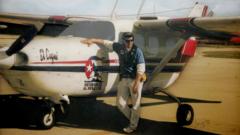
The United States Department of Justice unsealing of a superseding indictment against 94-year-old former Cuban President Raúl Castro Ruz marks a profound structural shift in extraterritorial legal enforcement. Ostensibly, the indictment addresses a legacy grievance: the February 24, 1996, shootdown of two civilian Cessna 337 Skymaster aircraft operated by the Miami-based exile group Brothers to the Rescue (Hermanos al Rescate), which resulted in the deaths of four men—Carlos Costa, Armando Alejandre Jr., Mario de la Peña, and Pablo Morales. To evaluate this development purely through a historical lens, however, is a fundamental analytical error.
The indictment is a calculated instrument of statecraft functioning within a broader geopolitical compression strategy. By charging Castro with conspiracy to kill US nationals, destruction of aircraft, and four counts of murder, the current US administration is executing a doctrine of individual sovereign liability. This strategy deliberately mirrors the January 2026 extraction of Venezuelan President Nicolás Maduro from Caracas by US Special Forces. It signals an operational evolution where sovereign immunity is structurally bypassed to achieve specific kinetic, economic, and diplomatic outcomes.
The Operational Mechanics of the 1996 Intercept
To understand the legal architecture of the indictment, one must first isolate the tactical variables of the 1996 engagement. The Cuban government's defense rests on an assertion of territorial sovereignty, claiming the civilian aircraft violated Cuban airspace. Independent investigations by the United Nations International Civil Aviation Organization (ICAO) and the Inter-American Commission on Human Rights concluded otherwise, establishing that the intercepts occurred over international waters, north of the 24th parallel.
The structural breakdown of the intercept confirms a highly coordinated military action rather than a spontaneous border enforcement measure. The operation relied on three distinct structural pillars:
- Intelligence Infiltration: The Cuban Directorate of Intelligence (DI) deployed assets to infiltrate Brothers to the Rescue in Miami. These double agents transmitted real-time flight telemetry, operational schedules, and pilot profiles directly to Havana.
- Premeditated Tactical Readiness: The indictment notes that following a January 1996 incident where the exile group dropped political leaflets over Havana, Castro—then serving as Minister of the Revolutionary Armed Forces (MINFAR)—authorized the use of deadly force. Throughout February 1996, the Cuban Air Force conducted specialized training missions utilizing Russian-made MiG-29 and MiG-21 fighter jets, specifically optimizing intercept vectors for slow-moving, low-altitude civilian propeller aircraft.
- Asymmetric Kinetic Execution: On February 24, three Cessna aircraft departed Opa-locka Airport in Florida. Cuban ground-controlled interception radar guided a MiG-29UB dual-seat fighter into position. The military pilot, Lorenzo Alberto Pérez Pérez, acting under a direct chain of command leading to Raúl Castro, deployed air-to-air missiles to destroy two of the unarmed aircraft without broadcasting standard international radio warnings or executing non-lethal interception maneuvers. A third plane, piloted by group founder José Basulto, escaped back to Miami.
This sequence removes the legal defense of spontaneous self-defense. The Department of Justice is using this established sequence to demonstrate a continuous, planned conspiracy, thereby satisfying the rigorous evidentiary thresholds required for a US federal court indictment.
The Doctrine of Asymmetric Geopolitical Leverage
The timing of this legal deployment operates as a variable within a complex geopolitical cost function. Cuba is currently experiencing its most severe macroeconomic collapse since the collapse of the Soviet Union, characterized by systemic electrical grid failures, hyperinflation, and acute food shortages. Concurrently, the Trump administration has intensified its maximum-pressure campaign, enforcing strict maritime blockades on external fuel supplies and maintaining Cuba's designation on the State Sponsors of Terrorism list.
The administration’s strategic framework uses legal indictments as structural leverage to force specific concessions from authoritarian regimes.
The utility of the indictment can be mapped across three distinct tactical horizons:
1. The Pretext for Kinetic Options
By securing a formal arrest warrant for a former head of state, the executive branch establishes a domestic legal framework that justifies potential direct action. Acting Attorney General Todd Blanche’s statement that Castro is expected to appear in a US courtroom "either by his own will or by another way" is a deliberate reference to the January operations in Venezuela. This shifts the classification of the Cuban leadership from political adversaries to international fugitives, significantly lowering the political threshold for targeted operations or naval blockades.
2. Theoretical Negotiation Anchors
Conversely, the indictment can function as a high-value chip in non-public diplomatic tracks. CIA Director John Ratcliffe’s mid-May meeting in Havana with high-level Cuban officials—including Castro’s grandson—indicates that back-channel communications remain active. In a structured negotiation, a federal indictment represents an asset that can be frozen, deferred, or bartered in exchange for structural changes on the island, such as the opening of the command economy to American private investment or the expulsion of Russian and Chinese intelligence infrastructure.
3. Domestic Coalition Consolidation
The spatial staging of the announcement—delivered at Miami’s Freedom Tower on Cuban Independence Day—reveals a calculated domestic optimization strategy. The administration maximizes its political equity with the highly organized, anti-communist Cuban-American electorate in South Florida. This satisfies a decades-long demand for accountability while distracting from the broader, highly controversial economic blockades that critics argue exacerbate the island's humanitarian crisis.
Limitations and Systemic Structural Risks
While this legal strategy projects high authority, a rigorous analysis must account for its systemic limitations and potential failure modes. The doctrine of using domestic courts to police foreign sovereign actors carries significant long-term structural risks.
The primary limitation is the low probability of conventional custody. Raúl Castro is 94 years old and resides within a highly militarized, deeply institutionalized police state. Barring a complete collapse of the internal security apparatus or a high-risk clandestine extraction operation—which would carry an entirely different set of escalatory risks compared to the Venezuelan intervention—Castro will never stand trial in Miami.
This creates an enforcement gap that can undermine the perceived authority of the US legal system if arrest warrants remain unexecuted indefinitely.
Furthermore, this strategy risks inducing a "siege mentality" within the Cuban ruling elite. When a regime perceives that its senior leadership faces irreversible life imprisonment or the death penalty in a foreign capital, the internal incentives for reform or peaceful transition drop to zero. The current president, Miguel Díaz-Canel, has already leveraged the indictment to rally nationalist sentiment, characterizing the legal move as an unprovoked precursor to military aggression.
Instead of forcing a liberalization of the economy, the pressure may cause Havana to double down on its internal security matrix and deepen its asymmetric defense dependencies on extra-hemispheric actors like Beijing and Moscow.
The Strategic Blueprint for the Florida Straits
To translate this indictment into a definitive geopolitical outcome, the administration cannot rely on the legal text alone. The indictment must serve as the opening move in a synchronized, three-part operational sequence designed to force a structural transition in Havana:
- Weaponize the Maritime Fuel Blockade: Capitalize on the legal classification of the Cuban regime as an illicit enterprise by immediately tightening secondary sanctions on shipping conglomerates transporting Venezuelan or Russian crude to the island. This accelerates the energy transition window, forcing the regime to choose between total industrial shutdown or compliance with US economic integration demands.
- Deploy Next-Generation Information Delivery Systems: The 1996 conflict began over physical paper leaflets. Modern asymmetric information warfare requires a technological upgrade. The US should leverage low-Earth-orbit satellite internet constellations and targeted digital broadcasting to bypass the state-controlled telecommunications monopoly (ETECSA), directly providing the Cuban population with unmonitored communication tools during rolling blackouts.
- Establish an Explicit Off-Ramp for Post-Castro Leadership: While maintaining the legal threat against the historic revolutionary generation, the Department of Justice and State Department must create a clear, conditional framework for mid-level military and bureaucratic officials. They must explicitly outline the criteria under which economic sanctions will be lifted and indictments withheld if the next generation of Cuban administrators de-escalates military posturing, releases political prisoners, and transitions toward market-driven economic reforms.