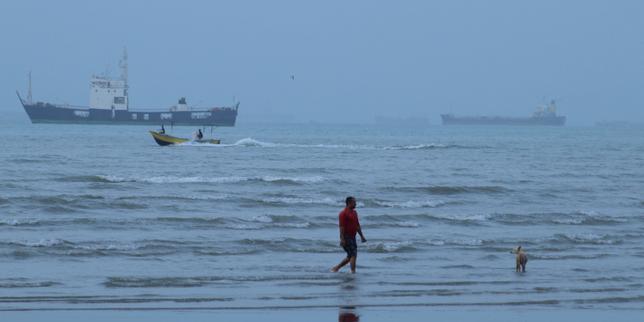
Geographic distance from a political capital does not insulate a region from military friction; instead, it exposes the logistical friction points where national survival is tested. Southern Iran, bordered by the Persian Gulf and the Strait of Hormuz, functions as the primary operational theatre where macroeconomic chokepoints intersect with decentralized defense architectures. Traditional journalism often frames this geography through human interest narratives of local fatigue, yet a rigorous analytical deconstruction reveals a calculated matrix of geographic vulnerability, asymmetrical naval denial, and state-level resource allocation.
The Three Structural Pillars of Southern Defense
Military operations in southern Iran operate on a triad of geographic and operational necessities designed to offset conventional military inferiority against technologically advanced adversaries.
- Asymmetric Coastal Geography: The jagged coastline, interspersed with subterranean tunnel networks, small craft bases, and rugged terrain, provides continuous cover for asymmetric naval assets. This configuration neutralizes the high-altitude sensing advantages of modern air power by maximizing clutter and concealment.
- Chokepoint Monopoly: Control over the maritime lanes of the Strait of Hormuz transforms a regional coastline into a global economic lever. The strategic utility of the south relies not on winning a blue-water naval engagement, but on maintaining the persistent, credible threat of transit disruption.
- Redundant Command Decentralization: Regional command structures in the south maintain operational autonomy from central headquarters in Tehran. This distribution ensures that local units can sustain localized defense and retaliatory capabilities even if high-level communication trunks are severed.
The Cost Function of Regional Attrition
When analyzing the economic and physical toll on southern populations and infrastructure, standard metrics of wartime damage fail to capture the underlying equations of endurance. The calculus governing this theater depends on a stark asymmetry of pain tolerance and strategic objectives.
Total Strategic Cost = (Infrastructure Damage Rate x Reconstruction Time) + (Economic Isolation Index - Asymmetric Deterrence Value)
For the central state, the southern provinces act as a sacrificial buffer zone where economic assets, such as oil terminals and port facilities, absorb kinetic strikes while preserving core political machinery inland. For regional populations, daily life is governed by a permanent wartime economy characterized by hyper-inflated logistics, restricted mobility, and structural adaptation to continuous surveillance. The local friction is not an accidental byproduct of war; it is the physical manifestation of a state doctrine that prioritizes regime survival over regional prosperity.
The Failure Modes of Conventional Analysis
Mainstream commentary frequently misinterprets the mechanics of conflict in southern Iran by relying on three flawed assumptions.
First, analysts often assume that localized economic destruction will trigger immediate internal political rebellion against the central government. Historical precedent in the region demonstrates that prolonged external pressure frequently produces a "rally-around-the-flag" effect or tightens internal security enforcement, overriding expected anti-regime uprisings.
Second, observers measure success strictly through kinetic scorecards, counting destroyed assets rather than evaluating the adversary's capacity to reconstitute low-cost asymmetric platforms like drones and fast attack craft.
Third, standard assessments treat the southern borderlands as a passive perimeter rather than an active laboratory for modern hybrid warfare, where electronic warfare, missile staging, and commercial shipping disruption are continuously optimized.
Strategic Execution and Systemic Bottlenecks
To understand how this theater shapes broader geopolitical outcomes, one must map the direct mechanisms connecting southern skirmishes to international supply chains.
- Logistics Interdiction: Persistent kinetic activity forces shipping insurers to reevaluate risk premiums, directly scaling up global energy transport costs without requiring a total physical closure of maritime routes.
- Resource Drain: Adversaries projecting power into the Persian Gulf face a highly unfavorable economic ratio, expending multi-million-dollar interceptor munitions against low-cost asymmetric vectors deployed from the southern Iranian littoral.
- Diplomatic Leverage Generation: Every day the southern corridor remains volatile, Tehran extracts diplomatic concessions by leveraging global economic anxiety tied to energy flow stagnation.
Shift focus away from localized human suffering and towards the structural mechanics of littoral denial. Monitor changes in the density of subterranean storage facilities along the Makran coast and track maritime insurance index spikes for very large crude carriers transiting the Persian Gulf to measure the real-time efficacy of regional deterrence.