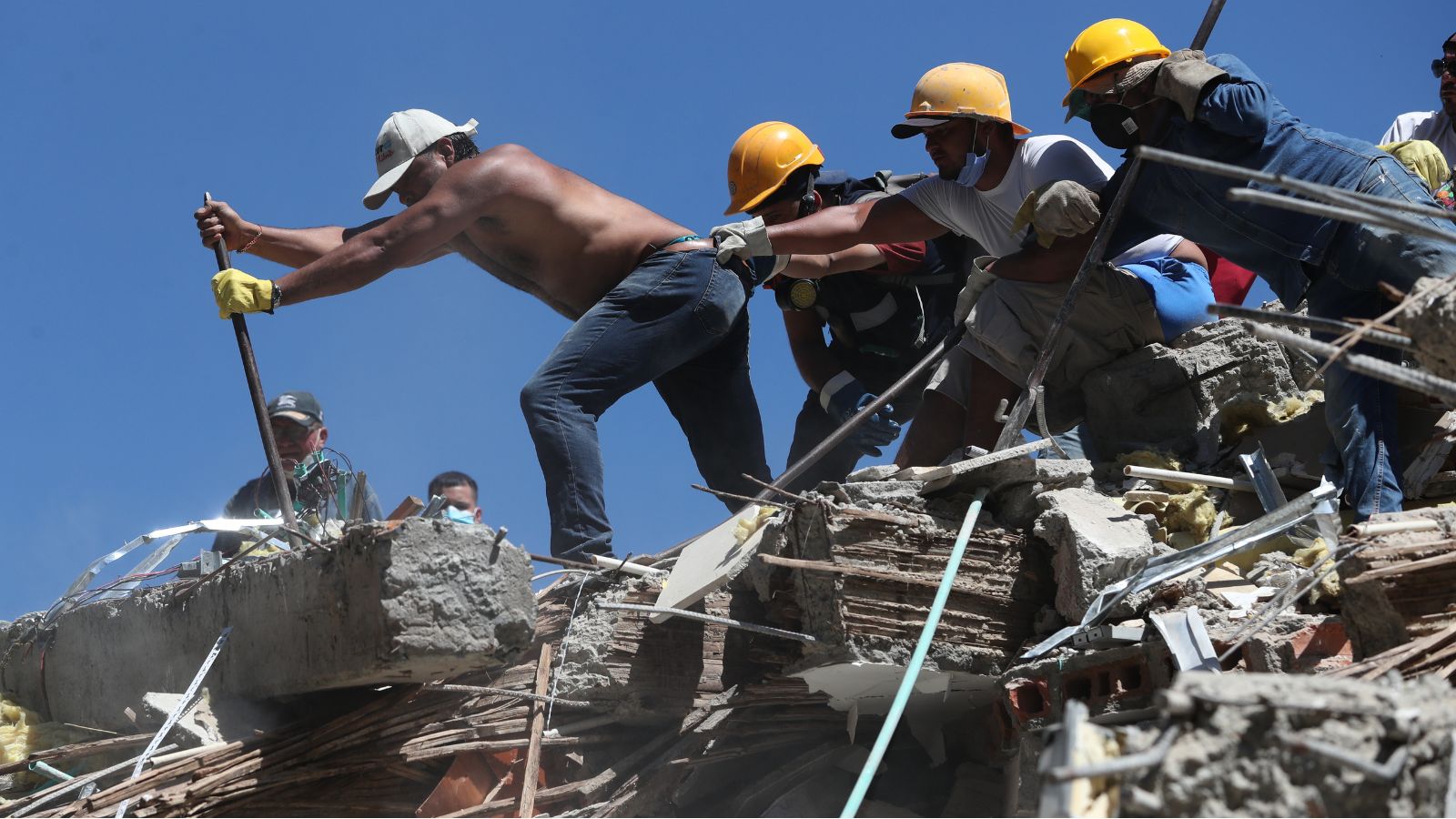
When a 7.4-magnitude seismic event ruptures the lithosphere beneath western Colombia, the resulting destruction is governed by physical laws rather than random chance. On Monday morning, an earthquake originating near San Jose del Palmar in the Choco region produced a casualty count exceeding 111 fatalities and structural failures across at least 1,600 buildings. Standard news reporting attributes this devastation solely to the magnitude of the tremor. A rigorous operational analysis reveals that the true cost function of the disaster is driven by three distinct variables: hypocentral depth, regional infrastructure vulnerability, and logistical friction in mountainous terrain.
The Mechanics of Tectonic Release
The earthquake struck at approximately 7:34 local time, with seismological agencies recording variations in depth and magnitude. The United States Geological Survey registered the event at a 7.4 magnitude, while local authorities noted it as the most powerful seismic occurrence in the country during the twenty-first century. The primary driver of surface acceleration in this event is the subduction zone dynamics where the Nazca Plate plunges beneath the South American Plate.
Energy propagation from an inland epicentre through the cordilleras of the Andes creates amplification effects in sediment-filled valleys. Cities like Cali, Pereira, and Manizales experienced severe ground motion not merely because of proximity to San Jose del Palmar, but due to basin effects that trap and prolong seismic waves. When wave energy encounters softer alluvial soils underlying urban centers, the velocity of the wave decreases, but the amplitude increases exponentially. This mechanical reality explains why structural damage was concentrated in specific municipal pockets while other areas remained largely intact.
The Structural Vulnerability Matrix
The human toll of 111 dead and 87 officially injured is directly tied to the built environment's resistance profile. Out of approximately 1,600 damaged structures, at least 61 completely collapsed. Urban architecture in western Colombia features a high density of unreinforced masonry and older concrete frame buildings that lack adequate lateral load-resisting systems.
During high-magnitude shaking, buildings without ductile detailing experience brittle shear failure. Columns and load-bearing walls fracture instantly under cyclic lateral loads, causing upper floors to pancake onto lower levels. In Cali and Pereira, reports of buildings collapsing inward or shedding facades highlight the absence of seismic retrofitting. The cost of deferred infrastructure hardening manifests directly in the ratio of total collapses to overall structural stock. Where building codes are lax or historical structures remain unreinforced, energy dissipation occurs through material destruction rather than elastic deformation.
Logistical Friction and Access Bottlenecks
Emergency response efficiency is bounded by geographic constraints. The epicentral region of Choco is characterized by dense jungle and rugged topography, making it one of the most logistically isolated departments in the country. Much of the territory relies exclusively on air or water transport.
When the earthquake damaged transport hubs—including the suspension of operations at airports in Pereira, Manizales, Quibdo, Armenia, Cartago, and Buenaventura—the regional supply chain for search and rescue operations suffered an immediate bottleneck. The time-to-treatment curve for trapped survivors follows a strict decay function; survival rates drop precipitously after the first twenty-four hours. In remote sectors of Choco, communication outages and compromised transit corridors delayed damage assessments, preventing heavy rescue machinery from reaching sites where citizens and local volunteers were forced to move concrete slabs by hand.
The Regional Risk Accumulation
This event does not occur in an isolated timeline. It follows a sequence of high-energy tectonic releases in northern South America, including the catastrophic double earthquakes in Venezuela earlier in the year. While the Venezuelan events carried a vastly higher mortality rate due to building stock characteristics, the repetition of major tectonic stress tests regional emergency response capacity.
State intervention, initiated by President Abelardo de la Espriella through a declared state of national disaster and emergency funding allocations, targets the immediate liquidity bottleneck for recovery. However, financial liquidity cannot instantaneously replace compromised physical infrastructure. Capital injection must be systematically paired with mandatory seismic code enforcement for all municipal construction zones along the Andean fault lines.
Deploy heavy urban search and rescue teams directly to secondary population centers in Risaralda and Valle del Cauca while simultaneously establishing temporary air-bridge corridors into isolated Choco municipalities to bypass damaged regional airports.