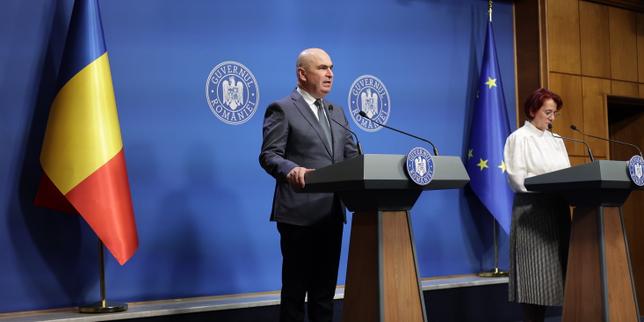
The collapse of the traditional cordon sanitaire in Romanian politics represents more than a localized parliamentary maneuver; it signifies a fundamental shift in the risk-reward calculus of the Social Democratic Party (PSD). By co-signing a no-confidence motion with the far-right Alliance for the Union of Romanians (AUR), the PSD has effectively commoditized its ideological boundaries to achieve a tactical objective: the destabilization of the governing PNL-USR-PLUS coalition. This realignment functions as a stress test for European democratic norms, where the immediate utility of power-sharing with nationalist factions outweighs the long-term cost of institutional de-legitimization.
The Tri-Polar Power Dynamics of the Censure Motion
To evaluate the significance of this "red line" being crossed, one must analyze the three distinct layers of motivation driving the signatories. The coalition between the center-left PSD and the ultra-nationalist AUR is not an ideological merger but a convergence of disparate utility functions.
1. The PSD Tactical Imperative: Governance Reclamation
For the PSD, the alliance is a mechanism to force early elections or a minority government configuration. Their logic operates on a simple survival metric: the longer they remain outside the executive branch, the more their patronage networks atrophy. By utilizing AUR’s parliamentary votes, the PSD bypasses the "reproach of history" in favor of the "immediacy of the state budget."
2. The AUR Strategic Validation: Normalization through Association
For the far-right, the signature of the PSD acts as a certificate of mainstreaming. In political science terms, this is the "Lesser Evil" trap. When a legacy party treats a fringe party as a valid partner for a no-confidence motion, they provide that fringe party with institutional cover. AUR’s primary goal is to shed its "extremist" label; the PSD has handed them the tools to do so.
3. The PNL-USR-PLUS Friction: The Catalyst for Collapse
The incumbent coalition’s inability to resolve internal disputes regarding judicial reform and local development funds (the Saligny program) created a vacuum. This internal friction lowered the cost of entry for the opposition. The "red line" was not crossed in a vacuum; it was pulled across by the governing parties' failure to maintain a coherent policy front.
The Cost Function of Political Legitimacy
The decision to collaborate with the far-right introduces a specific set of externalities that the PSD leadership has likely undervalued. These costs are not immediate but cumulative, affecting the party’s standing within the Party of European Socialists (PES) and its domestic branding as a "modern" European force.
Institutional Decay and the Cordon Sanitaire
The cordon sanitaire—the refusal of mainstream parties to collaborate with extremists—functions as a protective barrier for liberal democracy. When the PSD breaches this, they trigger a "devaluation of the norm." If the center-left can work with the far-right to bring down a government, the center-right is incentivized to do the same to maintain power. This creates a race to the bottom where the most radical elements become the kingmakers in every legislative cycle.
The Mechanism of Radicalization
Historical data suggests that when mainstream parties adopt the tactics or partnerships of the fringe, the fringe does not become more moderate. Instead, the mainstream party becomes more radicalized. This is a feedback loop:
- Cooperation: The mainstream party validates the fringe's presence.
- Assimilation: The mainstream party begins to adopt fringe rhetoric to prevent "voter leakage."
- Equivalence: The electorate views both parties as interchangeable on key nationalist or populist issues.
Quantifying the Legislative Risk
The no-confidence motion is a binary outcome (success or failure), but its impact is a gradient of instability. The Romanian constitution requires an absolute majority (234 votes) to topple a government. The arithmetic of the PSD-AUR alliance reveals a structural bottleneck.
- Total Signatories: The combined weight of PSD and AUR provides a formidable base but falls short of the total needed without help from disgruntled elements within the governing coalition (specifically the USR-PLUS wing).
- The USR-PLUS Dilemma: This party finds itself in a logical paradox. To punish their coalition partner (PNL) for perceived betrayals, they must vote alongside the very forces (AUR) they were elected to combat. This is a classic "Mexican Standoff" where every choice leads to a loss of core voter trust.
The Externalities of Nationalist Integration
The integration of AUR into a formal legislative process directed by the PSD has immediate implications for Romania's relationship with the European Union. Brussels views the rise of nationalist movements in Eastern Europe not as a local phenomenon, but as a systemic threat to the rule of law.
The "red line" mentioned by critics refers to the transition from "opposition by policy" to "opposition by identity." When the PSD aligns with a party that openly challenges the European framework, they signal to the European Commission that Romania's commitment to the Euro-Atlantic trajectory is subject to domestic tactical whims. This perception increases the risk premium on Romanian sovereign debt and complicates negotiations over the National Recovery and Resilience Plan (PNRR) funds.
Structural Bottlenecks in the Romanian Executive
The crisis highlights a deeper flaw in the Romanian semi-presidential system: the "Cohabitation Friction." When the President (Klaus Iohannis) and the parliamentary majority are misaligned, the executive branch enters a state of paralysis.
- The Appointment Loophole: The President has the power to nominate the Prime Minister, but the Parliament must approve. This creates a cycle of failed nominations if the PSD-AUR bloc holds.
- The Interim Trap: Romania has frequently fallen into "interim governance" where ministers lack the full legal authority to make long-term fiscal commitments. This creates a "shadow economy" of governance where decisions are deferred, leading to capital flight and administrative stagnation.
Logical Fallacies in the "National Interest" Rhetoric
Both the PSD and AUR justify their alliance through the lens of "saving the country" from a failing coalition. This is a category error. A no-confidence motion without a pre-negotiated alternative cabinet is not a solution; it is a demolition.
The logic of "First we destroy, then we negotiate" is fundamentally flawed in a fragmented parliament. Without a clear path to 50%+1 for a new government, the motion merely accelerates the decay of public services. The cost of governance (the ability to pass laws, manage the pandemic, and allocate budgets) drops to zero during the transition period, while the social cost (uncertainty, inflation, and public distrust) spikes.
Strategic Forecast: The Emergence of the "Hybrid Opposition"
The immediate future of Romanian politics will be defined by the "Hybrid Opposition" model. We are moving away from traditional left-right divides into a struggle between "Institutionalists" (those adhering to the cordon sanitaire) and "Opportunists" (those willing to leverage fringe volatility for tactical gains).
The PSD's gamble is that the electorate has a short memory regarding the AUR partnership. However, the data suggests that in polarized environments, voters reward clarity over cleverness. By blurring the lines, the PSD risks alienating its urban, moderate base while failing to fully capture the nationalist vote, which will always prefer the "authentic" radicalism of AUR over the "calculated" radicalism of the PSD.
The play for the PNL and USR-PLUS is to force the PSD to own the alliance. If the government falls, the narrative must not be "The government failed," but "The Social Democrats handed the keys to the far-right."
The final strategic move for the governing coalition is to utilize the Saligny development fund as a wedge. By forcing individual local PSD mayors to choose between party-line opposition and direct funding for their communities, the PNL can erode the PSD's parliamentary discipline from the bottom up. This is the only mechanism to counter the AUR-PSD alignment: replace high-level ideological posturing with granular, local-level fiscal reality. The survival of the current executive depends on shifting the battlefield from the "red lines" of national politics to the "black ink" of municipal balance sheets.