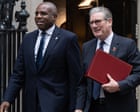
A prime minister who yields to a transition timetable before a formal leadership challenge is mounted commits structural suicide. Deputy Prime Minister David Lammy’s public declaration that Keir Starmer will not establish a schedule for his departure from Downing Street is not an expression of sentimental resilience; it is a calculated defense of executive authority. In parliamentary systems, the declaration of a fixed exit horizon instantly depreciates the incumbent’s political capital to zero, shifting the institutional cost of compliance onto a civil service that begins looking toward the presumptive successor.
The crisis engulfing the Labour administration—triggered by severe local election losses, the resignation of Health Secretary Wes Streeting, and more than 90 MPs demanding a leadership change—cannot be understood through the lens of media narratives or personal fortitude. It must be analyzed through the mechanics of institutional power, succession friction, and the market-driven penalties of governance instability. Don't forget to check out our recent article on this related article.
The Friction Mechanics of Executive Succession
When a governing party experiences internal destabilization, the executive faces a binary choice: maintain total executive friction against challengers or capitulate to an orderly liquidation of power. The ongoing conflict inside Downing Street demonstrates how the lack of a formalized succession protocol creates systemic vulnerabilities.
       [Local Election Losses]
                 │
                 ▼
    [Erosion of Backbench Confidence] ──► (Demands for Departure Timetable)
                 │                                        │
                 ▼                                        ▼
    [Streeting / Cabinet Resignations]         [Instant Lame-Duck Status]
                 │                                        │
                 ▼                                        ▼
    [Makerfield By-Election Pivot]     [Institutional Power Depreciates to Zero]
                 │
                 ▼
  [Burnham / Reform UK External Threat]
Under Labour Party rules, a formal challenge requires a specific threshold of parliamentary support: 20% of sitting MPs must submit letters of non-confidence to trigger a ballot. With approximately 90 MPs openly defecting, this statutory boundary has effectively been breached. Yet, by refusing to offer a timetable, Starmer forces his opponents to shoulder the operational risks of executing a public coup during a period of high economic volatility. To read more about the context here, TIME provides an informative breakdown.
The mechanics of this internal friction are driven by three distinct structural bottlenecks:
- The Lame-Duck Depreciation Curve: The moment an executive sets an expiry date on their tenure, the civil service begins discounting current policy directives. Long-term legislative files stagnate because government departments reallocate intellectual resources toward prepping briefings for the incoming administration.
- The Challenger Coordination Problem: By denying a definitive timeline, the executive forces rival factions to sustain a state of high-readiness mobilization that is financially and politically expensive. Potential successors must balance opposing ideological camps without the unifying framework of an active campaign timeline.
- The Institutional Hostage Dilemma: A standing prime minister retains control over patronage, reshuffles, and the legislative agenda. Relinquishing this leverage via a scheduled departure eliminates the executive's capacity to discipline backbenchers or reward loyalty, accelerating the collapse of the government's voting bloc.
The Strategic Trilemma of Labour Succession
The current positioning of senior figures outlines a strategic trilemma where no single faction possesses a clean path to power. The vacuum created by a potential Starmer exit splits the party along three distinct axes: the Left-Insurgent Strategy, the Soft-Left Regional Hedge, and the Technocratic Realist Defense.
The Left-Insurgent Strategy (The Streeting Model)
Wes Streeting's resignation as Health Secretary to prepare a leadership bid represents a high-beta bet on ideological realignment. Streeting's strategy relies on capturing the centrist core of the Parliamentary Labour Party (PLP). However, this approach faces immediate structural blowback from the party’s left wing. The structural risk here is a deep factional split; figures from the veteran left have already labeled this movement an elite coup designed to bypass grassroots members. This internal resistance ensures that any victory by this faction would inherit a fractured parliamentary party incapable of passing contentious legislation.
The Soft-Left Regional Hedge (The Burnham Model)
Greater Manchester Mayor Andy Burnham’s positioning ahead of the Makerfield by-election presents a unique constitutional anomaly. To mount a valid bid for the premiership, an individual must hold a seat in the House of Commons. Burnham is attempting to leverage regional executive popularity to transition back into Westminster.
The strategy aims to position him as a unifying figure capable of clawing back working-class voters who migrated to Reform UK during the local elections. The operational defect in this model is timing. The executive cannot afford to pause national governance while an outside challenger navigates a localized by-election. This lag allows the incumbent administration to control the timing of statutory instruments and party machinery to frustrate the challenger's entry.
The Technocratic Realist Defense (The Lammy-Nandy Axis)
David Lammy and Culture Secretary Lisa Nandy represent the institutional status quo. Their defense relies on emphasizing the direct macro-economic consequences of leadership instability. This faction uses the threat of external market punishments—such as increased government borrowing costs and gilt market volatility—to enforce discipline. Their primary vulnerability is that their argument is entirely defensive; it relies on the fear of chaos rather than a positive projection of policy momentum.
The Macro-Economic Consequences of Governance Friction
Political instability cannot be decoupled from sovereign financial performance. The ongoing leadership speculation has directly altered the risk premium associated with UK assets. When investors observe cabinet resignations and public infighting, they adjust their models to account for legislative paralysis.
The cost function of this instability manifests in two primary areas:
[Cabinet Instability & Factional Feuds]
                 │
                 ▼
   [Higher Sovereign Risk Premium]
                 │
                 ▼
   [Elevated Government Borrowing Costs] ──► [Squeezed Fiscal Space for Reforms]
Sovereign Borrowing Pressures
The yield on UK 10-year Gilts tracks political risk. As executive cohesion degrades, institutional investors demand higher yields to compensate for the uncertainty of long-term fiscal policy. This increase in borrowing costs directly reduces the Treasury’s available fiscal space, undermining the government's ability to fund public services or execute infrastructure commitments.
Structural Reform Paralysis
The current administrative gridlock arrives precisely when key economic indicators demand clear executive direction. Recent expansions in GDP numbers and nominal drops in NHS waiting times require sustained legislative support to stabilize. Major statutory overhauls—including the Employment Rights Act and crucial renters' rights bills—face delays when the center of government enters a defensive posture. The departure of key officials, such as the Cabinet Secretary and senior communications directors over the preceding months, has already thinned the administrative capacity of No. 10.
The European Red Line and Electoral Exposure
The ideological battleground to replace Starmer has exposed a profound structural debate regarding the UK’s relationship with the European Union. Streeting’s departure has reopened arguments around reversing key elements of Brexit, with some factions advocating for a return to the EU single market or customs union to generate non-inflationary growth.
This debate carries severe electoral risks. David Lammy’s strict adherence to existing cabinet red lines—rejecting any return to the customs union or single market—is an attempt to protect the party's flank against Reform UK.
Data from the recent local elections indicate that Labour’s primary vulnerability is no longer just the Conservative party, but a surging Reform UK capturing disaffected working-class constituencies. Reopening the European question creates a structural target for populist campaigns. If the leadership contest pivots toward rejoining European structures, it risks alienating the exact voter segments required to secure a stable majority at the next general election.
The Strategic Playbook for the Executive
To survive this institutional insolvency, the incumbent executive must transition from a posture of defensive resilience to aggressive structural containment. Relying on rhetoric about personal strength is insufficient; the prime minister must deploy the institutional levers of state to alter the cost-benefit calculations of his detractors.
First, the executive must exploit the Makerfield by-election to force party unity. By framing the contest as a binary choice between Labour and Reform UK, the administration can compel internal rebels to actively campaign for the party line. Refusing to support the campaign would be branded as institutional sabotage, giving the leadership clear justification to strip the whip from prominent dissenters. This maneuver effectively weaponizes the external populist threat to enforce internal discipline.
Second, the Prime Minister must immediately implement a radical restructuring of the Cabinet office. The recent exits of key senior advisers have left the center of government hollowed out and reactive.
Rather than waiting for a formal confidence vote, the executive should execute a targeted ministerial reshuffle, filling junior and mid-tier roles left vacant by resignations with ambitious backbenchers from the soft-left. This step breaks up potential voting blocs before they consolidate around challengers like Burnham or Streeting, while signaling to the civil service that the current administration retains the capacity to reward and punish.
Finally, the government must shift its communication matrix away from defending the Prime Minister's personal future and toward the immediate execution of supply-side economic reforms. The executive should fast-track the implementation of the Employment Rights Act and deploy targeted capital allocations to key infrastructure projects. By creating measurable legislative momentum, the administration shifts the public debate from a narrative of terminal decline to one of operational output.
This forces challengers to argue against a functioning legislative program, significantly raising the political cost of initiating a formal coup. Survival requires making the price of removal higher than the party is willing to pay.