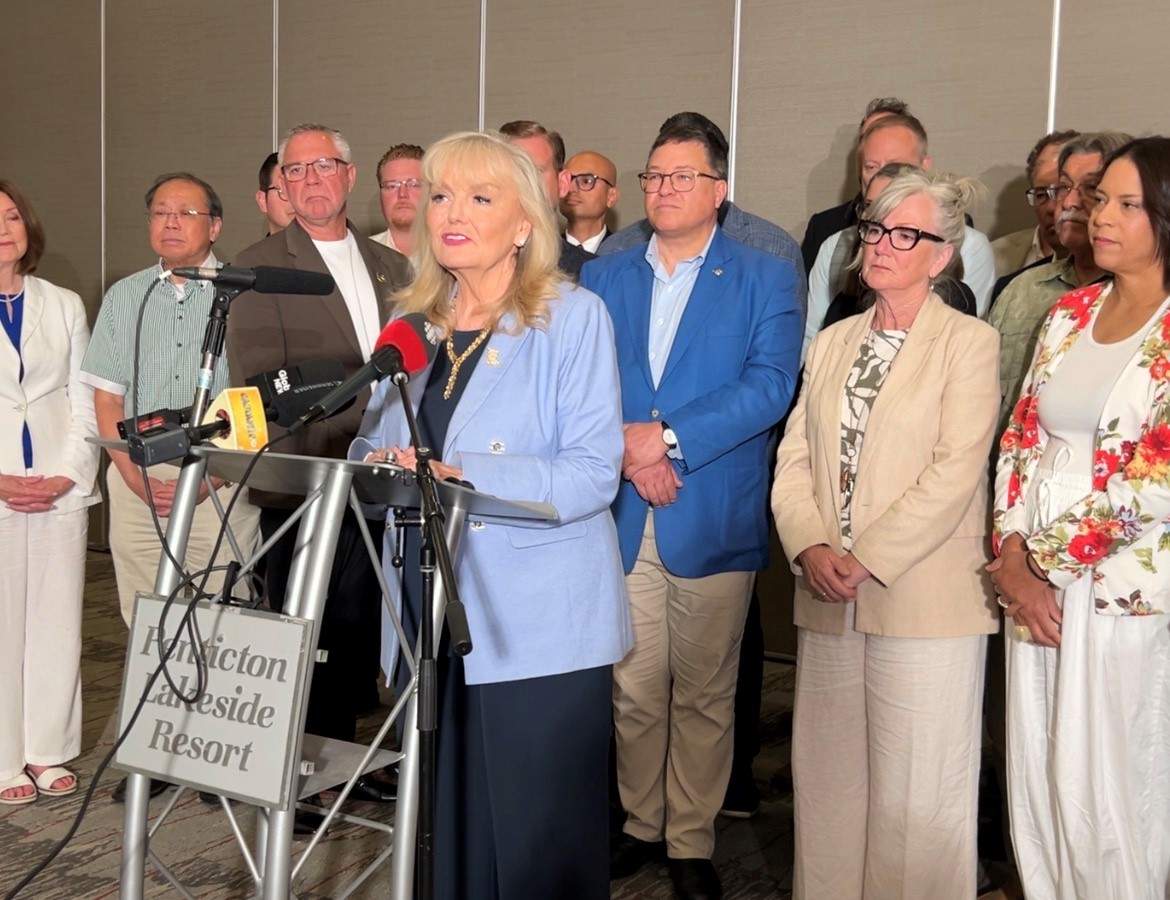
Political stability is a function of organizational alignment, not rhetorical consensus. The BC Conservative Party’s two-day caucus retreat in Penticton represents a calculated effort by newly elected leader Kerry-Lynne Findlay to stabilize a coalition that has faced intense structural volatility over the past eight months. Following a narrow 51 percent to 49 percent victory over Caroline Elliott in the May 2026 leadership race, Findlay inherits a 38-member caucus fragmented by internal ideological divides, a historical leadership ouster, and high-profile defections.
To transform an opposition party into a viable government-in-waiting, a leader must solve a complex coordination problem. This requires managing internal factionalism, securing institutional entry for unseated leadership, and establishing geographic firewalls against competitive poaching.
The Tri-Focal Alignment Matrix
The Penticton retreat targeted three distinct operational vulnerabilities within the BC Conservative apparatus. Rather than seeking ideological uniformity, the strategy relies on a structural compromise: enforcing baseline policy agreement while distributing legislative influence to competing internal factions.
                  [Findlay Leadership Core]
                             |
       +---------------------+---------------------+
       |                     |                     |
[Factional Balance]   [Legislative Access]   [Geographic Firewalls]
 - Post-race unity     - By-election paths    - Regional promotions
 - Discipline (Whip)   - Structural vacancy   - Okanagan preservation
1. Factional Balance and Internal Discipline
The May 2026 leadership election exposed a sharp cleavage between the party’s populist wing and its moderate, centre-right "free enterprise" contingent, the latter of which rallied behind candidates like Peter Milobar and Caroline Elliott. Managing this division requires structural mechanisms to enforce caucus discipline while simultaneously validating minority factions.
Findlay's first tactical move was the appointment of West Kelowna–Peachland MLA Macklin McCall as Official Opposition Whip. The Whip functions as the primary mechanism for party discipline, managing caucus business and ensuring voting alignment in the legislative chamber. By elevating a key regional representative to this enforcement role, the leadership aims to stabilize internal morale and suppress public dissent.
Concurrently, the retention of Kelowna Centre MLA Kristina Loewen (Prosperity and Social Development critic) and Kelowna-Mission MLA Gavin Dew (Economic Development critic) keeps influential moderates inside the shadow cabinet. This distribution of portfolios functions as a classic incentive alignment strategy, giving ambitious MLAs a stake in the current hierarchy and minimizing the risk of further wildcat defections.
2. The Legislative Access Bottleneck
A fundamental operational constraint limits Findlay’s immediate authority: she does not currently hold a seat in the British Columbia Legislative Assembly. This creates a critical institutional bottleneck. Without a seat, a party leader cannot directly confront the Premier during Question Period, dictate daily legislative tactics, or command the primary media spotlight during active sessions.
Resolving this constraint depends entirely on a high-stakes vacancy negotiation. For Findlay to enter the legislature before a general election, an existing Conservative MLA must resign their seat to trigger a by-election in a safe constituency.
- The Safe-Seat Hypothesis: Former leader John Rustad, who retains deep institutional capital after handily winning his Nechako Lakes riding with 67.5 percent of the vote in 2024, has indicated a willingness to discuss stepping down.
- The Transactional Cost: Such a maneuver carries significant risk. It forces a costly by-election, temporarily reduces the opposition's seat count, and requires negotiating a complex exit or alternative reward structure for the departing incumbent.
Until this transaction occurs, the party's day-to-day legislative execution remains decoupled from its primary executive leader.
3. Geographic Firewalls and the Poaching Threat
The selection of Penticton for the caucus retreat was a deliberate defensive choice. The Okanagan region represents the geographic core of the BC Conservative base, yet it remains highly vulnerable to aggressive incursions by the governing BC NDP, which currently holds a razor-thin one-vote majority in the legislature.
The defensive necessity of this regional focus was underscored during the retreat itself by a major defection event: Penticton-Summerland MLA Amelia Boultbee announced her decision to cross the floor and join the BC NDP. Boultbee had previously left the Conservative caucus in late 2025 due to friction with then-leader John Rustad, sitting as an Independent before formally aligning with the government.
[Defection Event]
Amelia Boultbee (Penticton-Summerland) ---> Crosses floor to BC NDP

[Strategic Response]
- Downplay systemic risk of individual floor-crossing
- Anchor remaining 38 MLAs through structural prominence
- Propose macro-economic policies (Western Alliance, Northern Pipeline Route)
This floor-crossing highlights a critical systemic vulnerability for the Conservatives. Premier David Eby’s administration is highly incentivized to exploit any lingering fissures within the conservative caucus to stabilize its own thin legislative majority. Findlay’s response—downplaying the individual move while doubling down on the remaining 38 MLAs—stresses a policy of containment rather than retaliation.
Macro-Policy Frameworks as Unifying Vectors
To shift internal focus away from personality conflicts and local defections, the leadership introduced two macro-economic policy pillars designed to serve as ideological gravity wells for both populist and centrist factions.
The Western Trade Alliance
Findlay proposed the creation of a "western alliance" of provinces aimed at the systematic removal of interprovincial trade barriers. This framework functions as a low-friction unifying policy because it appeals equally to free-market liberals who favor deregulation and regional populists focused on western autonomy. Economically, reducing non-tariff trade barriers acts as a supply-side stimulus that requires no direct provincial capital expenditure, making it an ideal platform for an opposition party seeking fiscal credibility.
Infrastructure Acceleration
The party positioned itself against federal regulatory drag by advocating for the acceleration of new pipeline proposals, specifically endorsing a northern route through the province. This policy intentionally highlights sharp ideological contrasts with the BC NDP's environmental platform. By advocating for the removal of provincial regulatory bottlenecks on energy infrastructure, the Conservative leadership seeks to capture corporate capital support while appealing directly to resource-dependent working-class voters in the interior and northern regions.
The Strategic Forecast
The BC Conservative Party's trajectory over the next legislative session will be determined by its ability to execute on three distinct milestones. First, the leadership must finalize the terms of an incumbent asset swap within the next sixty days to secure a safe-seat by-election for Findlay, eliminating the legislative access bottleneck. Second, the newly appointed Whip must maintain voting discipline across the 38-member caucus to prove the party can act as a coherent legislative block. Third, the shadow cabinet must successfully shift public messaging away from internal governance issues and toward targeted critiques of the NDP's economic performance. Failure to hit these operational targets will signal to the electorate that the party remains a fragile coalition rather than a cohesive government-in-waiting.