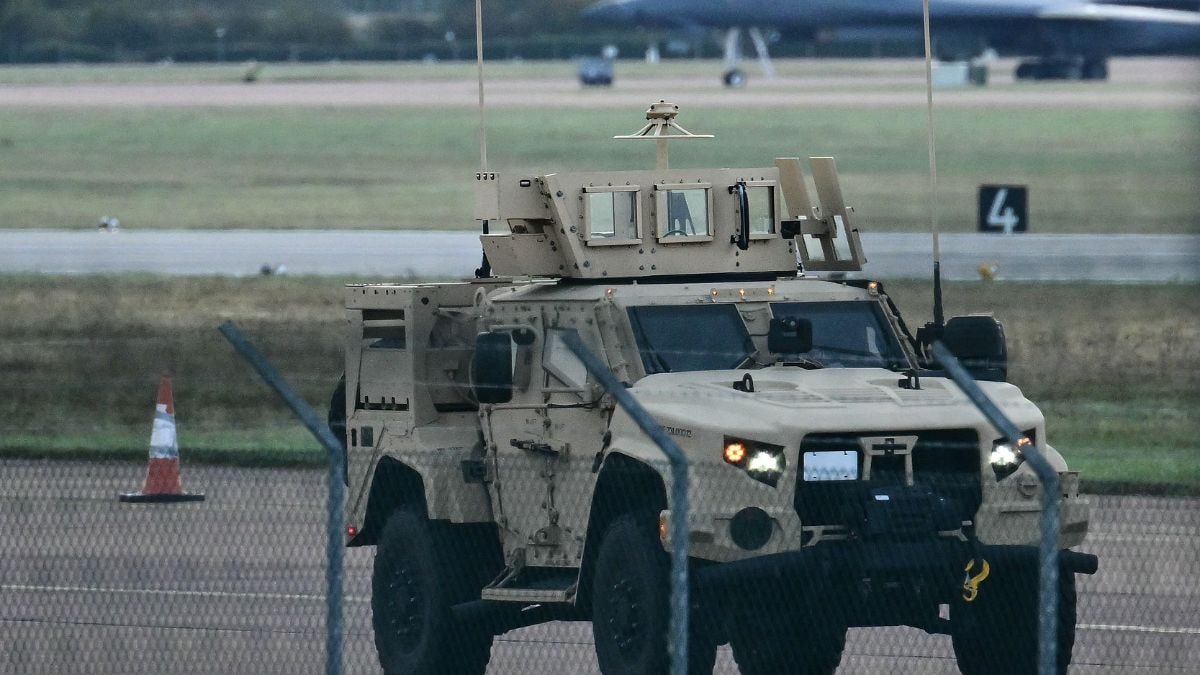
Strategic military installations function within a complex matrix of perimeter security, intelligence oversight, and asymmetric threat vectors. The security architecture surrounding dual-power installations—such as Royal Air Force stations utilized by United States strategic bomber wings—relies on multi-tiered defensive measures. When a security breach or planned disruption occurs in the vicinity of these facilities, it exposes systemic friction points between civilian infrastructure accessibility and high-value asset protection.
Deconstructing incidents of this nature requires analyzing the mechanics of hostile reconnaissance, proxy coordination, and physical security vulnerabilities. Rather than treating such events as isolated criminal anomalies, strategic analysts evaluate them through a triadic framework: asset criticality, adversary operational methodology, and defensive response latency.
The Triadic Framework of Installation Vulnerability
Military installations designated for power projection face a distinct operational calculus.
Asset Criticality and Target Attractiveness
Facilities hosting long-range strategic assets represent high-value nodes for state and non-state actors alike. The presence of foreign military personnel and strategic platforms exponentially increases the symbolic and tactical value of the site. Consequently, even low-level operational probes or material staging near the perimeter carry disproportionate intelligence value for hostile entities seeking to map response times, blind spots, and local logistical patterns.
Adversary Operational Methodology and Compartmentalization
Modern asymmetric operations frequently employ decentralized cellular networks rather than unified local commands. Investigative findings involving proxy-linked networks demonstrate a reliance on compartmentalized communication, often utilizing intermediaries or incarcerated handlers passing instructions via codified channels. This structure minimizes single-point failures within the network while complicating counter-intelligence attribution. Operational staging often involves local auxiliary assets—individuals recruited or directed to perform tactical reconnaissance, secure transport logistics, or material acquisition (such as accelerants or explosive precursors) without necessarily possessing full visibility into the broader strategic design.
Defensive Response Latency and Surveillance Gaps
The perimeter of a large military reservation is inherently porous where civilian infrastructure intersects with defense boundaries. The time differential between initial civilian observation, local law enforcement notification, and specialized counter-terrorism intervention creates a tactical window. When suspicious movements—such as unauthorized vehicle positioning or logistical staging—occur in rural or semi-accessible sectors, detection often depends on civilian vigilance rather than automated telemetry, highlighting a friction point in early-warning sensor integration.
The Mechanics of Proxy-Directed Infrastructure Probing
Hostile state actors engaging in hybrid warfare frequently utilize proxy networks to test host-nation security postures. This methodology operates on distinct operational phases designed to calibrate response mechanisms without triggering an immediate conventional escalation.
- Reconnaissance and Pattern-Mapping: Initial phases involve observing guard rotations, electronic surveillance sweeps, and local police response times. The use of multiple utility vehicles or localized positioning near access routes allows operatives to evaluate choke points and civilian traffic density.
- Logistical Staging: Securing material resources—ranging from basic transport to volatile materials like petrol—near the target zone indicates an advancement from passive observation to active operational preparation.
- Command and Control Friction: Modern counter-terrorism data shows that disrupted networks often rely on external command nodes attempting to direct local actions remotely. When primary nodes are compromised or intercepted by law enforcement, secondary relays attempt to maintain operational continuity, often introducing detectable communication signatures that intelligence agencies exploit.
Systemic Limitations in Counter-Asymmetric Defense
No defensive posture achieves absolute immunity against asymmetric infiltration. The deployment of strategic assets to allied host nations inherently introduces legal, jurisdictional, and logistical variables.
Civilian policing structures prioritize public safety and evidentiary thresholds required for judicial prosecution, whereas military counter-intelligence prioritizes threat neutralization and operational security. This divergence can create friction during fast-moving investigations where intelligence-led interventions must be balanced against statutory detention limits and evidentiary standards for formal charges under national security legislation. Furthermore, the physical footprint of airbases—spanning extensive acreage in rural or semi-rural environments—makes total perimeter denial economically and logistically unfeasible, necessitating a reliance on depth-defense and intelligence-led preemption rather than static fortification alone.
Strategic Realignment of Installation Defense
To mitigate vulnerabilities exposed by proxy-directed reconnaissance and localized terror planning, security doctrine must shift from perimeter hardening to predictive intelligence integration. Host-nation law enforcement and military counter-terrorism units must narrow the sensor-to-shooter loop by enhancing civilian-military reporting channels and increasing surveillance coverage over peripheral choke points. Strategic planners must treat localized logistical anomalies—such as unauthorized stationary vehicles near critical flight lines—not as civil infractions, but as primary indicators of hostile target preparation.