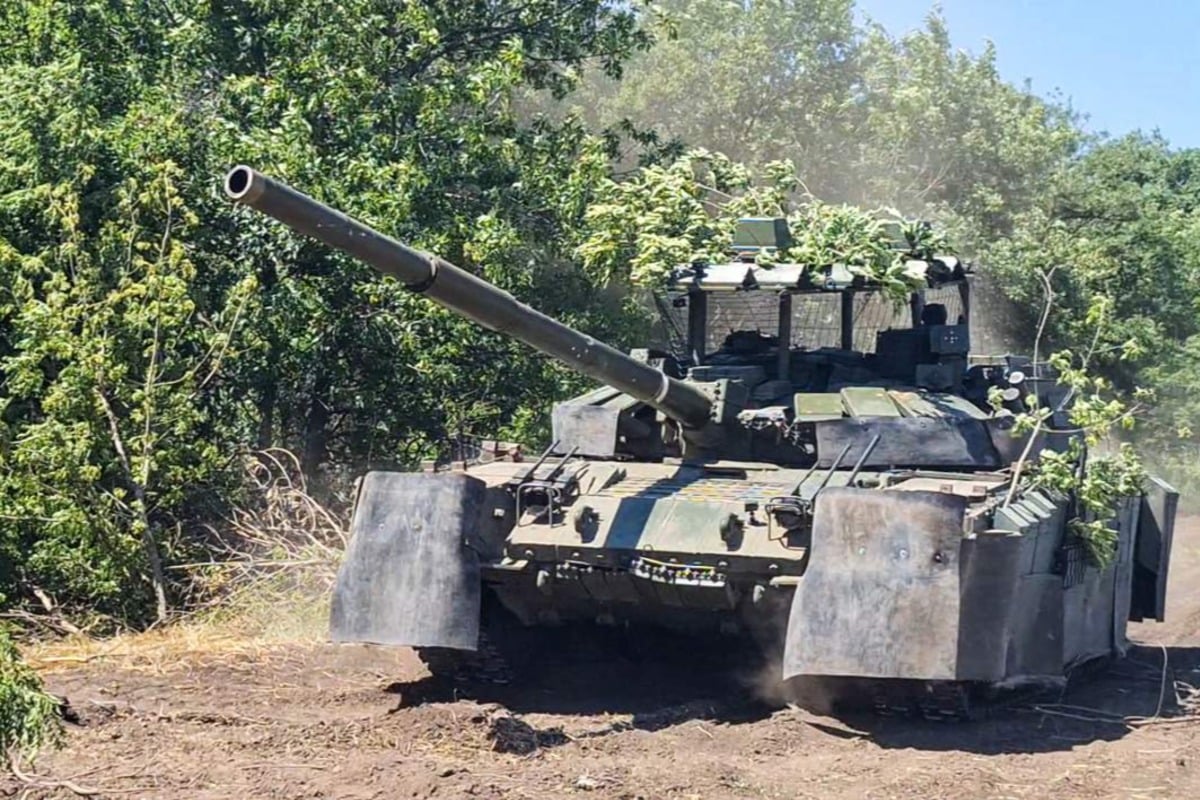
The traditional dominance of the main battle tank faces an existential crisis driven by the proliferation of low-cost First-Person View (FPV) drones and loitering munitions. This structural shift in battlefield attrition has forced a fundamental recalculation of vehicle protection. State defense conglomerate Rostec's deployment of updated T-90M, T-80BVM, and T-72B3M platforms directly addresses this asymmetry. Rather than relying on the field-expedient adaptations that characterized earlier stages of the conflict, such as improvised "turtle shells," the latest production batches integrate factory-standardized protective architectures. The core engineering objective is clear: neutralize the precision top-attack vector without permanently compromising the vehicle's operational mobility or tactical utility.
The Tri-Layered Protection Framework
To systematically counter the drone threat, factory designs have abandoned singular protective measures in favor of a three-tiered defense architecture. Each tier targets a specific phase of the drone's engagement cycle: acquisition, terminal guidance, and detonation.
1. Electromagnetic Suppression (The EW Dome)
The first layer relies on localized Electronic Warfare (EW) systems mounted directly to the vehicle's turret. These compact omnidirectional jamming units generate a localized radio frequency suppression field targeting the common control and video transmission bands utilized by commercial and modified FPV drones (typically 433 MHz, 900 MHz, 1.2 GHz, and 2.4/5.8 GHz). By breaking the command link or blinding the operator's video feed prior to terminal descent, the system forces the drone into an unguided ballistic trajectory, causing it to miss the moving target entirely.
2. Hard-Kill Active Interception (Arena-M Variant)
For munitions that successfully penetrate the EW envelope or utilize autonomous optical tracking immune to RF jamming, factory-upgraded T-90M and T-72B3M units incorporate a specialized variant of the Arena-M Active Protection System (APS). Traditional APS designs optimized for high-velocity anti-tank guided missiles struggle with the low-velocity, erratic flight paths of quadcopters. The refined Arena-M software framework specifically isolates low-speed radar signatures, launching directional fragmentation munitions to destroy incoming loitering threats at a distance of 20 to 50 meters from the hull.
3. Structural Deflection and Early Detonation (Hedgehog and Cage Armor)
The final line of defense handles munitions that reach the vehicle's physical profile. Factory-standardized top cages are now augmented with "hedgehog armor"—a matrix of extended, high-tensile metal wires and unwound aluminum cabling welded to an auxiliary frame. This architecture targets the fuse mechanisms of shaped-charge warheads.
- Standoff Detonation: The wire matrix triggers the drone's high-explosive anti-tank (HEAT) warhead at a distance greater than the optimal standoff length. This prevents the hyper-velocity plasma jet from focusing correctly, dissipating its energy against the open air rather than the thin top armor of the turret.
- Fuse Disruption: The dense wire arrays frequently crush or short-circuit the crude impact fuses found on improvised drones, neutralizing the weapon without triggering detonation.
The Weight-to-Protection Trade-off
The introduction of these layered defense mechanisms imposes severe physical constraints on the platform's core performance metrics. Operational engineering requires a strict balancing of the mass-to-power ratio.
While field-constructed "turtle tanks"—which encase vehicles in heavy steel sheets—proved capable of absorbing dozens of FPV strikes, they introduced debilitating operational bottlenecks. The structural mass severely reduced maximum speeds, strained the suspension systems, and locked the turret in a fixed forward position, effectively transforming a main battle tank into a crude assault gun.
The standardized factory upgrades seek to mitigate this penalty by utilizing modular high-strength alloys and optimized geometries. By replacing solid steel plates with hollow mesh profiles and wire arrays, the weight penalty is minimized, allowing the T-72B3M and T-90M platforms to retain full 360-degree turret traverse and preserve mechanical agility across varied terrain.
Systematic Weaknesses of the Factory Configuration
Despite these structural advancements, the current iteration of factory protection does not represent an absolute solution to the drone problem. Operational data indicates several critical limitations:
- Saturation Vulnerability: Active protection systems and localized EW arrays operate under strict capacity constraints. Simultaneous multi-directional drone swarms can overwhelm the target acquisition capabilities of the Arena-M radar or deplete its limited countermeasure canisters.
- Rapid Frequency Shifting: Commercial FPV operators constantly alter operational frequencies outside the standard suppression bands of the vehicle's EW domes, neutralizing the primary layer of defense until the hardware can be physically re-tuned or replaced.
- Degradation under Sustained Fire: The structural integrity of cage and hedgehog armor degrades linearly with each impact. Consecutive detonations shred the wire matrix, exposing the vulnerable armor beneath to subsequent attacks.
The evolution of vehicle survivability has shifted from static thickness metrics to dynamic adaptation cycles. The deployment of factory-level anti-drone protection demonstrates that the modern battlefield requires armored vehicles to function as mobile electronic and kinetic defense bubbles. The long-term efficacy of these platforms will depend entirely on the speed at which their EW systems and automated interceptors can adapt to the rapid software and frequency iterations of opposing drone networks.
Russia Unveils New Batch of Tanks With Advanced Anti-Drone Protection
This video provides a direct visual overview of the newly manufactured Russian armored vehicles equipped with the specific factory-standardized electronic warfare domes and top-attack cage arrays discussed in this analysis.