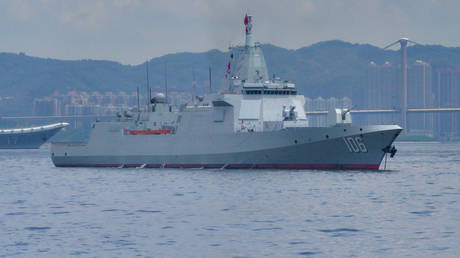
Beijing’s deployment of a "special maritime operation" in the Taiwan Strait represents a deliberate shift from kinetic military deterrence to gray-zone economic and logistical strangulation. By utilizing law enforcement assets—specifically the China Coast Guard (CCG) and maritime militia—rather than traditional People’s Liberation Army Navy (PLAN) warships, China alters the legal and operational calculus of regional stability. This strategy exploits a critical vulnerability in international maritime law: the gray area between peaceful passage and overt acts of war. Understanding this operation requires moving past alarmist headlines to analyze the specific economic bottlenecks, legal frameworks, and escalatory thresholds now in play.
The Dual-Engine Framework of Maritime Interdiction
The strategic execution of a special maritime operation relies on two distinct operational vectors that simultaneously target Taiwan’s sovereign claims and its supply-chain dependencies.
Jurisdictional Normalization
The primary political objective is the systematic erasure of the median line’s de facto status and the assertion of domestic administrative control over international shipping lanes. When the CCG boards commercial vessels or declares enforcement zones, it shifts the narrative from an international geopolitical standoff to an internal policing action. This creates a legal dilemma for Taiwan and its allies. Responding with naval force to a coast guard inspection risks positioning the defending nation as the escalator of violence. Failing to respond, however, establishes a precedent of uncontested Chinese jurisdiction.
Constriction Economics
The secondary objective is the inflation of risk premiums for commercial shipping. Taiwan relies on maritime imports for approximately 97% of its energy supply, including liquefied natural gas (LNG), coal, and oil. The mechanism of constriction does not require a physical blockade—a high-risk maneuver that could trigger international intervention. Instead, it operates through a cost-imposition function:
- Insurance Risk Premiums: The mere declaration of an operational zone prompts global maritime insurers to reclassify the Taiwan Strait as a war-risk area, drastically increasing hull and machinery premiums.
- Demurrage and Diversion Costs: Rerouting commercial vessels around the eastern coast of Taiwan adds days to transit times, escalating fuel consumption and labor costs.
- Supply Chain Friction: Just-in-time manufacturing sectors, particularly semiconductor fabrication plants, operate on razor-thin inventory buffers. Minor delays in chemical or silicon wafer delivery disrupt global production schedules.
The Logistics of the Three-Tiered Naval Encirclement
The operational architecture of the operation avoids a monolithic naval presence. It utilizes a layered, asymmetric deployment designed to maximize flexibility while minimizing the footprint of overt military aggression.
Layer 1: The Maritime Militia (The Vanguard)
Comprising commercial fishing vessels absorbed into state-directed structures, the maritime militia acts as the initial point of friction. Their primary utility lies in deniability and physical obstruction. By crowding shipping channels or anchoring in anchorage zones, they force commercial traffic to alter course, creating artificial bottlenecks that simplify tracking and interception by higher-tier assets.
Layer 2: The China Coast Guard (The Enforcer)
The CCG serves as the legal anchor of the operation. Armed with white-hulled vessels that frequently match or exceed the tonnage of regional naval warships, the CCG executes boarding actions, cargo inspections, and regulatory enforcement. This layer uses law enforcement frameworks to justify the restriction of freedom of navigation, presenting a paradox to foreign navies trained for military-to-military engagement.
Layer 3: The People's Liberation Army Navy (The Overwatch)
The PLAN remains over the horizon or positioned at strategic chokepoints outside the immediate zone of gray-zone operations. Its role is strictly deterrence and escalation management. By maintaining active radar tracks and conducting missile drills in adjacent sectors, the PLAN prevents the intervention of external military forces, securing the operational space for the CCG to execute the primary constriction strategy.
Quantifying the Chokepoint Vulnerability
A precise assessment of the Taiwan Strait’s maritime traffic reveals why localized operations yield global economic consequences. The strait functions as a primary artery for global commerce, connecting manufacturing hubs in Northeast Asia with markets in Europe and the Americas.
[South China Sea Traffic] ---> (Taiwan Strait Chokepoint) ---> [East China Sea / Pacific]
                                      |
                     [Taiwanese Ports: Kaohsiung / Keelung]
                                      |
                        (Energy Import Vulnerability)
The vulnerability of Taiwan’s ports can be categorized by three primary operational variables.
Storage Capacity Constraints
Taiwan's natural gas reserves are notoriously limited, frequently holding less than two weeks of consumption capacity during peak summer months. Unlike crude oil, which can be stored in large-scale strategic reserves for extended periods, LNG requires specialized cryogenic infrastructure. A localized maritime operation that delays LNG carrier berthing by even seven days pushes the electrical grid to the brink of rolling blackouts, directly threatening industrial output.
Port Concentration Risks
The Port of Kaohsiung handles the vast majority of Taiwan’s containerized cargo and bulk commodities. The geographic concentration of import infrastructure means that a targeted CCG presence off the southwestern coast effectively bottlenecks the island's economic intake. Diversion to smaller northern ports like Keelung or Taichung is limited by shallower draft capacities and inferior inland transportation links.
The Legal Limbo of Foreign-Flagged Vessels
A significant portion of the merchant fleet servicing Taiwanese ports flies flags of convenience (e.g., Panama, Liberia, the Marshall Islands). These vessels are owned, crewed, and insured by international consortia. If the CCG demands manifest inspections, foreign shipowners face a choice: comply with Chinese administrative mandates or risk vessel detention. Most commercial operators will prioritize asset protection and compliance over the geopolitical interests of Taipei, effectively automating the normalization of Beijing’s jurisdictional claims.
Escalation Dynamics and Strategic Limitations
While the special maritime operation offers Beijing a low-risk mechanism for coercion, the strategy is governed by distinct operational boundaries and inherent limitations that prevent it from becoming an absolute tool of dominance.
The Threshold of Kinetic Transformation
The efficacy of gray-zone coercion relies entirely on keeping the conflict below the threshold of open warfare. The moment a coast guard vessel fires upon a commercial or military target, the legal ambiguity dissolves. The conflict transitions instantly into a traditional military engagement, unlocking pre-arranged defense doctrines and potentially triggering international mutual defense treaties. Therefore, the operation is structurally constrained by the adversary's willingness to tolerate low-level friction without firing the first shot.
The Economic Backlash Function
China's domestic economy remains deeply integrated with global supply chains. A prolonged disruption of the Taiwan Strait does not occur in a vacuum; it impacts Chinese ports like Xiamen, Fuzhou, and Shanghai, which share the same maritime approaches. The unintended economic consequences—surging insurance rates for Chinese shipping, supply chain delays for domestic manufacturers dependent on Taiwanese components, and capital flight from regional markets—impose a self-limiting timeline on how long Beijing can sustain a high-intensity maritime operation before facing severe domestic economic blowback.
The Strategic Counter-Play
Countering a gray-zone maritime operation requires a departure from traditional naval deployment models. Relying solely on the deployment of carrier strike groups or heavy surface combatants plays into the escalatory trap designed by Beijing. Instead, a resilient counter-strategy must focus on asymmetric legal, economic, and logistical countermeasures.
National authorities must decouple energy distribution from real-time maritime arrivals. This requires immediate investment in floating storage and regasification units (FSRUs) anchored outside primary constriction zones, alongside a rapid expansion of domestic renewable and nuclear baseload power to reduce the vulnerability of the industrial sector to LNG disruptions.
Concurrently, a multinational maritime registry mechanism must be established to provide sovereign legal backing to commercial vessels transiting the strait. By replacing flags of convenience with explicit state-sponsored protection for specific cargo routes, coalition partners can force the CCG to confront the prospect of boarding a vessel directly backed by a foreign sovereign power, thereby shifting the burden of escalation back onto Beijing. Operational resilience relies not on winning a kinetic battle in the strait, but on systematically neutralizing the cost-imposition tools of gray-zone coercion.