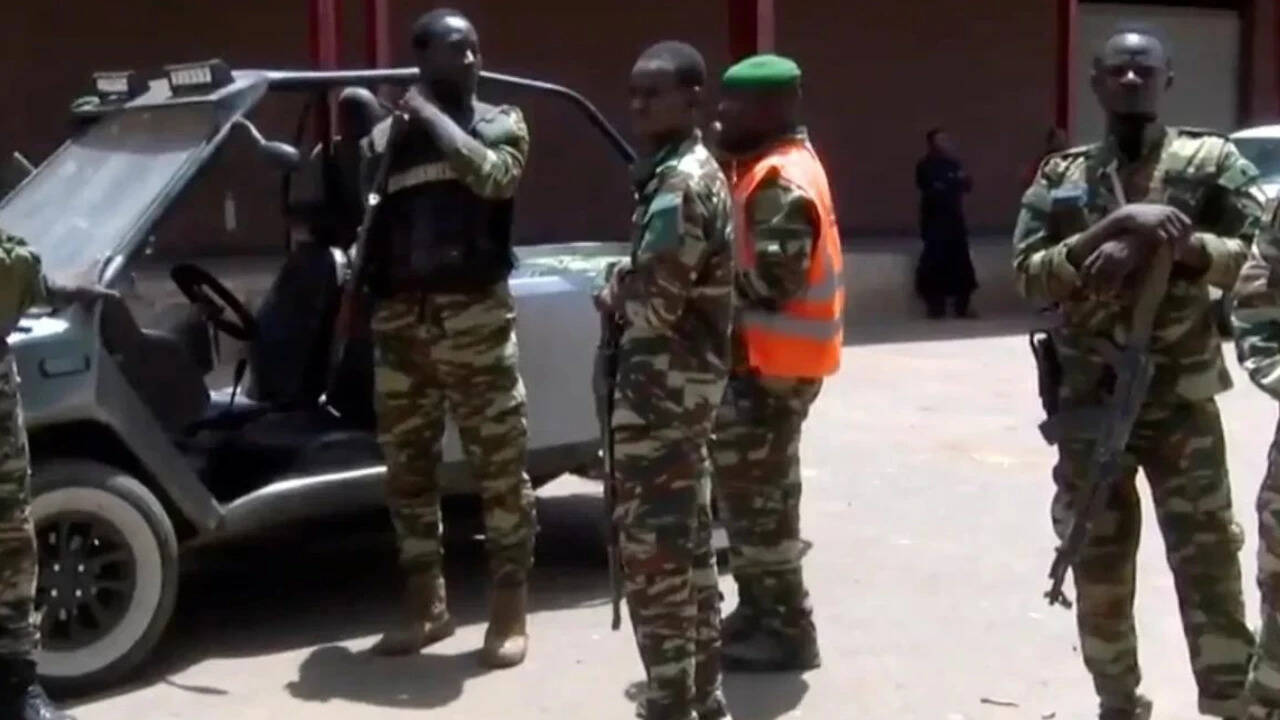
Political stability within military regimes depends entirely on the efficient distribution of operational control and resource rents among armed factions. When these mechanisms degrade, internal rebellion replaces external defense as the primary survival threat. The recent predawn assault across Niamey, characterized by sustained gunfire and explosions near Air Base 101 and the Plateau administrative district, illustrates a structural fracture within Niger's governing National Council for the Safeguard of the Homeland. Defense Minister General Salifou Mody characterized the event as a breach of military discipline and regulations, but operational indicators point toward deeper institutional strain resulting from chronic overextension, resource deprivation, and shifting geopolitical alignments.
Evaluating this security breakdown requires deconstructing the operational environment into three core pressure vectors: logistical overstretch, alliance restructuring costs, and command-and-control friction.
The Logistical Cost Function of Counterinsurgency
Military juntas that ascend through coups inherit an existing security deficit while simultaneously disrupting the external financing and logistical supply chains required to maintain state monopoly over violence. Since the July 2023 overthrow of the civilian government, Niger's ruling council has faced continuous attrition from jihadi insurgencies linked to al-Qaida and the Islamic State across the Sahel.
The cost function of managing this multi-front insurgency operates under severe resource constraints. Western security partners withdrew significant funding, intelligence-sharing frameworks, and material support following the junta's rise. Although the regime pivoted toward alternative partnerships, including Russian security contractors, the structural deficit in logistics, medevac capabilities, and troop rotation frequency remains unmitigated. Infantry units deployed to remote operational sectors endure prolonged exposure to high-threat environments without adequate reinforcement or rest cycles.
When combat units absorb continuous casualties without tactical wins, internal cohesion collapses. The seizure of officers at Diori Hamani International Airport—which houses both Niger's tactical Air Base 101 and the joint regional command for the Sahel alliance—targets the exact node where operational planning and resource allocation intersect. Restricting command access at this strategic choke point demonstrates that the mutinous elements understood the precise structural leverage points required to disrupt state command chains.
Command Friction and Geopolitical Reorientation
The shift from Western security architectures to localized and alternative alliances altered internal military promotions, resource flows, and operational doctrine. In professionalized or semi-professionalized armies, abrupt geopolitical realignments create immediate friction within officer corps, dividing factions between beneficiaries of the new political dispensation and officers sidelined by institutional purges or shifting loyalties.
Base 101 is not merely a tactical aviation hub; it serves as the logistical heartbeat for power projection in the capital. The facility has faced repeated security breaches, including previous assaults attributed to insurgents. When a critical military installation suffers repeated penetrations—first by external non-state actors and subsequently by internal mutineers—the vulnerability exposes a systemic failure in perimeter defense and internal vetting.
The mechanics of the incident followed a predictable sequence of operational disruption. Mutinous soldiers detained officers at the base and targeted sensitive sites within the capital, compelling state broadcaster RTN to halt transmissions temporarily. This media blackout served as an immediate tactical objective to prevent the dissemination of operational instructions or conflicting command signals while the junta evaluated its internal loyalties.
The Vulnerability of Centralized Administrative Districts
Concentrating political authority and military command within a tight geographical footprint creates systemic fragility. In Niamey, the Plateau administrative district houses both the presidential palace and primary government ministries adjacent to critical transit routes. When gunfire erupts simultaneously at the primary airport base and the administrative core, the capital's defensive architecture experiences simultaneous compound stress.
Regime survival under these conditions relies on the swift mobilization of counter-intervention units capable of isolating rebellious elements before structural paralysis spreads to other garrisons. While General Mody confirmed that security forces gradually regained control through a coordinated intervention, the persistence of urban clashes highlights the narrow margin of error facing centralized command structures when primary garrison loyalty becomes ambiguous.
External observers frequently misinterpret such events as isolated anomalies rather than symptoms of institutional fatigue. Insurgencies do not merely defeat armies on the battlefield; they erode the internal economic and psychological stamina of the state until military hierarchies fracture under their own weight. The simultaneous pressure of regional jihadi expansion, economic austerity driven by international aid cuts, and internal command friction creates an environment where garrison rebellions become a structural hazard of single-party military governance.
To forestall further institutional decay, the governing council faces a stark operational imperative: decentralize tactical decision-making to frontline commanders while radically overhauling the internal compensation and rotation mechanisms for rank-and-file soldiers deployed in high-attrition sectors. Failing to close the gap between operational demands and resource realities will ensure that future challenges to state authority originate not from external insurgents, but from within the barracks itself.