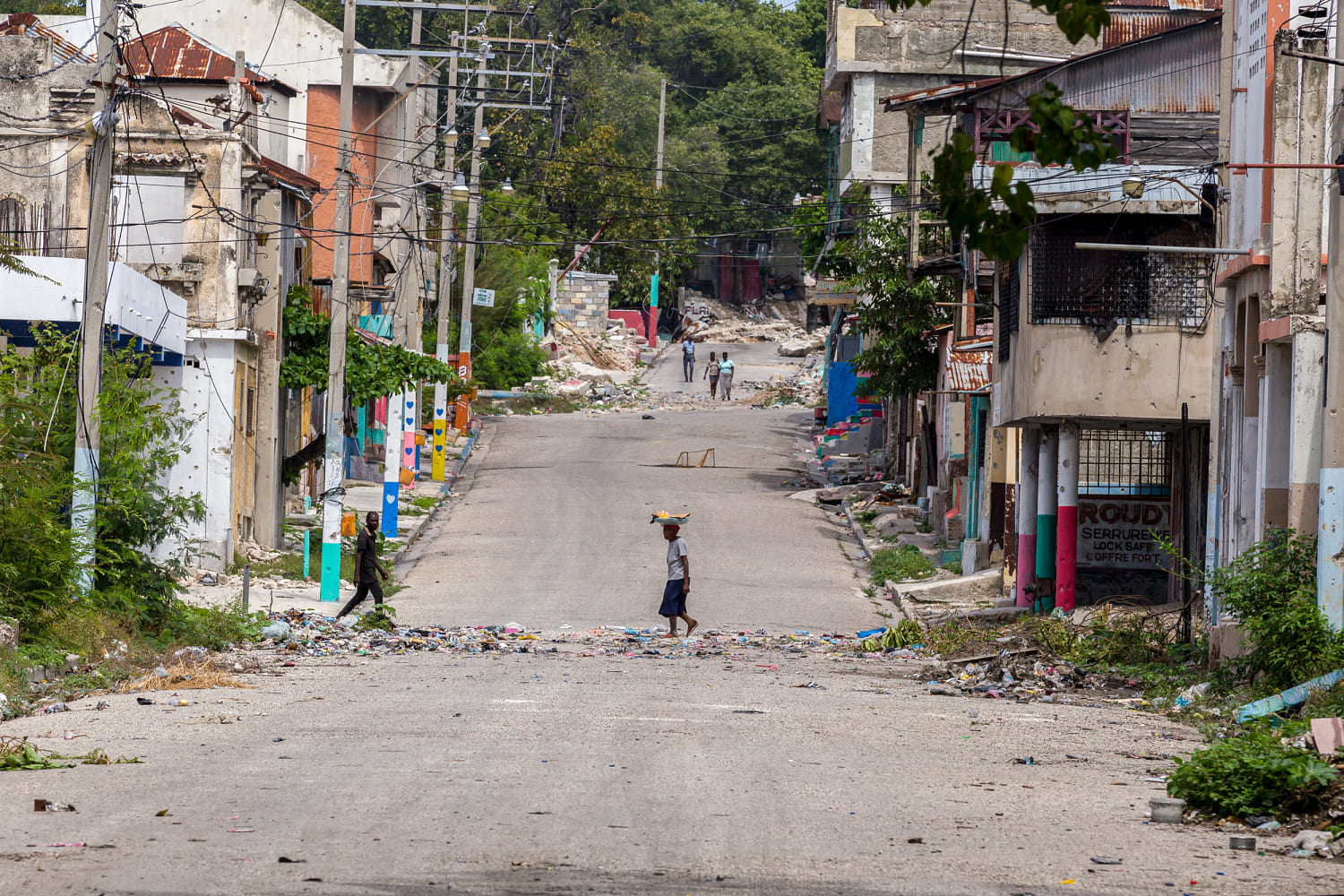
The abduction of a top security official in Port-au-Prince represents a structural shift in the operational strategy of Haitian gang coalitions, moving from indiscriminate economic kidnapping to targeted political extortion. When criminal syndicates breach the state's inner security perimeter, it signals that the traditional boundaries between sovereign authority and illicit actors have dissolved. This is not an isolated incident of urban lawlessness; it is a calculated execution of asymmetric warfare designed to systematically dismantle the state's remaining enforcement mechanisms.
To understand the trajectory of this crisis, analysts must abandon the narrative of chaotic violence and instead examine the cold operational logic driving these criminal syndicates. The escalation to high-level targets indicates that gangs have achieved a state of near-total territorial control, enabling them to project power into highly fortified zones. This shift redefines the security calculus for international intervention forces, domestic governance, and non-governmental organizations operating within the region.
The Escalation Matrix: From Economic Opportunism to Political Veto
Criminal organizations in hyper-unstable environments operate along an escalation matrix that dictates their choice of targets based on risk, resource availability, and strategic objectives. The transition from kidnapping low-profile civilians to abducting high-ranking state security personnel marks the final stage of this matrix.
- Stage 1: Fragmented Extraction (Low Risk, Low Reward): Gangs target localized civilian populations for small, immediate ransom payouts. This phase funds basic operational costs, small arms procurement, and territorial maintenance.
- Stage 2: Institutional Penetration (Medium Risk, High Reward): Targeting shifts toward mid-level bureaucrats, business owners, and humanitarian workers. The objective expands from capital accumulation to dictating the terms of local commerce and logistics.
- Stage 3: Sovereign Confrontation (High Risk, Strategic Reward): The abduction of top-tier security officials. The primary currency here is no longer cash, but political leverage, institutional immunity, and the demonstration of state impotence.
By neutralizing a high-level security asset, the gang coalition achieves a dual objective. First, it compromises the state's internal intelligence apparatus, as the captured official possesses critical operational data regarding deployment schedules, tactical vulnerabilities, and state informant networks. Second, it establishes a psychological veto over state decision-making. When the individuals tasked with managing national security cannot secure their own perimeters, the psychological foundation of state authority collapses.
The Cost Function of Urban Asymmetric Warfare
The expansion of gang networks across Port-au-Prince relies on a highly efficient cost function. Illicit coalitions capitalize on specific structural vulnerabilities within the Haitian state apparatus to minimize their operational risks while maximizing tactical yields.
Institutional Attrition and Resource Asymmetry
The Haitian National Police (PNH) suffers from chronic structural deficits that undermine its defensive capabilities. The resource asymmetry manifests in two distinct bottlenecks: logistical starvation and tactical immobility. Gang coalitions frequently possess superior firepower, utilizing smuggled automatic weapons that outclass the standard-issue equipment of state forces. Furthermore, the PNH operates under a fractured command-and-control architecture, where bureaucratic inertia delays response times, allowing mobile criminal units to execute high-profile operations and retreat into fortified enclaves before state forces can mobilize.
Territorial Enclavement
Port-au-Prince is geographically segmented into dense, highly defensible urban enclaves controlled by gang federations such as the G9 Family and Allies and the G-Pèp. These areas function as dense urban labyrinths where conventional military and police tactics are highly ineffective.
The architectural density and lack of formal infrastructure create a natural defensive barrier for criminal syndicates. When a high-level asset is moved into these zones, the cost of a state-led recovery operation escalates exponentially, requiring a level of urban combat capability that the domestic security forces currently lack.
Tactical Intelligence Asymmetry
The success of a high-level abduction requires precise, actionable intelligence regarding the target’s movements, security detail size, and route vulnerabilities. This indicates a profound level of institutional infiltration. Criminal syndicates leverage systemic corruption and economic desperation within the lower ranks of the state apparatus to purchase real-time telemetry. The state, conversely, operates in an information vacuum, lacking the signals intelligence (SIGINT) and human intelligence (HUMINT) networks required to preempt these highly coordinated operations.
The Geopolitical Bottleneck: Limits of International Intervention
The abduction of senior security personnel fundamentally alters the risk profile for foreign stabilization forces, specifically the Multinational Security Support (MSS) mission. The intervention strategy, initially designed to provide logistical and operational support to the PNH, faces structural limitations that prevent it from reversing the trajectory of institutional decay.
The first limitation is the mandate misalignment. International missions are structured around peacekeeping and capacity-building frameworks, which assume the existence of a viable state host willing and able to absorb assistance. When the host state’s security architecture is actively compromised from within, external forces cannot act as a mere force multiplier; they are forced to assume direct combat roles in hostile urban terrain, a scenario that contributing nations are politically averse to navigating.
The second limitation involves the tactical friction of urban counter-insurgency. Standard operating procedures for multinational forces prioritize force protection and collateral damage mitigation. Gang syndicates, conversely, utilize human shields and asymmetric urban ambush tactics. This creates a strategic bottleneck where international forces cannot deploy their full technological and kinetic advantages without causing massive civilian casualties, which would instantly delegitimize the mission both domestically and internationally.
Strategic Forecast: The Consolidation of a Parallel Sovereign
The current trajectory points toward the consolidation of a parallel sovereign authority within Haiti. This evolution is driven by the systematic degradation of state monopolies on violence and revenue collection.
[State Security Failure] ──> [Loss of Territorial Control] ──> [Gang Sovereign Consolidation]
         ▲                                                                 │
         └─────────────────── [Economic Infiltration] ─────────────────────┘
The capture of high-ranking officials is a clear indicator that the gang coalitions are transitionary entities evolving from predatory criminal networks into political actors demanding formal recognition. They are executing a strategy aimed at forcing the state into a negotiated settlement that grants permanent territorial concessions, amnesty for leadership cadres, and a de facto veto over future political appointments.
As the state's enforcement mechanisms continue to fray, economic entities operating within the country will be forced to adapt to this dual-sovereignty framework. Private enterprises, logistics providers, and humanitarian organizations will increasingly bypass state channels entirely, negotiating directly with territorial gang leaders for security guarantees and supply-chain access. This direct engagement further starves the legitimate state of revenue and legitimacy, accelerating the feedback loop of institutional collapse.
The primary variable determining the speed of this consolidation is the operational cohesion of the gang federations. Historically characterized by volatile internal rivalries, these syndicates have demonstrated an unprecedented level of strategic alignment under unified leadership structures. If these coalitions maintain their current operational unity, the formal Haitian government will find its authority restricted to a shrinking administrative zone in the city center, completely isolated from the broader economic and social realities of the nation.
To alter this trajectory, any security strategy must move beyond tactical skirmishes and focus on breaking the financial and intelligence linkages that sustain the syndicates. This requires strict maritime and border interdiction to halt the inflow of heavy weaponry, combined with aggressive forensic financial tracking to disrupt the laundering of ransom capital through legitimate commercial channels. Without dismantling the economic engine driving these syndicates, kinetic interventions will remain superficial, treating the symptoms of lawlessness while the structural rot of the state continues unabated.