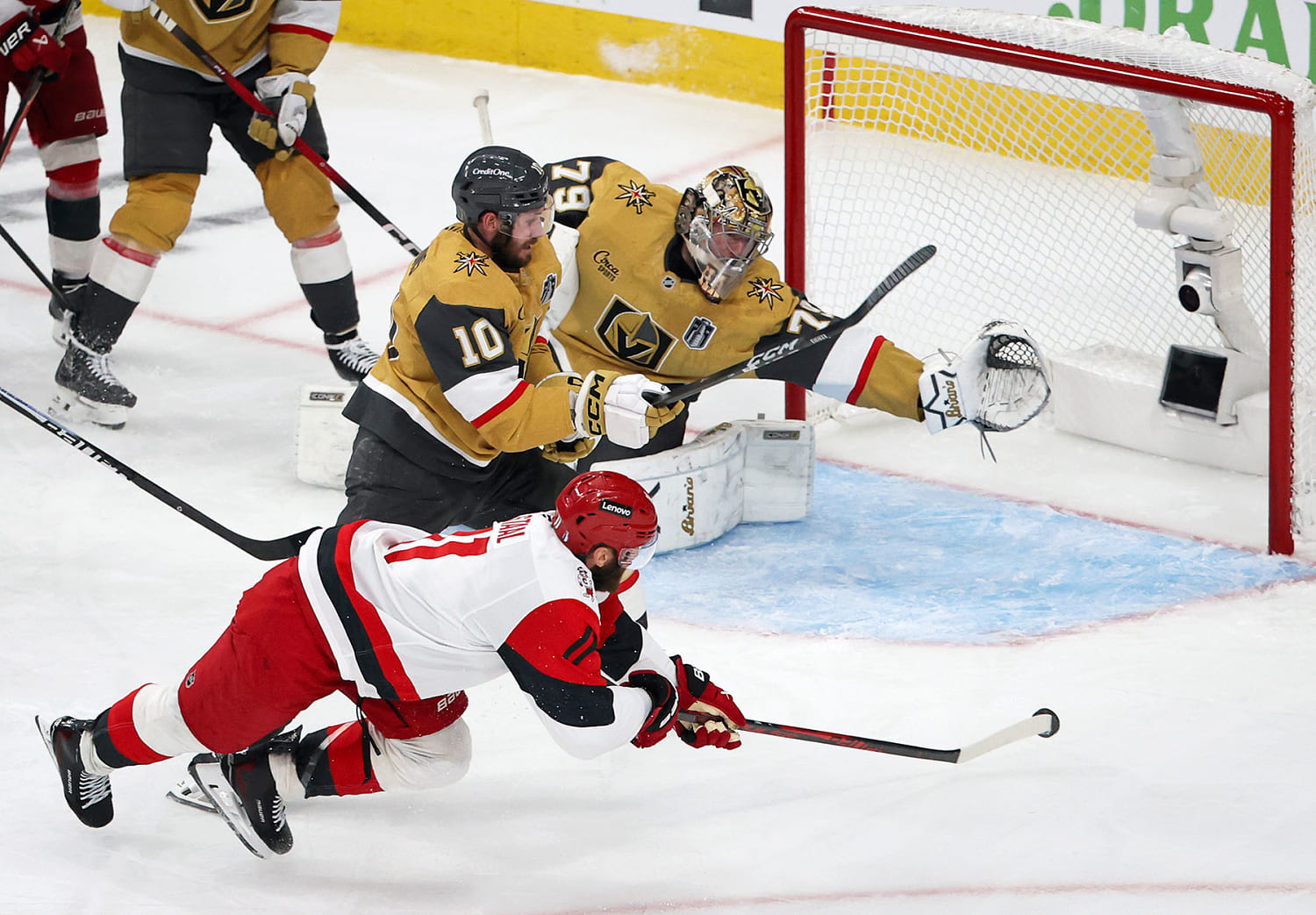
The outcome of Game 4 in the Stanley Cup Final was not decided by a sudden surge in momentum or an abstract desire to win. It was the mechanical byproduct of a tactical adjustment that neutralized high-event transition play. By restructuring their neutral-zone tracking and manipulating defensive-zone puck-retrieval cycles, Carolina choked out the counter-attacking sequences that dictated the early parts of the series. Winning a back-and-forth contest in the Stanley Cup Final requires a systematic reduction of variance, forcing the opponent to execute low-probability plays from low-danger areas.
To understand how the series shifted, the game must be deconstructed into three operational phases: spatial suppression in the neutral zone, structural integrity during structural breakdowns, and efficiency metrics behind high-danger scoring chances.
Spatial Suppression: Modifying the Neutral Zone Trap
The primary failure of Carolina’s opponent in Game 4 lay in their inability to generate clean entries across the blue line. In previous matches, they relied on a predictable but fast linear transition, utilizing a stretch pass to force Carolina’s defensemen into early pivots.
In Game 4, Carolina countered by altering their forechecking structure from a standard 1-2-2 to an aggressive, staggered 1-3-1 neutral-zone alignment.
This adjustment changed the geometry of the ice in three distinct ways:
- Forced East-West Lateral Passing: The center forward took away the primary vertical lane, forcing the puck carrier to pass laterally across the ice. This increased puck travel time and allowed the tracking wingers to close gaps prematurely.
- Defensive Denial at the Red Line: By stacking three players across the neutral zone, Carolina created a physical barrier that denied entry speed. Opposing forwards were caught flat-footed, eliminating their acceleration advantage.
- Predictable Dump-Ins: Denied a clean entry path, the opposing offense was forced to dump the puck into the corner. This played directly into Carolina's preferred defensive cycle.
This mechanical bottleneck reduced off-the-rush scoring opportunities by a significant margin. When an offense cannot gain the zone with possession, its scoring efficiency drops because it must spend valuable energy regenerating a cycle from a static position against a set defense.
The Cost Function of Defensive-Zone Breakdowns
When analyzing a back-and-forth game, observers often blame goaltending or individual defensive errors for goals scored. A more accurate model evaluates these breakdowns as a cumulative cost function derived from failed puck-retrieval cycles.
A team's defensive stability is inversely proportional to the time spent in their own zone under sustained pressure. During the second period of Game 4, Carolina’s opponent suffered a structural breakdown because of two distinct mechanical failures.
Weak-Side Rim Failures
The first failure occurred during puck retrieval along the boards. Instead of executing a direct D-to-D pass behind the net to reverse the pressure, the defensemen consistently attempted a weak-side rim up the glass. Carolina’s pinching defensemen anticipated this trajectory, trapping the puck at the blue line and keeping the defensive unit trapped on the ice.
Oxygen Depletion and Cognitive Friction
As defensive shifts extend past the 45-second mark, physiological fatigue introduces cognitive friction. Players begin to chase the puck rather than maintaining their positional zones. This opens up the high slot—the area directly between the faceoff circles. Carolina exploited this specific breakdown for their critical second-period goals, utilizing a low-to-high passing sequence that targeted defenders who failed to collapse toward the net front.
The Disconnect Between Shot Quantity and Shot Quality
A standard box score offers a distorted view of performance by treating all shots on goal as equal events. A data-driven analysis separates low-danger perimeter shots from high-danger chances inside the home plate area.
     _____________________________
    |             Net             |
    |       _____________/        |
    |      /             \        |
    |     /   High-       \       |
    |    /    Danger       \      |
    |   /     Zone          \     |
    |  /_____________________\    |
    |  |       Slot Area     |    |
    |__|_____________________|____|
In Game 4, Carolina's defensive strategy accepted a higher volume of low-danger perimeter shots to protect the high-danger scoring area.
The strategy succeeded because of systematic shot suppression mechanics:
- Stick-on-Puck Deflections: Carolina's defenders focused on taking away the passing and shooting lanes rather than delivering physical hits along the boards. This disrupted the pre-shot movement needed to shift the goaltender's eyes.
- Net-Front Clearing Cleans Visual Fields: By physically clearing the crease, Carolina allowed their goaltender to maintain a clean line of sight on long-range point shots. A set goaltender stops unscreened perimeter shots at a rate exceeding 95%.
- Elimination of Second-Chance Rebounds: The primary driver of high-event hockey is the second-chance opportunity. Carolina’s defensemen consistently boxed out opposing wingers, ensuring that any rebound was immediately cleared to the side boards, resetting the threat level to zero.
The opposing team’s offensive model relies on generating chaos through volume. By enforcing order and forcing shots from low-probability angles, Carolina dictated the terms of engagement, making the final score a predictable outcome of spatial management.
Exploiting Transition Deficiencies in the Third Period
As the game entered its final phase, the pressure shifted to the trailing team to force risky plays. Carolina's tactical framework adapted by transitioning from an active forecheck to a strict puck-management model designed to exploit the opponent's desperation.
When a team falls behind late in a Stanley Cup Final game, their defensemen begin to pinch down the walls prematurely to sustain offensive zone pressure. Carolina anticipated this behavior. By instructs their wingers to chip the puck off the glass and into the neutral zone, they created multiple odd-man rushes.
This approach exploits a fundamental flaw in high-risk offensive systems: they are entirely dependent on maintaining possession at the blue line. The moment that possession is broken, the structural positioning of the defensemen leaves the back end vulnerable to counter-attacks. Carolina’s third-period goals were not accidental counter-punches; they were the direct mathematical result of an opponent overextending their defensive resources to chase a deficit.
Operational Constraints and Series Outlook
Despite the success of Carolina's strategic pivot in Game 4, this model has specific operational limitations that will test its sustainability over a seven-game series.
The first constraint is the physical toll of the 1-3-1 trap. This system requires extreme discipline and constant skating from the forward units to close gaps. If Carolina's forward rotation suffers from fatigue or injuries, the execution of the trap will degrade, allowing the opponent's speed to puncture the neutral zone once again.
The second limitation is the reliance on officiating consistency. An aggressive neutral-zone interference threshold allows defenders to stretch the rules when disrupting entries. If the officiating standards shift in subsequent games to penalize marginal contact in the neutral zone, Carolina will be forced to back off their tight gaps, granting the opposition the clean entries they need to find their rhythm.
The optimal strategic path forward for the opposition requires a total abandonment of linear rush entries. To crack Carolina's defensive structure, they must implement a heavy diagonal dump-and-chase game that targets Carolina’s weaker-skating defensemen on the turn. By forcing Carolina's defense to retrieve pucks under heavy physical contact, they can re-establish the high-cycle game that won them earlier matchups. The team that wins Game 5 will not be the one that displays more emotional intensity, but the one that adapts its spatial geometry to exploit these structural vulnerabilities.