Mass youth mobilization in France operates as a recurring institutional pressure valve rather than an isolated eruption of generational anger. When hundreds of thousands of students and young workers occupy urban centers across Paris, Lyon, Marseille, and Bordeaux, standard news coverage treats the event as an emotional reaction to a single legislative bill or economic shock. That framing misses the underlying operational architecture. French youth protests are predictable outputs of a rigid dual-track labor market, centralized state governance, and high-density student union logistics that convert diffuse economic anxiety into synchronized street-level disruption within seventy-two hours.
Understanding these demonstrations requires stripping away surface-level slogans and analyzing the structural incentives driving participants, organizers, and the state. A mass turnout is rarely spontaneous. It represents the intersection of long-term socioeconomic friction and short-term political catalysts, executed through established mobilization networks that rely on physical blockades to extract policy concessions. Building on this topic, you can find more in: Inside the China Oman Diplomacy Shift Nobody Is Talking About.
The Structural Drivers of Generational Friction
Young adults in France face a distinct set of institutional bottlenecks that amplify the perceived stakes of any legislative reform affecting education, employment, or social security. Unlike economies with fluid entry-level hiring and low barriers to termination, the French labor model creates a sharp divide between protected permanent contracts (Contrat à Durée Indéterminée, or CDI) and precarious temporary arrangements (Contrat à Durée Déterminée, or CDD, alongside internships and gig work).
This dual-market structure shifts the burden of economic adjustment onto new entrants. When companies anticipate slower growth or higher regulatory costs, they freeze permanent hiring first. Young workers absorb the immediate shock through higher unemployment rates, delayed financial independence, and prolonged reliance on state subsidies or family support. Experts at Reuters have shared their thoughts on this trend.
Three specific pressures consistently prime the youth demographic for mass mobilization:
- The Credential-to-Employment Bottleneck: France maintains a heavily subsidized public university system that grants broad access to higher education without guaranteeing proportional labor market absorption. When the state proposes stricter university selection criteria, higher tuition tiers, or modifications to national diploma standards, students interpret these measures as an arbitrary narrowing of social mobility rather than administrative efficiency.
- Intergenerational Fiscal Asymmetry: In a state with high public expenditure and an aging population, pension and healthcare obligations consume an expanding share of national output. Reforms that raise the retirement age or alter contribution formulas are viewed by younger cohorts as a double penalty—requiring them to fund current beneficiaries while delaying their own entry into stable, full-time careers.
- Urban Housing and Cost-of-Living Compression: Student stipends (bourses) and entry-level wages frequently lag behind housing inflation in major university hubs. When real purchasing power erodes, minor reductions in housing allowances or transit subsidies trigger disproportionate financial stress, lowering the opportunity cost of skipping classes or shifts to join a march.
The Mechanics of Rapid Mobilization
A grievance alone does not put hundreds of thousands of people into the streets simultaneously across dozens of cities. Converting latent dissatisfaction into coordinated national action depends on organizational infrastructure unique to the French civic ecosystem.
Mobilization follows a repeatable operational sequence:
- The Institutional Trigger: The executive branch introduces a bill, invokes constitutional bypass mechanisms such as Article 49.3 to pass legislation without a parliamentary vote, or announces a decree affecting student status or labor rules. The use of executive bypass mechanisms acts as a force multiplier, transforming a technical policy dispute into a question of democratic legitimacy.
- Union and Student Federation Alignment: Major student unions—such as UNEF, FAGE, and high school syndicates like UNL or FIDL—coordinate with national trade union confederations (CGT, CFDT, FO, Solidaires). This alliance is critical. Trade unions provide legal permits, sound trucks, marshaling teams, and media amplification, while student groups supply high-energy foot traffic and campus-level organizing.
- Campus and High School General Assemblies: Before a national day of action (journée de mobilisation), local activists convene general assemblies (assemblées générales) at universities and lycées. Votes taken in these assemblies authorize localized strikes and physical blockades.
- Physical Choke-Point Execution: On the morning of a protest, small groups erect barricades using trash bins, fencing, or furniture at high school entrances and university gates. By physically preventing classes from proceeding, organizers artificially expand the pool of available demonstrators, turning passive observers into active participants in the afternoon march.
This blockade mechanism explains why high school participation often surges rapidly. Once a lycée is locked down by thirty activists, the remaining eight hundred students have nowhere to go, and a substantial fraction joins the nearest municipal protest route.
Asymmetrical Crowds and the Measurement Problem
Assessing the true scale of French demonstrations requires navigating a persistent statistical gap between state estimates and organizer claims. During major nationwide protests, figures reported by the Ministry of the Interior and those published by trade unions routinely diverge by a factor of two to three.
This discrepancy is not merely political spin; it stems from fundamentally different counting methodologies:
- Prefecture and Police Methodology: Law enforcement relies on overhead surveillance, fixed choke-point counters, and grid-density formulas applied to verified march routes. Police count individuals moving past specific checkpoints within a defined timeframe, excluding stationary onlookers and late arrivals.
- Organizer and Union Methodology: Confederations aggregate rough headcounts submitted by local chapters across hundreds of municipalities, often including participants at morning campus blockades, decentralized rallies, and peripheral gatherings that never pass police checkpoints.
Because neither metric captures total civic sentiment, strategists evaluate protest potency using secondary indicators rather than raw headcount alone:
- Geographic Dispersion: A march of 150,000 concentrated solely in Paris carries less political weight than 300,000 distributed across 150 medium-sized towns and regional capitals. Broad geographic spread signals that discontent has penetrated beyond traditional activist strongholds.
- Cross-Sector Convergence: When student marches synchronize with transit strikes, refinery blockades, and public sector walkouts, the economic cost of the mobilization escalates exponentially. Youth protests isolated from labor strikes rarely force policy reversals; youth protests fused with infrastructure stoppages create immediate governance crises.
- Duration and Cadence: A single massive turnout is survivable for an administration. Weekly or bi-weekly escalations that sustain high attendance over six to eight weeks test executive endurance and fracture parliamentary majorities.
Escalation Dynamics and Public Order Friction
Within every large French youth demonstration, two distinct operational tracks run in parallel: the declared union procession (cortège syndical) and autonomous radical blocs (cortège de tête or black bloc formations). Understanding the friction between these groups and riot police (CRS and gendarmes mobiles) is essential to analyzing protest outcomes.
The declared procession follows a pre-negotiated route negotiated between union marshals and the local police prefecture. Marshals maintain perimeter discipline, direct chants, and ensure the march terminates at a designated dispersal square.
Ahead of or alongside this main body, decentralized networks of radicalized youth operate without formal leadership. Their tactical objective is not symbolic representation, but direct confrontation with state symbols—bank branches, luxury storefronts, municipal infrastructure, and police lines. This creates an acute operational dilemma for law enforcement:
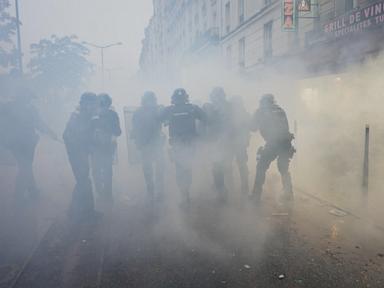
- Containment vs. Dispersal: Aggressive police charges or heavy tear gas deployment near the front of a march frequently spill backward into the peaceful student contingent. When uninvolved high schoolers experience indiscriminate tear gas or kettle tactics, moderate participants radicalize quickly, increasing turnout for the subsequent protest date.
- The Visual Narrative Trap: Media coverage disproportionately focuses on burning barricades and clashes at the head of the march. While violent imagery can alienate older, conservative voters, heavy-handed police responses captured on smartphone video simultaneously generate sympathy for young demonstrators and put the Ministry of the Interior on the defensive.
The Policy Feedback Loop and Strategic Limitations
For young protesters, street mobilization functions as a rational substitute for low electoral participation. French citizens aged 18 to 24 consistently exhibit the lowest voter turnout rates in national elections. Recognizing that their demographic weight at the ballot box is diluted by older, higher-turnout cohorts, youth movements rely on direct street pressure to exercise a de facto veto over unfavorable policies.
Historical precedent reinforces this behavior. From the withdrawal of the Devaquet university bill in 1986 to the repeal of the First Employment Contract (Contrat Première Embauche, or CPE) in 2006, French youth movements have demonstrated that sustained street mobilization can force prime ministers to abandon ratified or pending legislation.
Yet this strategy carries severe structural limitations:
- Veto Power Without Policy Design: Street protests excel at blocking specific bills, but they rarely produce coherent alternative legislation. Once a reform is withdrawn, the underlying fiscal or labor market dysfunction remains unresolved, guaranteeing that a future government will reintroduce a modified version of the same measure within three to five years.
- Coalition Fragmentation: Student unions and youth collectives are ideologically fractured across Trotskyist, anarchist, social-democratic, and nationalist lines. Maintaining tactical unity beyond a single defensive campaign proves nearly impossible, causing movements to collapse once the immediate legislative threat recedes or passes into law.
- Executive Insulation: Under the Fifth Republic's constitutional framework, a president with a functional parliamentary majority—or the willingness to survive no-confidence votes following Article 49.3 deployments—can wait out street protests if economic infrastructure remains operational. When the state absorbs the reputational damage without yielding, protest fatigue sets in, and attendance drops precipitously after the sixth or seventh week.
Strategic Forecast and Institutional Response
The recurrence of mass youth mobilization in France will not subside through public relations campaigns or minor legislative amendments. As long as entry-level labor markets remain insulated by rigid dismissal protections and public higher education operates without clear vocational pathways, every structural reform targeting pensions, labor flexibility, or university admissions will trigger predictable street opposition.
For institutional decision-makers, labor leaders, and policy analysts tracking European political risk, three operational realities govern the trajectory of these movements:
- Monitor Infrastructure Linkage Over Crowd Size: Disregard headline estimates of youth turnout unless they coincide with active work stoppages in rail transport, energy distribution, or waste management. Youth mobilization alone generates noise; youth mobilization paired with logistical bottlenecks forces legislative retreat.
- Track High School Blockade Counts as the Leading Indicator: University strikes build slowly, whereas lycée blockades scale overnight. A sharp spike in blocked high schools during the first forty-eight hours of a campaign reliably predicts whether national turnout will cross the threshold required to destabilize the government's legislative calendar.
- Anticipate Reform Sequencing Shifts: Future French administrations facing youth street vetoes will increasingly bypass omnibus parliamentary bills in favor of incremental regulatory decrees, targeted tax incentives, and local pilot programs—fragmenting the legislative target so student federations lack a single focal point around which to organize a nationwide shutdown.