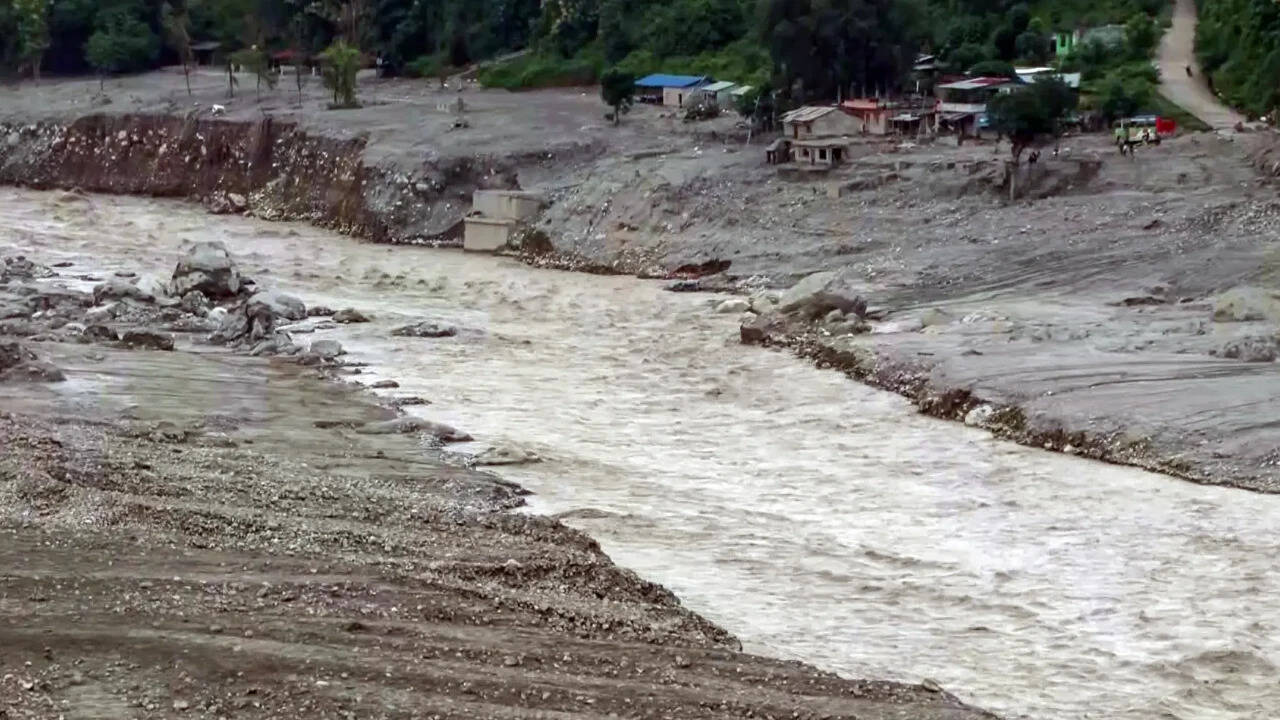
Disaster mitigation in mountainous terrain is rarely bottlenecked by meteorological tracking technology; it fails at the final mile of transmission. When sudden hydrological surges occur, the efficacy of an institutional emergency response is bounded by communication latency, infrastructure fragility, and bureaucratic friction. The preservation of 370 students and teachers during a severe flash flood in Nepal, triggered by an individual running through a school screaming a warning, exposes a critical operational truth about emergency management. Institutional warning systems often introduce a delay vector that human-in-the-loop decentralization bypasses entirely.
Understanding how a single localized alert outperformed regional automated protocols requires analyzing the physics of flash floods, the architecture of information propagation in rural schools, and the failure modes of centralized disaster response units. Also making headlines in related news: The Texas Manatee Migration Is Not a Novelty And That Is the Problem.
The Mechanics of Flash Flood Latency
A flash flood is defined by a rapid rise of water in a-water body, typically occurring within six hours of causative events such as heavy rainfall, dam failure, or ice jams. In steep river valleys, this timeframe contracts dramatically. Water volume accumulates through steep catchment areas, transforming a dry or shallow bed into a high-velocity debris flow in minutes.
The time window available for evacuation ($T_{evac}$) is a function of the distance from the source ($D$), the velocity of the flood wave ($V_{w}$), and the detection lag of the monitoring apparatus ($L_{det}$). More details into this topic are covered by NPR.
$$T_{evac} = \frac{D}{V_{w}} - L_{det}$$
In standard bureaucratic frameworks, $L_{det}$ is heavily inflated. Data must move from remote sensors or eyewitness reports to a central municipal office, be verified by an authority, trigger an administrative protocol, and then be disseminated down through a hierarchical chain of command. Each node in this institutional chain adds minutes of processing latency. When $L_{det}$ approaches or exceeds the travel time of the water wave, $T_{evac}$ drops to zero, rendering formal evacuation orders operationally useless.
The runner who breached the school perimeter eliminated institutional latency. By operating outside the chain of command, the informant reduced $L_{det}$ to near-zero. The physical intervention shifted the information bottleneck from a serial processing queue to a parallel broadcast model.
Information Propagation Failures in Institutional Hierarchies
Centralized emergency systems assume a reliable, high-bandwidth communication infrastructure. In rural or developing regions, this assumption is structurally flawed. Power grids fail early in severe weather events, cutting off cellular towers, internet routers, and municipal radio dispatchers.
When power fails, institutional systems experience total cascade failure. A top-down command structure cannot transmit a directive if the transmission medium relies on electricity. Decentralized human agents do not share this dependency. They rely on acoustic and visual signaling, which require zero auxiliary power.
Furthermore, institutional warnings suffer from the bystander effect and signal degradation. When an automated alert sounds—such as a distant siren or a mass text message—recipients often experience ambiguity regarding the severity and proximity of the threat. They look for social proof or confirmation before initiating a costly behavioral change like evacuation.
In contrast, a peer-to-peer physical warning delivered by a panicked individual inside a building carries immediate emotional and contextual weight. The recipient processes the signal not as a probabilistic warning, but as an immediate binary threat: run or perish. This bypasses the cognitive deliberation phase that delays evacuation in formal drills.
The Cost Function of Evacuation Decision-Making
To understand why human-driven alerts succeed where automated systems stall, we must examine the cost function of evacuation. Every evacuation incurs a cost—interruption of operations, loss of property, physical exhaustion, and potential false-positive embarrassment.
Rational actors balance the expected cost of false evacuation against the expected cost of inaction. In institutional settings, risk-averse managers wait for definitive proof of danger to minimize the cost of false positives. Unfortunately, by the time a flash flood provides definitive proof—such as water breaching the doorstep—the physical velocity of the water has already blocked egress routes.
A face-to-face warning alters the cost function by artificially inflating the perceived probability of catastrophe to one. The recipient does not calculate risk; they execute a pre-programmed survival heuristic.
Designing Resilient Localized Early Warning Nodes
Relying on random acts of civilian heroism is an insufficient strategy for systemic risk reduction. Communities must engineer redundancy into their early warning architectures by institutionalizing decentralized human nodes.
To operationalize this, vulnerable institutions must decouple their safety protocols from fragile telecommunication grids. First, physical line-of-sight monitoring posts should be established upstream from facilities at risk of rapid inundation. Second, communication protocols must allow any community member to trigger a local alarm without requiring administrative authorization. Bureaucratic gatekeeping during a high-velocity environmental crisis is a primary point of failure.
Emergency response planning must account for the reality that the first 300 seconds of a flash flood determine survival rates. Automated sensors and governmental text alerts serve a purpose for macro-level regional awareness, but they cannot replace the raw speed of a human runner intercepting a physical space before the water arrives.
Deploy resources toward training local spotters, establishing manual acoustic alarm systems, and empowering individuals to bypass institutional hierarchies the moment environmental anomalies are detected. The margin between safety and catastrophe is measured in seconds, and seconds are saved only by removing intermediaries from the chain of survival.