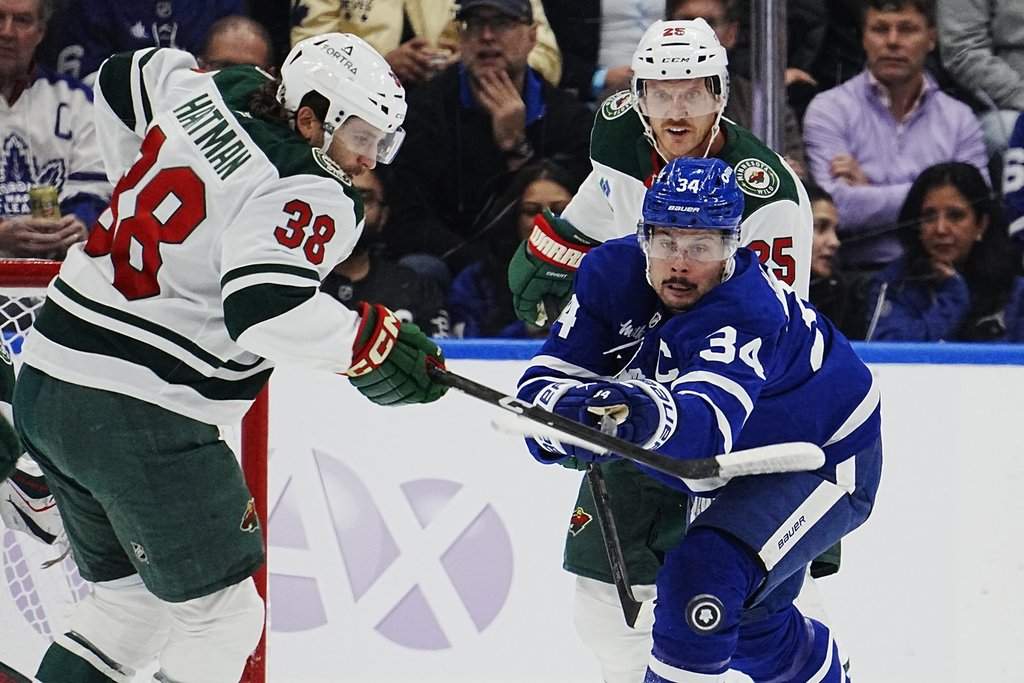
A five-game losing streak in the National Hockey League rarely stems from bad luck or an isolated slump in shooting percentage; it is the predictable output of compounding structural failures across three distinct zones of the ice. When the Toronto Maple Leafs drop five consecutive contests due to repeated unforced errors, the superficial narrative attributes the collapse to a vague lack of focus or generic "mistakes." That diagnosis fails to identify the underlying mechanics. In elite professional hockey, mistakes are not random anomalies; they are the downstream symptoms of broken spatial spacing, misaligned puck-support triangles, and systemic risk-reward miscalculations. To understand how a roster built around high-end offensive talent spirals into a multi-game skid, analysts must replace emotional post-game cliches with an operational audit of decision-making under pressure, transition defense, and structural discipline.
The Taxonomy of Unforced Errors
Standard sports reporting treats all turnovers and defensive lapses as equal units of failure. Operational analysis requires segmenting these errors into distinct categories based on their root causes and expected goals against (xGA) impact. A five-game losing streak driven by self-inflicted wounds typically involves three specific failure modes. For a more detailed analysis into similar topics, we recommend: this related article.
1. Execution Errors Under Low Pressure
An execution error occurs when a player possesses time, space, and clear sightlines, yet fails to complete a routine mechanical play—such as missing a tape-to-tape outlet pass or mishandling a stationary puck at the offensive blue line. In isolation, a single execution error is a statistical inevitability over an 82-game schedule. However, when execution errors cluster across multiple lines simultaneously, they indicate cognitive overload. Players begin rushing routine plays because they no longer trust the structural positioning of their teammates. Instead of scanning the ice to confirm a lane, the puck carrier forces a pass into a predetermined area, resulting in an immediate turnover.
2. Structural Misalignment and Spacing Failures
Structural errors occur before the puck even arrives at a player's stick. Modern NHL defensive systems rely on tight five-man cohesion, maintaining specific distance thresholds between the defensemen and the supporting forwards. When the Maple Leafs suffer extended breakdowns in their own zone, the root cause is frequently a widening gap between the defensive pair retrieving the puck below the goal line and the centerman tasked with providing a low-post outlet. If the forwards vacate the defensive zone early—a habit known as "cheating for offense"—the defensemen are left without short-range passing options. Forced to attempt high-risk, long-range stretch passes through congested neutral-zone traffic, the defensemen inevitably turn the puck over. The box score assigns the giveaway to the defenseman, yet the structural failure belongs to the forward group. For further context on this topic, extensive reporting is available at NBC Sports.
3. Decision-Making and Risk-Reward Miscalculations
High-skill rosters naturally skew toward aggressive, high-variance plays. During winning streaks, high-risk lateral passes through the slot or pinching defensemen at the offensive blue line generate high-danger scoring chances. During a losing streak, the exact same risk profile becomes catastrophic. Decision-making errors happen when players fail to adjust their risk tolerance to the game state. Attempting a low-percentage, east-west pass inside the offensive zone while protecting a one-goal lead, or forcing a play through double coverage at the end of a long shift, converts controlled possession into an immediate odd-man rush against.
The Compounding Cost Function of Transition Breakdowns
To understand why these mistakes prove fatal across a five-game sample, one must examine the mechanics of NHL transition play. Ice hockey is a continuous-flow game where possession changes trigger immediate shifts in defensive vulnerability. The cost of a turnover is not uniform; it scales exponentially based on the location of the loss and the velocity of the players involved.
Consider the mechanics of an offensive-zone blue-line turnover. When a team establishes possession in the attacking zone, its defensemen step up to hold the line, and its forwards cycle low, often positioning themselves below the faceoff dots. All five skaters have their momentum oriented toward the opponent's net. If a forward attempts a low-percentage pass to the point that gets intercepted by an opposing winger, the spatial geometry flips instantaneously. The opposing winger accelerates into open ice with forward momentum, while the defending players must pivot, arrest their forward velocity, and skate backward against a developing rush.
This creates a severe temporal and spatial deficit:
- The Reaction Lag: The defending players lose roughly 0.5 to 1.0 seconds processing the change of possession and transitioning from offensive posture to defensive pursuit. At NHL skating speeds, a one-second delay translates to 25 to 30 feet of uncontested ice for the attacking team.
- The Numerical Disadvantage: Because the attacking forwards were deep in the offensive cycle, they are completely removed from the backcheck. A single mistake at the blue line routinely manufactures a three-on-two or two-on-one rush against the defending goaltender.
- The Goaltender Exposure: Odd-man rushes force the goaltender to respect both the shooter and the backdoor pass option. Lateral puck movement across the royal road—the imaginary line connecting the two faceoff dots down the center of the slot—forces the goaltender to slide across the crease, drastically reducing save percentages regardless of the netminder's baseline talent.
During a five-game skid, the cumulative weight of these transition breakdowns erodes team confidence. Once players recognize that every minor turnover results in a high-danger rush against, they begin playing tentatively. Tentative play slows down puck movement, allowing opposing forecheckers to close space faster, which in turn generates more turnovers. The mistake becomes a self-reinforcing feedback loop.
Psychological Contagion and Grip-Stick Mechanics
In high-performance athletics, individual errors rarely remain isolated within a single line or defensive pair. Across a multi-game losing streak, performance degradation spreads through the bench via psychological contagion—a documented phenomenon in organizational psychology where stress and anxiety transfer rapidly among team members operating in high-stakes environments.
When a team drops three or four consecutive games, the bench environment shifts from proactive execution to error avoidance. This distinction is critical. Proactive execution focuses on achieving a positive outcome, such as penetrating the middle of the ice or establishing a forecheck. Error avoidance focuses entirely on not being the player responsible for the next goal against.
The physiological consequences of error avoidance are measurable on the ice:
- Increased Muscle Tension: Anxiety triggers a sympathetic nervous system response, increasing tension in the forearms and hands. In hockey, tight grip mechanics destroy puck control, causing pucks to bounce over sticks on routine receptions and reducing shot accuracy.
- Tunnel Vision: Under acute stress, peripheral vision narrows. A defenseman retrieving a puck behind the net who suffers from stress-induced tunnel vision fixates on the immediate forechecker rather than scanning the weak side for an open winger. The result is a panicked rim around the boards directly to an opposing point man.
- Shift Extension: Desperate to compensate for earlier mistakes, top-end players frequently overextend their shifts, staying on the ice for 65 to 80 seconds instead of the optimal 40 to 45 seconds. Fatigue degrades anaerobic recovery, leading to sloppy stick penalties—hooking, tripping, and slashing—when tired players reach for opponents instead of moving their feet.
Special teams inevitably suffer during this cycle. Taking unnecessary fatigue-induced penalties puts an already stressed penalty-killing unit on the ice repeatedly. Meanwhile, the power play—which relies on fluid, relaxed puck movement and creative deception—becomes static and predictable, telegraphing passes from the perimeter because players fear losing possession and yielding a shorthanded breakaway.
Diagnostic Blind Spots in Coaching and Roster Deployment
When a team loses five straight games to self-inflicted errors, the coaching staff faces an immediate diagnostic dilemma: are the mistakes a personnel issue or a systemic issue? Misdiagnosing the root cause leads to tactical adjustments that exacerbate the losing streak.
A common coaching reflex during a skid is line juggling—blending forward combinations and defensive pairings in search of a spark. While line juggling can temporarily disrupt complacency, it frequently worsens structural errors. Elite chemistry relies on implicit communication: knowing where a linemate will be without looking. Disrupting established pairs forces players to spend extra milliseconds verifying positions before passing, slowing down breakout execution against aggressive forechecks.
A second diagnostic trap is over-indexing on defensive shell tactics. When a high-offense roster bleeds goals due to turnovers, coaches often instruct players to simplify their game by chipping pucks off the glass and out of the zone rather than executing controlled exits. While chipping the puck out eliminates immediate defensive-zone turnovers, it surrenders possession voluntarily. Against structured NHL opponents, surrendering possession simply invites another wave of attack within ten seconds. You cannot defend your way out of a losing streak if you refuse to hold the puck; you merely extend the amount of time spent in your own end, increasing the probability of another defensive lapse.
Furthermore, goaltending performance becomes impossible to evaluate cleanly during a systemic collapse. A goaltender posting a sub-.880 save percentage over a five-game stretch looks statistically culpable on the surface. Yet if the skaters in front of the net are yielding double-digit high-danger chances off broken plays, screen shots, and backdoor tap-ins, the goaltender's metrics are merely reflecting the team's structural failure. Benchings or goalie rotations under these conditions treat the symptom while leaving the disease untouched.
The Structural Limits of Talent-First Roster Construction
Every losing streak exposes the inherent architectural trade-offs of a roster. Teams constructed with heavy capital allocation toward elite offensive forwards operate on a specific economic and tactical thesis: superior puck possession and finishing talent will outscore defensive vulnerabilities over the long run.
This model performs reliably across large sample sizes when execution is sharp. However, it carries a specific structural fragility: low margin for error when puck management slips. Because the roster relies on skill-based exits and possession-heavy entries rather than heavy, low-event forechecking, any dip in passing accuracy immediately strips the team of its primary defensive mechanism—keeping the puck away from the opponent. Without a fallback identity built on physical, grind-it-out neutral-zone clogging, a skill-dominant team looks uniquely disorganized when its execution falters.
The limitation of relying on pure offensive talent to break a slump is that individual skill cannot override broken five-man spacing. A superstar forward cannot deke through three defenders in the neutral zone if his defensemen failed to make a clean five-foot outlet pass. Until the foundational mechanics of support distances and puck protection are restored, individual brilliance remains stranded on the perimeter.
Tactical Remediation Protocol
Breaking a five-game losing streak driven by unforced errors requires an immediate, disciplined reset of on-ice priorities. The coaching staff and leadership group must abandon broad motivational speeches and implement a strict operational protocol focused on spatial control and risk management.
- Mandate Five-Foot Support Triangles: During defensive-zone retrievals, the center and strong-side winger must collapse below the tops of the circles to provide two immediate, short-range passing outlets for the puck-retrieving defenseman. Long stretch passes to the far blue line must be banned until the team strings together two consecutive periods of clean, controlled zone exits.
- Enforce Strict 40-Second Shift Caps: Eliminate shift extensions entirely, particularly for top-six forwards. Fresh legs prevent the late-shift fatigue that causes mental lapses, missed assignments, and stick penalties. Rolling four lines with disciplined shift lengths restores tempo and forces opponents to defend against sustained pace.
- Establish Hard-Rim and Below-the-Goal-Line Offensive Entries: When crossing the offensive blue line under pressure, ban east-west lateral passes inside the top of the zone. Puck carriers must drive the puck deep behind the opponent's goal line, forcing the opposing defensemen to turn and absorb physical contact on the forecheck. Getting pucks behind the defense eliminates blue-line turnovers and stops odd-man rushes before they start.
- Isolate and Simplify Special Teams Entries: Strip the power play back to a single, repeatable zone-entry pattern—such as a structured drop-pass to a speeding carrier—followed by an immediate emphasis on shot volume and net-front recovery rather than searching for low-percentage cross-seam passes.
Executing this protocol will not immediately produce aesthetic, highlight-reel hockey. It will, however, eliminate the high-cost turnovers feeding the opponent's transition game, stabilize goaltending exposure, and re-establish the structural baseline required for high-end talent to take over games once again.