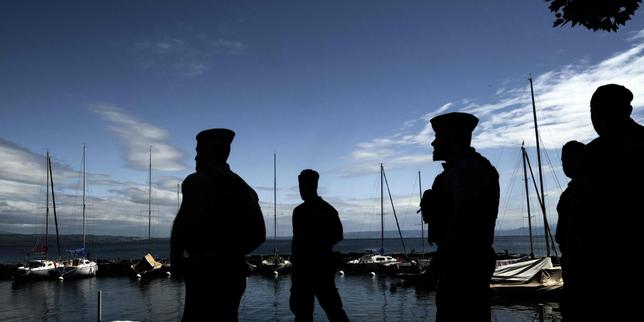
The fatal collision in Haute-Savoie involving a G7 Republican Guard motorcycle escort highlights a systemic fragility in high-security transit protocols: the optimization of speed and protection invariably compromises structural safety margins. When a convoy maneuvers through public infrastructure, it operates not as a collection of independent vehicles, but as a singular, highly volatile kinetic system. The death of one gendarme and the severe injury of two others during a VIP escort mission underscores the reality that tactical success in security logistics depends on a delicate equilibrium between three competing variables: route closure integrity, kinetic energy management, and situational communication redundancy.
Analyzing this incident requires looking past the immediate tragedy to examine the operational mechanics of mobile protection units. Security details for international summits like the G7 do not fail because of a lack of personnel or equipment; they fail due to the compounding risks inherent in mixed-speed, multi-vehicle formations navigating unpredictable civilian topography.
The Tri-Linear Risk Framework of Mobile Escorts
Mobile security operations rely on three independent operational pillars. A degradation in any single pillar creates an exponential increase in systemic risk, often culminating in catastrophic mechanical or human failure.
                  [Tactical Velocity]
                          / \
                         /   \
                        /     \
                       /       \
  [Structural Isolation]-------[Inter-Vessel Telemetry]
1. Structural Isolation (Route Integrity)
The primary defense of a moving convoy is physical separation from the surrounding environment. In high-security escorts, this isolation is dynamic rather than static. Outriders and advance units must establish a rolling block, temporarily sealing intersections, roundabouts, and access points ahead of the main VIP transport capsule.
The breakdown of structural isolation occurs when civilian traffic penetrates this moving perimeter. In mountainous or semi-rural terrain like Haute-Savoie, blind curves, rapid changes in elevation, and limited sightlines compress the time window available for outriders to clear a path. If a civilian vehicle enters the convoy's path, the entire security formation must adjust its trajectory instantly, shifting the risk burden entirely onto the second pillar: kinetic energy management.
2. Tactical Velocity and Kinetic Energy Management
Convoys travel at elevated speeds to minimize the window of vulnerability to static threats. However, high velocity creates a severe trade-off in braking distance and directional control, particularly for motorcycle outriders.
The kinetic energy ($E_k$) of a vehicle increases with the square of its velocity ($v$), as dictated by the fundamental equation:
$$E_k = \frac{1}{2}mv^2$$
For a 300-kilogram police motorcycle traveling at tactical speeds, any sudden alteration in the leading vehicle's velocity forces a chain-reaction deceleration down the line. Because motorcycles lack the physical stability and impact absorption of armored support SUVs, they serve as the most vulnerable nodes in the formation. When the leading elements of a convoy encounter an unexpected obstacle, the deceleration wave travels backward through the formation. If the following distances are compressed to maintain a tight security perimeter, the reaction time approaches zero, making a multi-vehicle pileup mathematically probable.
3. Inter-Vessel Telemetry and Communication Redundancy
A high-security convoy functions as a distributed network. Every node—from the advance scout to the rear guard—must maintain real-time awareness of the formation's collective velocity and vector changes.
In topographically challenging environments, line-of-sight communication can fail, and radio latency can delay critical warnings by vital fractions of a second. If a lead vehicle brakes hard to avoid a hazard, the trailing motorcycles rely on immediate visual cues (brake lights) or instantaneous radio callouts. A delay of even 500 milliseconds at highway speeds translates to dozens of meters of un-alerted travel, eliminating the safety buffer between escort riders.
The Compounding Physics of Multi-Vehicle Impact
The Haute-Savoie accident demonstrates the lethal nature of compounding momentum within tightly packed formations. When multiple motorcycles travel in a staggered or linear security formation, their operational profiles are interdependent.
- The Deceleration Cascade: In a standard highway formation, vehicles maintain a safe following distance based on human reaction time. In a tactical escort, this distance is intentionally compressed to prevent civilian vehicles from cutting into the convoy. When an anomaly occurs at the front of the formation, the required braking force increases exponentially for each subsequent vehicle in line.
- Vector Deviation Constraints: A motorcycle rider facing an immediate obstacle has two options: maximum braking or evasive steering. In a convoy environment, evasive steering is severely restricted. Deviating to the left may push the rider into oncoming civilian traffic; deviating to the right may cause a collision with the armored VIP vehicles they are protecting. This constraint forces riders into hard braking maneuvers that risk locking the wheels or losing traction, particularly on mountain roads where asphalt grip varies due to temperature and altitude.
- Mass Asymmetry: A significant hazard in mixed convoys is the mass disparity between the transport assets. A typical armored limousine or support SUV weighs between 3.5 and 5 metric tons. A police motorcycle, including the rider and gear, weighs less than 450 kilograms. In any scenario where a motorcycle collides with a support vehicle, or is pinned between two heavier assets, the laws of conservation of momentum dictate that the lighter vehicle absorbs the vast majority of the kinetic energy transfer, resulting in catastrophic structural failure of the motorcycle and fatal forces applied to the rider.
Operational Vulnerabilities in Summit Security Deployment
The deployment of regional forces for macro-level events like a G7 summit introduces secondary operational friction points that contribute to tactical failures.
Personnel Fatigue and Cognitive Overload
Summit security requires extended operational shifts, often spanning several consecutive days. Escort riders must maintain hyper-vigilance while managing high-horsepower machinery under intense stress. Fatigue dulls peripheral vision and slows cognitive processing by vital milliseconds. When navigating complex routes under time pressure, a fatigued rider is more likely to misjudge the closing distance between their asset and the vehicle ahead.
Integration of Non-Homogeneous Units
Large-scale events frequently require the integration of different departmental units—such as local departmental gendarmerie, specialized republican guard units, and national police escorts. Although these units operate under similar foundational doctrines, subtle differences in training, signaling protocols, and tactical communication habits can manifest as coordination friction during high-stress maneuvers.
Strategic Re-Engineering of Convoy Protocols
Mitigating the inherent risks of high-speed security escorts requires shifting away from reliance on human reaction times and moving toward structural, technology-driven safeguards.
Implementation of Active Proximity Telemetry
The integration of specialized LiDAR or radar-based proximity warning systems tailored for tactical formations can eliminate the latency of human perception. These systems do not take control away from the rider; instead, they provide instantaneous haptic or visual alerts the exact millisecond a leading vehicle's deceleration rate exceeds a safe threshold, preserving precious reaction time.
Dynamic Buffer Allocation
Fixed-distance convoy formations are fundamentally flawed when traversing variable terrain. Protocol must mandate dynamic buffer allocation, where the distance between escort motorcycles and the central capsule automatically expands and contracts based on real-time telemetry data, including vehicle speed, road grade, and surface moisture levels.
[Low Speed / Urban Terrain] -> Compress Buffer (Maximize Security Closure)
[High Speed / Mountain Terrain] -> Expand Buffer (Maximize Kinetic Safety Margin)
By institutionalizing a fluid formation model, security details can preserve the lives of their operational personnel without compromising the core defensive posture of the VIP capsule. The Haute-Savoie incident stands as a stark reminder that in the calculus of tactical transit, the laws of physics remain an absolute constraint that no level of security authority can override.
To systematically address these vulnerabilities, operational commands must execute three immediate tactical adjustments on all future high-profile transit deployments. First, replace rigid linear formations with a staggered, multi-lane matrix that provides outriders with clear, unobstructed escape lanes in the event of sudden deceleration. Second, integrate automated road-surface scanning units into the advance scout vehicles to transmit real-time friction coefficient data to trailing riders via heads-up displays. Third, establish strict maximum operational shift limits for motorcycle personnel, enforcing a hard ceiling of four consecutive hours of active escort duty to prevent the cognitive degradation caused by physical and mental exhaustion. Implementing these structural changes shifts the operational framework from a reliance on flawless human execution to a resilient, system-level safety design.