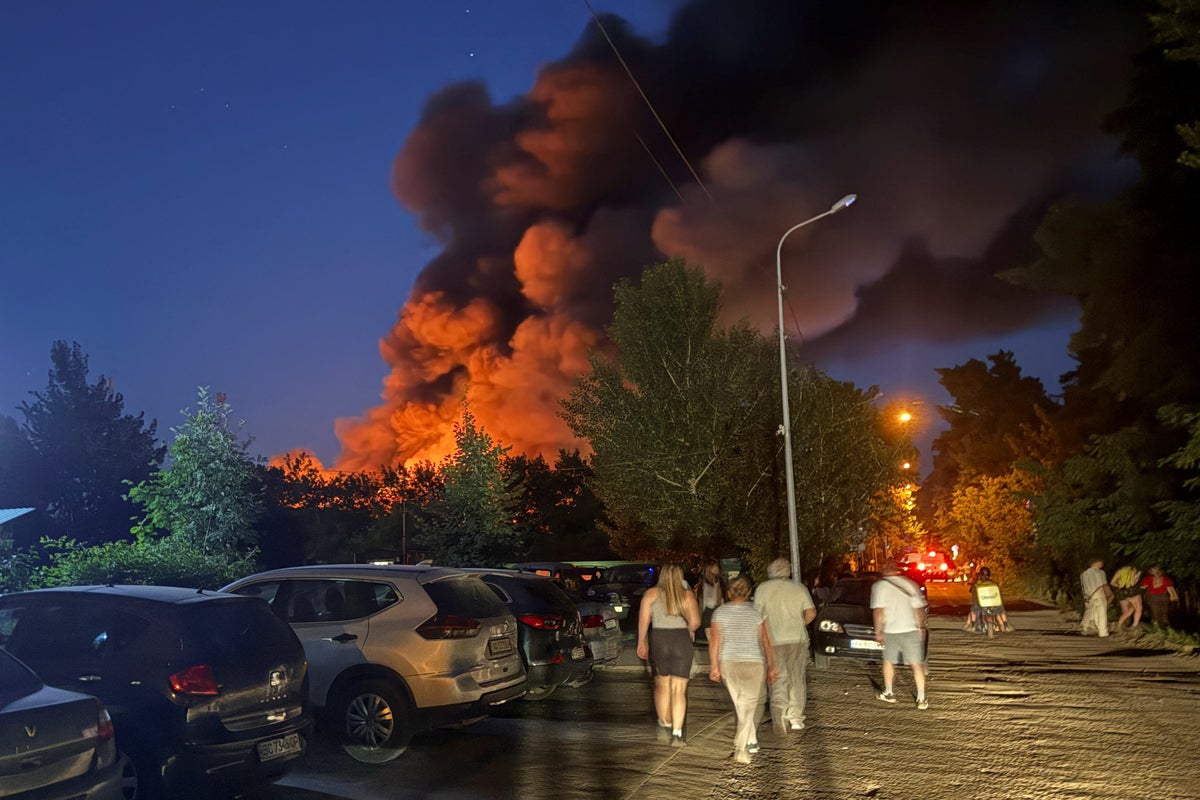
The strategic calculus of the Russia-Ukraine war shifted fundamentally with Kyiv's transition from reactive border defense to a synchronized, time-delimited deep-strike offensive. This operation is not characterized by isolated, symbolic drone raids, but rather by a high-density kinetic campaign explicitly designed to exploit vulnerabilities in Russia’s domestic air defense architectures and choke its defense-industrial output. The baseline blueprint of this strategy was made clear on June 27, 2026, when Ukrainian forces deployed domestically produced FP-5 Flamingo cruise missiles against the Federal Research and Production Center Titan-Barrikady in Volgograd, a critical node 600 miles east of the Ukrainian border. By examining the mechanics of this strike alongside parallel disruptions to the Russian energy supply chain, we can map the exact cause-and-effect vectors driving Kyiv’s 40-day influence campaign.
The Tri-Axis Attrition Framework
The operational logic governing Kyiv’s expanded deep-strike strategy relies on three distinct tactical vectors. When executed simultaneously, these vectors create systemic compounding failures across the Russian military apparatus.
                  [ CO-DEPENDENT TARGET MATRIX ]
                                |
        +-----------------------+-----------------------+
        |                       |                       |
        v                       v                       v
[ Production Nodes ]    [ Logistics Chokepoints ]  [ Protection Arbitrage ]
(Titan-Barrikady)       (Vtorovo Station / Ferries)  (Forced Redeployment)
1. Primary Industrial Deconstruction
The strike on the Titan-Barrikady facility targets the root of Russia's heavy military manufacturing. This defense enterprise specializes in the production of heavy artillery systems and specialized self-propelled launchers for strategic ballistic missile platforms, specifically the Iskander-M, Yars, and Topol-M. By using intermediate-range cruise missiles like the Flamingo FP-5 to physically destroy assembly workshops, Ukraine bypasses the delays associated with international economic trade barriers. The kinetic degradation of an industrial plant creates immediate upstream bottlenecks, interrupting the replacement cycle of heavy missile launchers faster than raw component supply lines can adapt.
2. Downstream Logistics Deprivation
Simultaneously, the strike vectors target transportation and energy distribution networks that feed active combat theaters. The synchronized operation included an SBU drone strike on the Vtorovo oil pumping station in the Vladimir region, a facility that pumps diesel fuel into the Moscow Ring Oil Product Pipeline and onwards to major distribution centers feeding the Baltic Sea and western military hubs.
When paired with strikes on roll-on/roll-off transport assets, such as the Petropavlovsk car ferry near Kerch in occupied Crimea, the operational outcome is a localized supply failure. The degradation of fuel transport nodes forces the Russian military to rely on less efficient, highly vulnerable road transport assets, directly constricting the daily tonnage of fuel and munitions reaching frontline tactical units.
3. Air Defense Protection Arbitrage
The third axis is structural rather than physical. By expanding the geographic envelope of attacks to cities like Ufa (930 miles from the front lines), Volgograd, and Cheboksary, Kyiv forces the Russian General Staff into an acute asset-allocation dilemma. Russia's available inventory of modern surface-to-air missile systems, such as the S-400 and Pantsir-S1, is finite.
To protect high-value state infrastructure in Moscow, St. Petersburg, and presidential residences like Valdai, military planners must strip air defense assets away from peripheral industrial corridors and active logistics routes. This displacement creates vast, undefended corridors across Russia's interior, making subsequent intermediate-range missile and drone penetrations increasingly viable.
Quantification of the Kinetic Dilemma
The tactical scaling of Ukrainian long-range capabilities can be directly measured by the sheer volume of assets required to saturate and exhaust Russian interception systems.
[ Air Defense Saturation Curve ]

   High ^                                 * (660 Drones)
        |
        |                           * (556 Drones)
Volume  |
        |
    Low +----------------------------------------------->
        May 2024                 May 2025               June 2026
Data compiled from localized engagements reveals a deliberate upward trajectory in saturation thresholds. During a single multi-region operational window, Russian air defense systems faced an influx of 660 Ukrainian aerial units across twelve distinct provinces. This marks a clear escalation from the previous high of 556 units recorded in mid-May 2025.
The structural cost function of this saturation strategy is unfavorable to the defender. Russia is forced to expend high-cost, low-inventory surface-to-air interceptors against mass-produced, low-cost loitering munitions. Once a local air defense envelope is depleted or overloaded by the initial drone wave, Ukraine introduces high-speed cruise missiles, such as the Flamingo, to deliver heavy payloads directly onto industrial targets.
Systemic Limitations and Operational Risks
Despite the clear tactical successes of the Volgograd and Vladimir operations, the strategy contains fundamental structural limits that prevent it from being a definitive solution.
- The Production Squeeze: Domestically produced precision cruise missiles like the Flamingo require advanced microelectronics and propulsion systems that remain vulnerable to international supply chain blockages. Scaling production under constant threat of retaliatory strike packages remains an unsolved industrial bottleneck for Kyiv.
- The Sovereign Sanctuary: The entire 40-day campaign is designed around an extreme political constraint. Ukraine remains bound by diplomatic agreements with Western partners restricting the use of foreign precision-guided munitions inside internationally recognized Russian territory. This forces Kyiv to shoulder 100% of the research, development, and manufacturing costs for the intermediate-range systems used in these deep strikes, limiting the overall volume of fire.
- The Escalation Pivot: Striking deep within the Russian interior alters the domestic political math for Moscow. Rather than deterring aggression, intense pressure on civil energy infrastructure and manufacturing plants has galvanized hardline nationalist factions. This accelerates calls for total state mobilization or the deployment of tactical non-strategic nuclear assets, threatening to widen the scope of the war beyond manageable parameters.
The Strategic Play
Kyiv’s current military objective is not the immediate, total destruction of the Russian armed forces through deep strikes; rather, it is the systematic inflation of the war's economic and material cost to force a diplomatic recalculation in Moscow. By degrading major refinery infrastructure, like the Moscow oil refinery, and taking critical heavy weapons plants offline, Ukraine is creating a structural resource deficit that will intersect directly with Russia's autumn combat operations.
The definitive play for the next 30 days will center on whether Ukraine can maintain this high-volume launch rate. If Kyiv successfully sustains this saturation campaign through the end of the 40-day window, the resulting domestic fuel shortages and localized air defense vacuums will open clear opportunities for localized Ukrainian counter-offensives along the southern and eastern front lines. Moscow will be forced to either scale back its frontline offensive operations to conserve shrinking fuel reserves or accept an exposed, undefended domestic airspace.