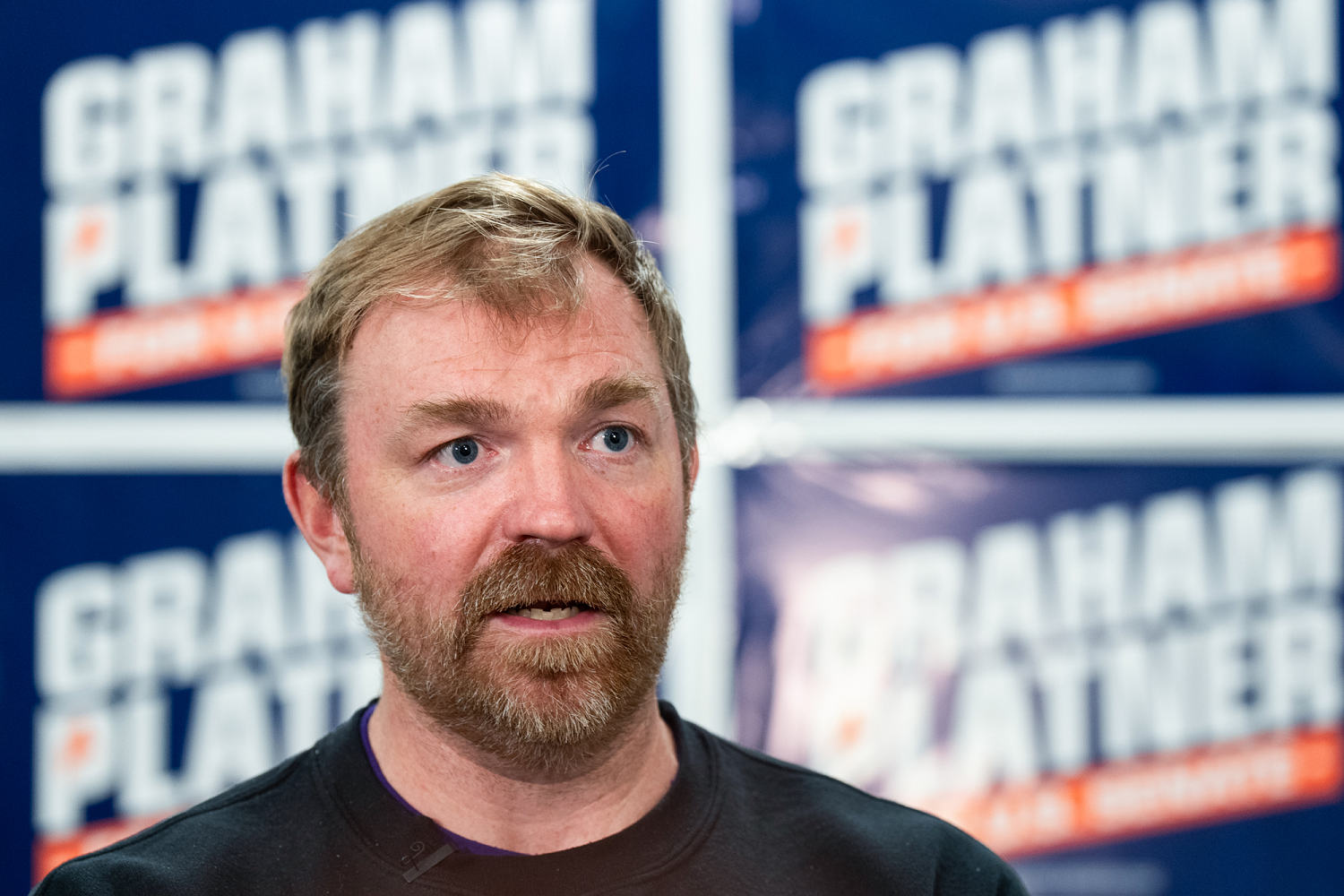
Graham Platner stands at a podium that feels too small for the weight of the words he is about to drop. He isn’t just another candidate in a sharp suit reciting the approved script of a political consultant. He looks like a man who has stayed up too late reading the fine print of a contract the American public never actually signed. When he speaks about the Supreme Court or the former President, he isn't just talking about legal filings. He is talking about the foundation of the house we all live in.
The air in the room changes when he says it. Impeachment. Investigation.
These are heavy, jagged words. They are the kind of words that break things. But Platner’s argument is that the things are already broken; we are just the last ones to admit it.
Consider the average person—let's call her Sarah—who works a job in a town where the factory closed ten years ago. Sarah doesn’t spend her mornings refreshing SCOTUSblog. She doesn't have a Google Alert for the Federalist Society. But she feels the downstream effects of their decisions every time she seeks healthcare, every time she looks at her paycheck, and every time she wonders if her vote actually moves the needle. For Sarah, the "integrity of the court" isn't an abstract legal theory. It is a question of whether the rules apply to the people at the top the same way they apply to her.
Platner is betting his political life that Sarah is tired of the silence.
The Architect and the Sledgehammer
The core of Platner’s platform isn't just a grievance; it’s an audit. He is calling for an aggressive investigation into Donald Trump, framed not as a partisan hit job, but as a necessary accounting of what happens when executive power meets a vacuum of accountability.
To Platner, the legal battles surrounding the former President aren't distractions. They are the main event. He views the attempt to overturn the 2020 election not as a singular moment of madness, but as a stress test that the system barely passed. He argues that if we don't examine the cracks now, the next hit will bring the whole ceiling down.
But the real fire in his eyes appears when he turns his gaze toward the marble pillars of the Supreme Court. Specifically, Justices Clarence Thomas and Samuel Alito.
The standard political move is to offer "grave concerns" or "disappointment" in their rulings. Platner has no interest in standard moves. He is calling for their impeachment.
It is a radical stance. It is a move that makes traditionalists in Washington flinch and reach for their pearls. The Supreme Court is supposed to be the "least dangerous branch," the one sheltered from the winds of politics by lifetime appointments. But Platner argues that this very shield has been turned into a sword.
He points to the revelations of undisclosed luxury gifts, the private jet travel funded by billionaire donors, and the flags flown over personal residences that signal deep-seated political biases. To Platner, these aren't just ethical lapses. They are a betrayal of the basic deal between the governed and the governors.
Imagine a referee in a championship game. Now imagine that referee is wearing the jersey of the home team under his black-and-white stripes. Would you trust the final score? Would you even stay to watch the second half?
The High Cost of Looking Away
The skepticism toward Platner’s plan is easy to find. Critics say he is "tilting at windmills," or that he is radicalizing a process that should be handled with surgical precision. They worry that impeaching justices or aggressively pursuing a former President sets a precedent that will turn the American legal system into a carousel of retribution.
Platner’s rebuttal is simple: The precedent has already been set by those who broke the rules, not by those trying to enforce them.
He speaks with the urgency of a mechanic who sees smoke coming from the engine while the driver is insisting they just need to turn up the radio. The facts are cold and immovable. Justice Thomas accepted gifts for decades without disclosure. Justice Alito’s impartiality has been called into question by his own public statements and symbolic gestures. These are not rumors. They are entries in a ledger of declining public trust.
The invisible stake here is the concept of "the consent of the governed."
Laws only work because we all agree to follow them. We stop at red lights at 3:00 a.m. even when no one is looking because we believe in the system of traffic safety. But if the person who designed the lights is caught taking bribes from the green-light company, the whole social contract begins to fray. People start running the lights. They start making their own rules.
The Human Toll of a Tainted Bench
We often talk about the Supreme Court as if it exists in a vacuum of leather-bound books and Latin phrases. But their decisions are the physical boundaries of our lives.
When a justice votes on environmental regulations, a child with asthma in a coal town breathes differently. When they vote on labor laws, a father decides whether he can afford to take a day off to see his daughter’s play. When they vote on the limits of presidential immunity, they are deciding whether the person in the Oval Office is a neighbor or a monarch.
Platner’s push for impeachment isn't about policy disagreements. He isn't calling for their removal because he dislikes their judicial philosophy—though he certainly does. He is calling for it because he believes the bench has become a clubhouse for the elite, far removed from the consequences of their own rulings.
He tells stories of people who have lost faith. He talks about the cynicism that sits in the gut of the American voter like a lead weight. That cynicism is the real enemy. It’s the quiet voice that says, "Why bother? The fix is in."
Platner wants to kill that voice.
A Gamble on the Truth
Running for Senate on a platform of "investigate and impeach" is a high-wire act without a net. It alienates the donors who want stability. It scares the centrists who want a quiet life. But Platner seems to understand something that the "business as usual" crowd has missed: the silence is getting too loud.
He is betting that there is a hunger for a candidate who treats the crisis of democracy with the same gravity as a house fire. He isn't offering a ten-point plan for incremental change. He is offering a bucket of water and a way out of the building.
The logic is jarringly direct. If a President tries to subvert an election, they must be investigated. If a Supreme Court Justice accepts millions in benefits from those with business before the court, they must be removed.
It sounds like common sense until you realize how rarely it is actually said in the halls of power.
Platner’s journey is a reflection of a broader American realization. We are discovering that the "guardrails" we were told would protect us are actually just lines painted on the road. They only work if someone is willing to steer the car.
As he travels from town to town, the narrative he builds isn't one of despair, but of a brutal kind of hope. It is the hope that comes from finally looking at a wound and deciding to clean it, rather than just covering it with a fresh bandage. He is challenging the idea that we are helpless spectators in the decay of our own institutions.
The man at the podium isn't just asking for a vote. He is asking for a reckoning.
He knows that the road ahead is paved with procedural hurdles, political roadblocks, and a media cycle that favors soundbites over substance. He knows that the people he is targeting have more power than he does. But he also knows that power is a borrowed thing. It belongs to the people until they decide to take it back.
The room is silent as he finishes. It isn't the silence of boredom. It is the silence of people realizing that the "standard" way of doing things is no longer an option. The choice isn't between Platner and a moderate alternative. The choice is between an uncomfortable truth and a comfortable lie.
In the end, Graham Platner is holding up a mirror to the American system and asking us if we like what we see. If the reflection is distorted, if the glass is cracked, if the frame is rotting—maybe it's time to stop trying to fix the mirror and start fixing the reality it shows.
The house is shaking. The wind is howling through the gaps in the door. We can pretend the storm isn't coming, or we can start reinforcing the walls. Platner has made his choice. Now he is waiting to see if anyone is willing to pick up a hammer and join him.