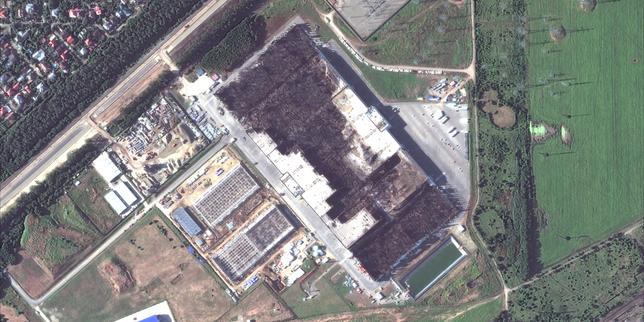
The ongoing transformation of modern armed conflict is defined less by direct theater engagement and more by systemic disruption of civilian-commercial supply chains. Recent kinetic strikes targeting the distribution infrastructure of major retail platforms inside the Russian Federation illustrate a fundamental shift in targeting methodology. Rather than focusing strictly on military-industrial nodes, modern deep strike strategies target dual-use commercial assets to degrade macro-economic stability and force multiplication capacity.
Deconstructing this operational shift requires analyzing the vulnerabilities of hyper-scaled retail logistics networks under asymmetric attack.
The Three Pillars of Commercial Logistics Vulnerability
Commercial e-commerce infrastructure optimized for rapid consumer fulfillment inherently possesses structural vulnerabilities when subjected to military targeting. These vulnerabilities are defined by three distinct operational characteristics: geographic centralization, spatial footprint, and inventory heterogeneity.
+------------------------------------------------------------+
|                LOGISTICS VULNERABILITY MATRIX              |
+----------------------------+-------------------------------+
| Vector                     | Operational Impact            |
+----------------------------+-------------------------------+
| Geographic Concentration   | Single-point supply failure   |
| High-Density Footprint     | Accelerated fire propagation  |
| Dual-Use Inventory Storage | Blurring of civilian targets  |
+----------------------------+-------------------------------+
The first vulnerability stems from geographic concentration. To minimize delivery times and optimize transport costs, modern retail giants consolidate inventory into massive regional distribution centers. These hubs serve as choke points for entire federal districts. When a single facility spanning tens of thousands of square meters is compromised, the downstream disruption affects millions of end consumers and breaks regional supply continuity.
The second vulnerability is the physical footprint required to maintain high throughput. Modern fulfillment hubs are engineered as sprawling, single-story clear-span structures dominated by high-bay racking systems, automated sorting machinery, and vast quantities of polymer-based packaging materials. This architecture maximizes interior volume but creates an optimal environment for rapid fire propagation when breached by explosive ordnance or incendiary drone debris.
The third vulnerability involves inventory heterogeneity. Mega-retailers like Wildberries function as logistics backbones that absorb diverse product categories, ranging from consumer goods to dual-use technical items utilized across broader state supply chains. The sheer density of stored commodities ensures that kinetic impacts generate catastrophic secondary detonations and multi-day structural fires that overwhelm municipal emergency response capabilities.
The Economic Cost Function of Distributed Disruptions
Evaluating the macro-economic impact of targeting commercial distribution hubs involves calculating the friction introduced into the national supply chain. Traditional military cost-benefit analyses focus on the replacement value of physical assets. In asymmetric retail logistics warfare, the real damage resides in systemic friction.
The total cost function is determined by three variables: asset replacement expenditure, inventory write-offs, and supply chain rerouting penalties. While corporations often report that localized fires leave portions of stored goods intact, the thermal and smoke damage frequently results in total inventory write-offs due to contamination risks.
Cost Function = C(Asset) + C(Inventory) + C(Friction)
Supply chain rerouting introduces exponential operational penalties. When a primary distribution center in a region such as Voronezh or the Urals is forced offline, incoming inventory must be redirected to secondary facilities hundreds or thousands of kilometers away. This redirection strains regional transportation fleets, increases fuel consumption, extends delivery lead times, and degrades customer retention metrics for the platform operator.
The Mechanics of Long-Range Asymmetric Targeting
Executing precision strikes at distances exceeding one thousand kilometers from contested borders requires a specialized technological and operational architecture. The methodology relies on low-cost, long-range unmanned aerial systems capable of autonomous navigation via satellite or inertial guidance systems designed to bypass electronic warfare countermeasures.
The strategic rationale for prioritizing commercial logistics hubs over heavily defended military installations involves return on investment. Conventional military assets are typically protected by layered air defense networks, hardened shelters, and active electronic suppression systems. Conversely, commercial logistics parks, by virtue of their civilian classification and vast geographic spread, present softer profiles with predictable perimeter security.
By shifting targeting vectors toward these commercial nodes, an attacking force achieves three operational objectives simultaneously:
- Degradation of domestic economic confidence through visible infrastructure failures.
- Creation of logistical bottlenecks that absorb state emergency and security resources.
- Interruption of secondary supply networks utilized by auxiliary state apparatuses.
Operational Limitations and Defensive Adjustments
No strategic doctrine operates without friction or limitation. Deep strike campaigns against retail infrastructure face diminishing returns as defenders adapt their posture.
The primary limitation of this strategy is the transient nature of inventory displacement. Unlike permanent heavy manufacturing plants or oil refineries, e-commerce inventory is inherently mobile and constantly distributed across thousands of local pickup points and smaller sorting facilities. Destroying a centralized hub disrupts macro-logistics temporarily, but it does not permanently eliminate the underlying commercial network's ability to reconstitute operations in alternative locations.
Defensive adaptations by retail operators typically involve decentralizing high-value inventory, hardening internal fire suppression systems, and establishing redundant node capacity. However, these mitigations impose a permanent operational tax, driving up capital expenditure and eroding profit margins.
Strategic Outlook
The systematic targeting of scaled commercial infrastructure marks a permanent evolution in the character of modern conflict. As supply chains become primary instruments of national resilience, the boundary separating civilian enterprise from strategic depth dissolves entirely. The long-term trajectory points toward increasingly automated, resilient, and subterranean or hardened commercial logistics models designed to withstand persistent asymmetric attrition.


