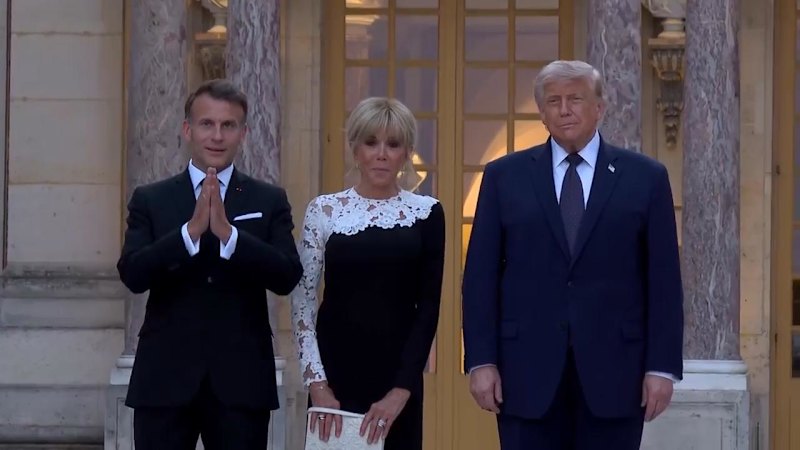
The deployment of state architecture as an instrument of bilateral coercion is a foundational tenet of asymmetric diplomacy. French President Emmanuel Macron’s invitation to U.S. President Donald Trump for a private dinner at the Palace of Versailles, immediately following the G7 summit in Évian-les-Bains, represents a calculated attempt to alter the cost-benefit calculus of American foreign policy. By leveraging high-prestige physical environments, the French state seeks to generate symbolic capital capable of offsetting structural deficits in economic and military leverage. This mechanism operates on the premise that personal deference and spatial grandiosity can modulate the decision-making variables of an administration structurally resistant to traditional multilateral pressure.
The strategic utility of this encounter is defined by acute geopolitical friction. The structural relationship between Washington and Paris is currently stressed by fundamental misalignments across trade, security, and technology. The U.S. administration's unilateral military engagements, specifically the war in Iran initiated on February 28 without allied consultation, have destabilized European security architectures. Simultaneously, threat perceptions regarding Ukraine remain unaligned, while the immediate threat of a 100% U.S. tariff on French wine—designed to force the retraction of Paris’s digital services tax on American technology firms—creates a zero-sum economic bottleneck.
To parse the true efficacy of the Versailles dinner, the interaction must be evaluated through a three-part analytical framework: spatial optimization, transactional alignment, and domestic cost structures.
The Architecture of Spatial Optimization
State visits utilize architectural space to impose a psychological asymmetric advantage. The selection of Versailles, the historical epicenter of absolute monarchy under Louis XIV, serves two distinct diplomatic functions:
- Ego Inflation as a Negotiating Variable: Foreign policy analysts identify a distinct pattern in the American president's diplomatic preferences: a high responsiveness to aesthetic prestige and overt displays of respect. By orchestrating a sequence that includes the golden gates, a guided tour of the Hall of Mirrors, and an exhibition on historic Franco-American relations, the French executive explicitly attempts to build personal goodwill. The objective is to transition the counterparty from an adversarial posture to a collaborative one before hard policy vectors are introduced.
- The Historic Continuity Defense: By officially framing the dinner as a celebration of the 250th anniversary of American independence—highlighting France’s foundational role in the Revolutionary War—Macron establishes a historical path dependency. This framing creates an implicit cognitive obligation, reminding the U.S. executive that American sovereignty is historically intertwined with European alliances.
Transactional Alignment and the G7 Bottleneck
The dinner acts as an extension of the G7 summit, designed to resolve gridlocks that cannot be defused in a multilateral setting. In a smaller, bilateral environment, the probability of achieving transactional alignment increases. Three core files dominate this specific cost function:
1. The Iran Conflict and Maritime Security
The unilateral escalation of the Iran war by the United States and Israel created a profound rift with European allies. However, the operational reality of winding down the conflict requires European participation. The strategic play at Versailles centers on maritime security, specifically the de-mining of the Strait of Hormuz. While France previously refused to deploy warships to support unilateral U.S. actions, a fragile ceasefire introduces a new operational variable. Paris and London have indicated an interest in assisting with de-mining operations, provided the pause in conflict is formalized. Macron’s goal is to trade European operational support in the Persian Gulf for a binding commitment from Washington to include allies in post-conflict architecture.
2. The Wine Tax and Digital Services Friction
The economic bottleneck is highly direct. The U.S. threat of a 100% tariff on French wine is an enforcement mechanism aimed at dismantling France’s digital services tax, which penalizes major U.S. tech conglomerates. In this arena, the asymmetry favors the United States due to the scale of its consumer market. Macron’s strategy relies on a firm, non-retractive posture, attempting to decouple tech regulation from agricultural trade by offering alternative bilateral tax harmonization talks. The limitation of this strategy is that it assumes the U.S. executive views these two markets as structurally distinct, whereas the administration consistently uses cross-sectoral tariffs as baseline leverage.
3. The Artificial Intelligence Governance Divide
The final day of the G7 summit highlighted a sharp divergence regarding the regulation of generative artificial intelligence and social media safety. European leaders, moving toward strict regulatory frameworks including proposed bans on social media for children under 16, face resistance from the U.S., which prioritizes market dominance and corporate expansion for entities like OpenAI and Anthropic. At Versailles, France aims to pitch a unified transatlantic security standard to counter Chinese AI deployment, shifting the narrative from market restriction to geopolitical competition.
The Domestic Cost Function of Flattery
The primary risk of high-prestige diplomacy is the domestic political cost incurred by the host. The strategy of accommodating a disruptive foreign leader creates severe friction within the French domestic landscape.
The French left, led by figures within La France Insoumise and the Communist Party, has characterized the Versailles dinner as an act of obsequious capitulation. The domestic critique states that rolling out the red carpet for a leader who has repeatedly attacked French economic interests and mocked the French executive represents a net loss in national sovereignty. This domestic polarization restricts Macron’s margins. If the dinner fails to produce concrete concessions—such as a formal suspension of the wine tariffs or a multilateral commitment on Iran—the event will be weaponized domestically as an expensive, submissive spectacle that yielded zero structural return.
The structural limitations of this diplomatic methodology are clear. Asymmetric diplomacy via prestige assumes that superficial deference can override deep-seated economic nationalism and structural shifts in geopolitical strategy. While the architecture of Versailles may successfully delay sudden negative policy actions, such as immediate tariff implementation, it rarely alters long-term structural trends. The transactional nature of the current U.S. administration means that goodwill generated in a historical palace is highly volatile and depreciates the moment the executive exits the French airspace.
The optimal strategic play for the French executive is to exit the Versailles summit with a joint communique that commits the United States to a bilateral working group on trade and maritime security. This formalization binds the fluid, transactional impulses of the American presidency into a structured bureaucratic process, effectively converting the transient prestige of the dinner into durable institutional leverage.