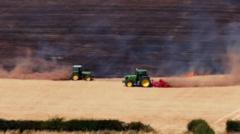
When wildfire breaches the perimeter of industrial or agricultural interfaces, emergency services face immediate capacity constraints. The Stourbridge fire incident demonstrated a structural reliance on private capital and decentralized assets—specifically local farming equipment—to solve public sector resource deficits. Municipal fire services operate under fixed capital expenditure limits and predetermined staffing models designed for baseline statistical probabilities. When an extreme localized event exceeds these parameters, the marginal cost of public intervention spikes instantly. Private agricultural machinery bridges this structural deficit, functioning as an uncompensated auxiliary reserve for civil defense.
Decentralized operational assets lack formal integration into standard incident command protocols. Farmers deploy heavy machinery based on localized situational awareness and ad-hoc communication networks rather than centralized dispatch directives. This creates a coordination friction point between professional incident commanders and independent operators. Understanding the mechanics of rural crisis intervention requires examining how private agricultural capital absorbs public infrastructure shock during extreme weather events.
The Resource Allocation Deficit in Rural and Semi-Urban Zones
Public fire suppression systems rely on geographic coverage models calibrated for average response times and standard structural hazards. These models assume uninterrupted access to municipal water mains and predictable road networks. When an environmental fire spreads across open stubble fields or dry acreage surrounding semi-urban corridors like Stourbridge, municipal infrastructure faces three concurrent bottlenecks.
First, water volume accessibility drops rapidly outside municipal hydrant grids. Standard fire appliances carry finite storage capacity, requiring continuous drafting from open sources or long relay lines. Second, topography restricts heavy vehicle mobility. Traditional fire engines lack the ground clearance and tire traction necessary to navigate unpaved terrain, stubble, or uneven gradients. Third, unit economics dictate staffing limits. Maintaining a permanent municipal workforce sized to contain rare, multi-acre environmental fires creates an unsustainable fiscal burden for local municipalities.
Independent agricultural operators solve these structural failures by deploying high-capacity, off-road mechanical assets directly to the fire front. Tractors pulling heavy cultivation discs or water bowsers do not merely supplement municipal capability; they execute functions that standard emergency vehicles cannot perform.
[Municipal Fire Apparatus] ---> Constrained by Hydrants & Paved Access ---> High Friction in Open Terrain
[Agricultural Machinery]  ---> Optimized for Off-Road & Soil Manipulation ---> Low Friction in Open Terrain
Mechanized Containment Mechanics
The tactical contribution of farming equipment centers on soil manipulation and kinetic firebreak creation. Combustible fuel continuity drives wildfire propagation. Without a continuous bed of dry organic matter, a fire front stalls and loses thermal intensity.
Agricultural operators deploy three primary categories of equipment during a crisis:
- Tractors paired with heavy disc harrows: Cultivating the topsoil strips the organic surface layer, exposing mineral earth. This creates an immediate, non-combustible barrier that halts surface fire creep.
- High-capacity agricultural bowsers: Transporting thousands of liters of water directly across unpaved terrain allows operators to suppress spot fires ahead of the primary front, protecting perimeter assets before municipal units can reposition.
- Telehandlers and front-end loaders: Moving round or square straw bales away from high-risk zones eliminates fuel clusters that generate extreme radiant heat fluxes capable of igniting secondary structures.
These interventions alter the thermodynamic equation of the fire. By converting a continuous fuel bed into isolated patches separated by mineral soil, agricultural actors reduce the rate of spread to zero within their operational footprint.
The Governance and Liability Vacuum
While decentralized intervention yields high tactical value, it operates within a severe regulatory and operational vacuum. Private citizens utilizing heavy machinery near active fire zones assume substantial personal and financial risk without formal institutional protection.
Emergency services operate under strict statutory frameworks regarding safety, equipment certification, and personnel training. Independent farmers possess deep operational competence in handling their machinery, but they lack formal certification in incident command structures, toxic smoke mitigation, and fire behavior prediction. This introduces a dual risk profile.
Asset Capability: High (Immediate containment, localized mobility)
Institutional Integration: Low (Ad-hoc deployment, unmapped coordination)
Liability Exposure: Asymmetric (Private risk absorption for public benefit)
When an untrained operator enters an active fire zone, they introduce variable risk into the incident commander's operational calculus. A tractor positioned incorrectly can block emergency egress routes, draw limited municipal water supplies into unverified lines, or become trapped by shifting wind vectors, turning a containment asset into a rescue liability.
Furthermore, insurance structures rarely account for the commandeering or voluntary deployment of commercial agricultural assets in civil emergencies. Damage sustained to a quarter-million-dollar tractor during a firefighting operation falls outside standard commercial agricultural policies unless specific endorsements exist. The economic model currently depends on uncompensated altruism and informal risk absorption by the private sector to correct public infrastructure shortfalls.
Systemic Optimization Pathways
Relying on crisis-driven improvisation is a sub-optimal strategy for civil defense. As environmental volatility increases the frequency of dry-season agricultural fires, municipalities must transition from ad-hoc reliance to structured public-private integration.
Integrating agricultural assets into municipal civil protection frameworks requires three structural shifts.
- Pre-Incident Asset Mapping: Regional emergency services should maintain secure inventories of heavy agricultural machinery within their jurisdiction, cataloging equipment type, location, towing capacity, and operator contact protocols.
- Standardized Interoperability Protocols: Establishing communication bridges between incident command channels and prominent local agricultural networks ensures that tactical deployments occur via direct instruction rather than spontaneous convergence.
- Indemnification and Cost-Recovery Models: Creating transparent legal frameworks that guarantee equipment insurance coverage and operational compensation removes the financial friction that currently deters or penalizes proactive civilian participation.
Failing to formalize these pathways leaves rural resilience exposed to the whims of coincidence. When the next thermal spike pressures municipal boundaries, the system will again depend on whether private operators choose to risk their capital to fill the void left by public underinvestment. The strategic priority moving forward is to codify this operational interdependence into standard operating procedures before the next baseline capacity failure occurs.