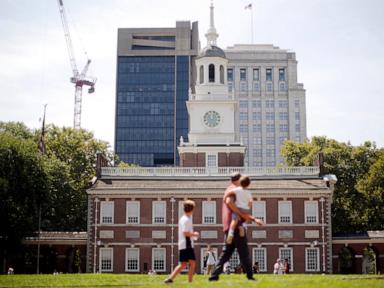
A precision-milled stainless steel cylinder weighing 900 pounds will sink ten feet into the dirt of Philadelphia's Independence National Historical Park. It is the official America 250 time capsule, a congressionally mandated snapshot of a fractured nation slated for exhumation on July 4, 2276. While public relations broadcasts champion the vessel as a chest of pure optimism, the inventory list reveals a deeper, more complicated reality. Inside lies a raw psychological profile of a country caught between technological hubris and institutional anxiety, desperately trying to prove to the future that it survived.
The contents read like an eclectic junk drawer of the American psyche. Arkansas sent a raw diamond. Maine contributed a fragment of a bone from an endangered North Atlantic right whale. Arizona used advanced nano-etching to burn the entire U.S. Constitution onto a single stainless steel coin, while California surrendered its agency to an artificial intelligence chatbot, sealing a printed machine-generated prediction of what the state will look like in two and a half centuries.
Beneath the quirky variety of these regional offerings lies a highly calculated exercise in survival engineering. The true story of the Semiquincentennial capsule is not what we are saying to the future, but how desperately we are trying to ensure our voice does not rot before it gets there.
The Chemistry of Forgetting
Time capsules are historically a catalog of engineering disasters. The fundamental flaw of civic preservation has always been a lack of respect for basic thermodynamics. When the Bicentennial era of 1976 triggered a craze of burying locked trunks and copper boxes across municipal lawns, local committees unwittingly created subterranean stew pots.
Water always wins. Most historical capsules buried in humid climates leaked within three decades. The combination of creeping moisture, volatile organic compounds released by decomposing plastics, and acidic paper turned prized local histories into unrecognizable sludge.
To prevent a repeat of these archival failures for the 2276 deadline, the federal government bypassed commercial manufacturers. It assigned the design to the Fabrication Technology Office at the National Institute of Standards and Technology (NIST) in Gaithersburg, Maryland.
+-------------------------------------------------------+
|          1,100-LB STAINLESS STEEL BELL JAR            |
|  (Traps a permanent air pocket to repel groundwater)  |
|                                                       |
|   +-----------------------------------------------+   |
|   |         900-LB CYLINDRICAL VESSEL             |   |
|   |  (Precision-milled high-grade stainless steel)|   |
|   |                                               |   |
|   |   +---------------------------------------+   |   |
|   |   |         INDIUM METAL GASKET           |   |   |
|   |   |  (Soft metal flows into microscopic   |   |   |
|   |   |   imperfections under heavy pressure) |   |   |
|   |   +---------------------------------------+   |   |
|   |                                               |   |
|   |   +---------------------------------------+   |   |
|   |   |       NITROGEN ENVIRONMENT            |   |   |
|   |   |  (35% Relative Humidity checkpoint)   |   |   |
|   |   +---------------------------------------+   |   |
|   +-----------------------------------------------+   |
+-------------------------------------------------------+
The engineering team abandoned the traditional box geometry entirely. Square corners are structural liabilities that crack under tectonic shifts and soil compaction. Instead, they milled a heavy-walled cylinder designed to distribute external pressure evenly.
The primary vulnerability of any cylinder is its lid. Standard rubber or silicone gaskets degrade into sticky brittle dust over a span of decades, compromising the internal vacuum.
NIST engineers resolved this by turning to a rare, incredibly soft post-transition metal: indium. When the heavy steel lid is mechanically forced shut into the sealing groove, the indium gasket deforms completely under the pressure. It cold-flows into the microscopic imperfections of the steel surfaces, creating a molecularly tight, metal-on-metal barrier impervious to gas and liquid.
Before sealing, the interior atmosphere was stabilized at exactly 35% relative humidity. This specific target represents a delicate chemical compromise. If the internal environment is too dry, organic fibers like paper and wood become brittle and fracture. If it exceeds that threshold, the moisture accelerates the slow self-destruction of ink and paper.
To double-down on water defense, the 900-pound cylinder will not face the earth alone. It will be lowered beneath a massive 1,100-pound stainless steel bell jar. This heavy outer shroud acts like an inverted glass submerged in a sink. It traps a permanent pocket of air around the inner capsule, forcing any rising groundwater away from the primary seal.
The Censors in the Archive
What survives the strict environmental screening is just as telling as what failed. The curation process, managed by preservation experts at the Library of Congress and project officials, operated on a zero-tolerance policy for chemical reactivity. The rules of materials science accidentally functioned as political and cultural censors.
Maryland attempted to include a tin of its iconic Old Bay seasoning, a cultural touchstone for the Chesapeake region. The submission was promptly rejected. The high salt content and volatile spices presented an immediate corrosion risk to the interior of the steel vessel if the spice tin leaked.
Similarly, an intricate piece of Native American beaded artwork was initially turned away because it was mounted on traditional elk hide. Raw animal hides contain unstable fatty acids and residual oils that outgas over time, creating an acidic micro-climate capable of eating away neighboring paper documents. The artist was forced to remount the entire piece on an inert fabric background before it was granted entry.
The final manifest reveals an institutional obsession with paper. Despite living in an era defined by digital cloud infrastructure, decentralized servers, and solid-state drives, the planners overwhelmingly pinned their hopes on physical sheets of archival-grade paper.
The choice is a stark admission of technological vulnerability. We recognize that our digital formats are fleeting. A flash drive or a micro-SD card buried today would be an unreadable relic in two centuries, not just because the silicon chips degrade, but because the hardware interfaces and software codecs required to read them will have vanished into obsolescence.
Instead, the capsule relies on older, more resilient mediums. It contains a high-tech digital device loaded with historic collections, but the core of the state submissions consists of hundreds of physical letters, posters, and poems.
Among these paper deposits are official letters written by every living American president. There are also pieces of corporate legacy, including a glass Coca-Cola bottle holding a preserved copy of the sheet music for "I'd Like to Buy the World a Coke," a nod to commercial culture designed to resemble a literal message in a bottle.
The Succession Problem
The greatest threat to a time capsule is not environmental rot or structural collapse. It is human amnesia.
The historical record is littered with grand national markers that were simply forgotten by the populations that inherited them. In 1940, the Crypt of Civilization at Oglethorpe University was sealed with immense fanfare, intended to remain closed until the year 8113. Today, it sits behind a locked basement door near a campus cafeteria, largely ignored by the passing student body.
Worse still are the capsules that vanish entirely because of poor record-keeping or altered landscapes. A prominent Bicentennial capsule buried in 1976 disappeared for years because the topsoil shifted and the original markers were removed during routine park maintenance.
The National Park Service is attempting to solve this succession crisis through institutional bureaucracy. Bureaucracy outlives individuals.
Rather than relying on a brass plaque that can be stolen or obscured by weather, the exact geographic coordinates and engineering specifications of the America 250 capsule have been woven directly into the multi-generational land-management succession plans of Independence National Historical Park. The data will be passed down through formal government administrative transitions as a permanent legal property encumbrance.
The View from 2276
When the citizens of the United States open this cylinder 250 years from now, they will not find a pristine, idealized monument to our era. They will find a mirror of our anxieties.
They will see a generation that was fully aware of its own instability. They will examine a bone from a right whale that may well be extinct by their time. They will read a machine-generated prediction from California that highlights our current fascination—and deep unease—with artificial intelligence. They will look at sports memorabilia from the 2026 NFL playoffs and a season-opening baseball game, relics of a mass entertainment infrastructure that holds a divided population together.
The capsule contains a photograph of the NIST fabrication team along with a letter written by project director Mike Berilla. "Greetings from the living, breathing hearts and hands of 2026," the text reads. It is an explicit acknowledgment of mortality, a plea for remembrance sent from an era that suspects it might be judged harshly by history.
The 900-pound cylinder is ultimately an act of defiance against our own cultural fragmentation. We are burying our artifacts deep in the earth because we are no longer certain our institutions can preserve them above ground. By sealing these letters, stones, and bones in an airtight pocket of nitrogen and indium, we are forcing the future to acknowledge that we were here, we were conflicted, and we desperately hoped the grand experiment would last long enough to meet them.
For a deeper look into the construction and sealing process inside the federal labs, watch this TODAY Show report on the America 250 Time Capsule, which offers a visual walkthrough of the NIST facility and the preservation techniques used by the engineers.