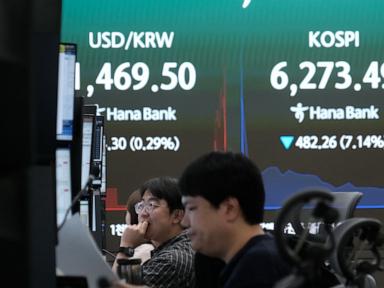
The South Korean stock market just slammed the emergency brakes.
You woke up Tuesday morning to see the Kospi index down nearly 9.5%, hitting its absolute lowest level since April. The financial news networks are flooding your feed with panicked headlines about artificial intelligence losing its momentum. Let's cut through the noise. The AI boom hasn't run out of oxygen. But the era of blindly throwing money at any stock with "semiconductor" in its corporate profile is officially dead. In other updates, read about: The Tariff Trap Why India Textile Exporters Are Still Bleeding.
Samsung Electronics took a brutal 9% hit. SK Hynix fell off a cliff, dropping over 11%. A staggering $264 billion in market value vanished into thin air. I've watched Asian equities for years, and a drop this violent isn't just a regular market correction. It is a fundamental repricing of risk by institutional players who see a massive shift coming on the horizon.
If you own tech stocks, you need to understand exactly what broke in Seoul this week. It has very little to do with AI hype fading and everything to do with a brutal new reality in global semiconductor manufacturing. The Economist has analyzed this fascinating issue in extensive detail.
The Chinese Elephant in the Trading Room
Generic financial reporting blames this crash on "concerns over AI sustainability." That is lazy analysis. To understand why institutional money fled Seoul at record speeds, you have to look across the Yellow Sea to Shanghai.
On Monday, a Chinese chipmaker named CXMT made its trading debut on the tech-oriented STAR exchange. The stock didn't just perform well. It exploded, jumping 466% in a single day. They successfully raised at least $8.6 billion in their initial public offering.
That number terrified South Korean executives.
When a direct rival raises nearly $9 billion in fresh capital, they aren't going to sit on it. They are going to buy equipment. They are going to poach engineering talent. They are going to aggressively expand manufacturing capacity at a pace that South Korean firms will struggle to match. Kim Seok-hwan, an analyst at Mirae Asset Securities, hit the nail on the head. He pointed out that the market isn't sweating CXMT's current earnings. The panic is entirely about their potential for accelerated capacity expansion and rapid technology development following this massive IPO.
Investors looked at that $8.6 billion war chest and realized the profit margins for Samsung and SK Hynix are about to get squeezed hard. The easy monopoly on high-end memory chips is facing an existential, well-funded threat.
Anatomy of a Market Meltdown
Let's look at how the chaos actually unfolded. A stock index doesn't just quietly slide 9% without breaking a few mechanical limits along the way.
As soon as the opening bell rang, heavy selling pressure materialized. Algorithms caught the scent of blood. As SK Hynix and Samsung cratered, margin calls started triggering for retail investors and highly geared funds. By 9:03 a.m., the Kospi's decline crossed the 8% threshold.
That triggered a Level 1 circuit breaker.
For 20 agonizing minutes, trading across the entire market froze completely. Circuit breakers are supposed to give traders time to breathe and reassess. Instead, it just built up the pressure. This isn't even a rare occurrence in Seoul anymore. This marked the eighth or ninth time a circuit breaker fired in 2026 alone, highlighting a terrifying level of extreme volatility in what should be a mature, stable market.
When trading resumed, the damage was irreversible for the day. Geared ETFs tied to the semiconductor sector unwound their positions forcefully. Retail investors—locally known as "ants"—tried to buy the dip, but their buying power was completely overwhelmed by foreign and institutional capital rushing for the exits.
Why Memory Matters More Than Processors Right Now
To grasp the severity of this selloff, you have to understand the specific type of technology these companies produce. Nvidia designs the incredibly smart brains of the AI revolution. But those brains cannot function without short-term memory.
That is where High Bandwidth Memory (HBM) comes in. SK Hynix has been the undisputed king of HBM for the last two years. Samsung has been fighting tooth and nail to catch up. The entire artificial intelligence infrastructure build-out relies heavily on these two companies pumping out flawless memory stacks to pair with advanced GPUs.
But standard memory chips (DRAM) remain the primary cash cow that funds all this advanced HBM research. If Chinese firms like CXMT flood the global market with cheap, heavily subsidized standard DRAM, Samsung and SK Hynix will see their core revenue streams evaporate. They would be forced into a brutal price war on legacy chips just to maintain market share.
You simply cannot fund trillion-won research facilities for next-generation AI memory if your base business is bleeding cash. That is the exact scenario institutional sellers priced into the Kospi on Tuesday.
The Regional Contagion Effect
A financial earthquake of this magnitude never stays confined to one country. The aftershocks ripped through neighboring markets almost instantly.
Taiwan's Taiex index, home to TSMC and a massive ecosystem of hardware manufacturers, dropped a painful 3.8%. Japan's Nikkei 225 tumbled 3%. Even oil prices slipped more than 1% as traders started pricing in a broader economic slowdown.
Asian markets act as the canary in the coal mine for global hardware manufacturing. When Taipei, Tokyo, and Seoul all bleed on the same day, it signals a massive recalibration of global supply chain expectations. The geopolitical reality is sinking in. With Iran threatening to block the Strait of Hormuz and broader Middle East instability driving up shipping and energy costs, the macroeconomic environment for tech manufacturing is deteriorating rapidly. Add a weak Korean won surpassing the 1,560 level against the dollar, and foreign investors have zero incentive to hold won-denominated assets.
They took their money out of Seoul and parked it in cash.
Actionable Moves for Tech Portfolios
Panic selling your tech holdings because of a circuit breaker in Seoul is a fast track to destroying your wealth. But ignoring a 9% structural crash is equally foolish. You need to adjust your exposure based on the new reality of the hardware market.
Look at your portfolio right now. Differentiate between companies building the AI application layer (software, cloud services, data management) and those trapped in the hardware manufacturing trench warfare.
The hardware layer is about to experience severe margin compression. Massive capital expenditures from new Chinese entrants will flood the market with supply. Limit your exposure to companies that rely purely on legacy semiconductor manufacturing to hit their quarterly earnings estimates.
Shift your focus to the infrastructure bottlenecks that money can't immediately solve. Power generation, cooling systems for data centers, and specialized networking equipment remain heavily supply-constrained. Do not buy the dip on memory chipmakers expecting a quick V-shaped recovery this week. Wait for the dust to settle, watch the currency exchange rates, and look for entries only when institutional outflows actually stabilize.