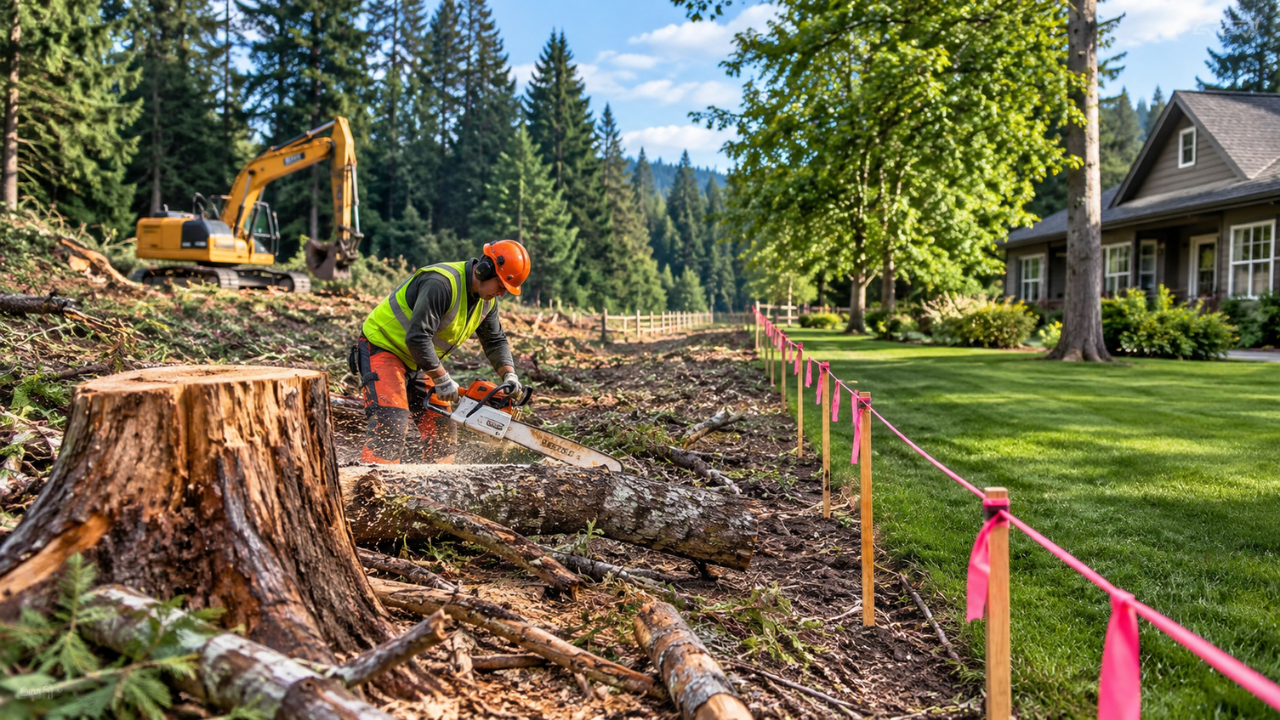
An Oregon appellate court recently affirmed an $810,000 judgment against a property owner who cleared trees across a neighbor’s boundary line back in 2018. That figure is not a typo, nor is it an outlier reserved for corporate logging conglomerates stripping national forests. It is the predictable, statutory consequence of timber trespass laws colliding with residential entitlement. When someone takes a saw to mature trees they do not own—whether to open up a view, clear brush, or expand a yard—Oregon law does not merely ask them to buy a few saplings from a local nursery. It triggers a punitive financial mechanism designed to make unauthorized clearing prohibitively expensive.
Most homeowners treat property lines as polite suggestions until a dispute erupts. They eyeball a fence, assume a stand of firs belongs to the shared wilderness, and hire a crew to thin out the canopy. In the Pacific Northwest, that casual assumption can bankrupt a household.
The Math Behind Massive Timber Judgments
To understand how a 2018 tree-clearing incident snowballs into an $810,000 liability, you have to look at Oregon Revised Statutes (ORS) 105.810. Unlike standard property damage claims—where a negligent driver pays the depreciated value of a dented bumper—timber trespass operates under a multiplier system built specifically to deter self-help landscaping.
Under Oregon law, if a person willfully injures or removes trees, timber, or shrubs from another person’s land without lawful authority, the court awards treble damages. Three times the actual value. Even when the trespass is casual, involuntary, or based on a genuine mistake about where the property line sits, ORS 105.815 still imposes double damages. You do not need malicious intent to get hit with a multiplier. You just need to be wrong about the dirt you are standing on.
The baseline valuation itself is where defendants get blindsided. Courts do not price a mature forty-year-old Douglas fir or western red cedar at its firewood value. Depending on the nature of the property, damages can be calculated using:
- Replacement and Restoration Costs: For residential or ornamental trees that provide privacy, shade, or aesthetic value, appraisers calculate the cost to purchase, transport, and plant comparable mature specimens, alongside years of soil remediation and care. Replacing a single large mature tree can easily exceed $30,000 to $50,000 once crane rentals and root-ball logistics are factored in.
- Diminution of Property Value: If the clearing ruins a residential buffer, exposes a home to highway noise, or destabilizes a hillside, real estate appraisers measure the drop in the entire parcel's market value.
- Stumpage and Commercial Value: On timberland, foresters calculate the board-feet of lost lumber, accounting for species, grade, and market rates at the time of the cut.
Take ten or fifteen mature trees valued at $18,000 each on a restoration basis. You are already at $270,000 in actual damages. Multiply that by three for a willful cut—such as ignoring a survey, pushing past an established fence, or clearing trees specifically to improve a scenic view—and you land squarely at $810,000.
Why Appellate Courts Rarely Rescue the Tree Cutter
When defendants get hit with a six-figure verdict at the trial level, they almost always appeal on the same two grounds: that the damages are wildly disproportionate to the land's overall value, and that the valuation method was speculative. Appellate courts consistently reject both arguments.
The legal philosophy here is blunt. If the law only required a trespasser to pay the raw market drop of a rural acre—say, $5,000—wealthy landowners would treat timber trespass as a convenient fee-for-service transaction. A homeowner wanting an unobstructed mountain or river view could simply clear-cut their neighbor’s hillside, write a $5,000 check, and pocket a $200,000 increase in their own home’s resale value. Treble damages exist to destroy that economic incentive. By tying awards to restoration costs and tripling the bill, Oregon courts ensure that stealing a view costs far more than the view is ever worth.
Furthermore, appellate judges give wide latitude to trial juries and arboricultural experts. Determining the value of living, non-commercial trees is inherently complex because there is no open retail market for seventy-foot conifers. As long as the plaintiff’s certified arborist uses accepted industry standards—such as the Trunk Formula Method established by the Council of Tree and Landscape Appraisers—appeals courts will not second-guess the math. Once a jury decides the cut was willful rather than accidental, the treble multiplier is mandatory under the statute. The judge has zero discretion to lower it out of sympathy.
The View-Clearing Epidemic and the Insurance Trap
Decades of covering property litigation reveal a clear pattern behind these lawsuits. Rarely does a neighbor cut down trees out of pure spite. Almost every high-dollar timber trespass case in Oregon, Washington, and California stems from one motive: view enhancement.
Consider a hypothetical scenario common along the Willamette Valley or the Oregon coast. A homeowner buys an uphill lot with a partial view of a river gorge. Downslope, a neighbor owns a wooded buffer strip that blocks the prime sunset angle. The uphill owner asks the neighbor to top or thin the trees. The neighbor refuses. Six months later, while the neighbor is out of town, a crew arrives on the uphill property, crosses fifteen feet over the unmarked line, and drops a dozen trees. The uphill owner claims a miscommunication with the contractor.
This is where the second financial catastrophe strikes. Standard homeowners insurance policies almost never cover intentional acts.
When the neighbor sues for $800,000, the defendant tenders the claim to their liability carrier, expecting their insurer to provide a defense attorney and pay any settlement. The insurer reads the complaint, notes the allegation of willful trespass, and issues a reservation of rights—or an outright denial. Insurance covers accidental occurrences, not deliberate decisions to alter someone else’s land. Even if the homeowner argues they mistakenly believed the trees were on their own side of the line, many policies exclude property damage arising out of intentional cutting or clearing operations. The homeowner ends up paying tens of thousands of dollars out of pocket just to litigate the case, before paying a dime toward the judgment.
The Contractor Blame Game
A frequent defense in these trials is pointing the finger at the hired tree service. Property owners argue that they paid a licensed arborist or landscaper, pointed vaguely toward the back forty, and trusted the professionals to stay within bounds.
That defense fails in court for two reasons. First, under agency law, a landowner is generally liable for the trespass committed by a contractor acting under their direction. Second, reputable tree services know the liability exposure and protect themselves in writing. Most commercial tree-care contracts contain explicit indemnification clauses stating that the property owner warrants the location of the boundary line and assumes full legal responsibility for verifying ownership.
If a crew cuts across a line because the homeowner guessed where the property pins were located, the homeowner eats the treble damages. Only when a contractor blatantly ignores explicit written boundaries provided by the client does the liability shift—and even then, the plaintiff sues both parties, leaving them to tear each other apart in cross-claims while the interest on the judgment ticks upward at Oregon’s statutory 9 percent rate.
How Boundary Assumptions Turn Toxic
Rural and semi-rural parcels in Oregon are notorious for ambiguous boundaries. Fences built forty years ago by previous owners often meander around boulders, creeks, or old stumps, sitting ten to thirty feet inside or outside the actual deeded line. Over time, both neighbors treat the fence as the border.
Then one parcel sells. The new buyer pulls up a county GIS tax-lot map on their phone, sees an overlay line cutting through the woods, and assumes the aerial satellite image is gospel.
County GIS overlays are notoriously inaccurate. They are administrative mapping tools, not legal surveys, and frequently shift by ten to twenty feet depending on terrain distortion. Relying on a smartphone app to authorize chainsaw work is an invitation to an $810,000 lawsuit. Without a licensed land surveyor physically locating the iron rebar pins in the ground and flagging the line, any clearing near a border is a gamble.
What Property Owners Must Do Before Clearing Near a Line
Avoiding a catastrophic timber trespass claim requires strict discipline before any equipment touches the dirt:
- Hire a Licensed Surveyor: If work is happening within fifty feet of a suspected boundary, pay for a boundary survey. A $2,500 survey is cheap insurance against an $810,000 judgment. Require the surveyor to place visible flagging tape at close intervals along the exact line.
- Get Written Permission for Shared or Border Trees: Under common law, if a tree’s trunk straddles the property line, it is a boundary tree owned in common by both neighbors. Neither owner can legally remove or fatally damage it without the other’s express consent. Put any agreement in writing, signed by both parties, specifying exactly which limbs or trunks may be touched.
- Restrict Overhanging Branch Trimming: You generally have the right to trim branches and roots that encroach onto your airspace or soil, up to the exact vertical plane of the property line. However, you cannot cross onto the neighbor's land to do it, and you cannot prune so aggressively that you kill or destabilize the tree. If your trimming kills the neighbor's tree, treble damages still apply.
- Document the Pre-Work Site: Take timestamped photos and video showing the survey flags, the intact trees, and the scope of the planned work before the crew starts their saws.
The Quiet Brutality of Statutory Interest and Liens
The $810,000 figure upheld by the Oregon court is not static. In Oregon, civil judgments accrue simple interest at 9 percent per annum from the date the judgment is entered. On an $810,000 award, that adds $72,900 every single year the case winds through the appellate process. A multi-year appeal can easily push the final payoff past the million-dollar mark once statutory costs and prevailing-party attorney fees—which ORS 105.810 also allows—are tacked onto the ledger.
Once affirmed, the judgment becomes an automatic lien against the defendant's real property. The neighbor does not have to wait patiently for a check. They can garnish bank accounts, seize non-exempt assets, or force a sheriff’s sale of the defendant’s own home to satisfy the debt.
In the end, the 2018 clearing case serves as a stark warning about how modern courts view ecological and residential permanence. You can rebuild a fence in a weekend, and you can repave a driveway in two days, but a sixty-year-old stand of native timber cannot be replaced on a human timeline—so the law extracts its price in generational wealth instead.