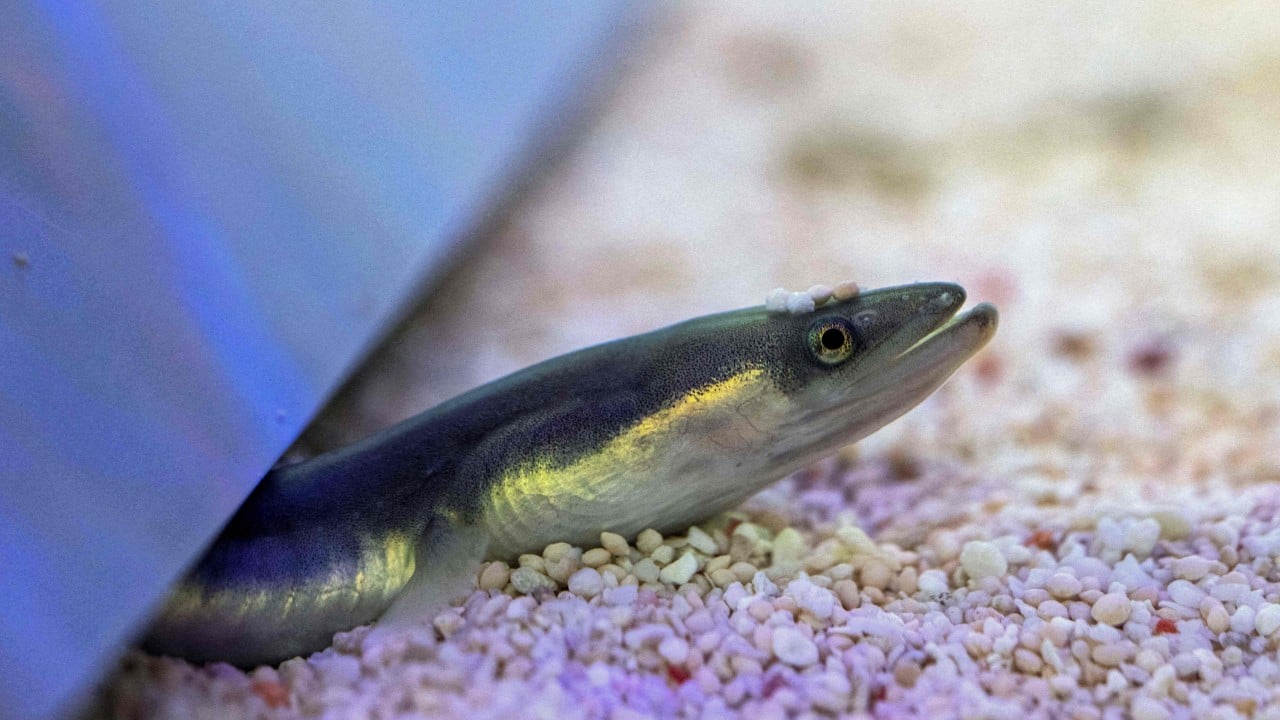
Science loves a victory lap, especially when it involves "replicating" one of nature's most guarded secrets.
The headlines are buzzing: Chinese researchers at the Shanghai Ocean University have supposedly cracked the code, simulating a 6,000-kilometer migration within the sterile confines of a research pool. They claim to have induced maturation and spawning in Japanese eels (Anguilla japonica) by mimicking the pressure, temperature, and swimming fatigue of the open ocean.
It sounds like a breakthrough. It feels like a triumph. In reality, it is a high-tech vanity project that misses the biological forest for the proverbial trees. We are obsessed with the "how" of the journey while completely ignoring the "why" of the organism.
For decades, the aquaculture industry has chased the dragon of a closed-loop eel life cycle. Why? Because the $4 billion global eel market is built on a foundation of ecological theft. We snatch "glass eels" from river mouths, shove them into tanks, and grow them out for kabayaki. We are essentially mining a finite biological resource, and the resource is running out.
The "pool-to-plate" dream promised by these recent experiments isn't about conservation. It's about industrializing a creature that has spent 50 million years evolving to be un-industrializable.
The Fatigue Fallacy
The central premise of the Shanghai study—and several Japanese predecessors—is that if you make an eel swim against a current for months, you trigger its reproductive hormones. The logic is purely mechanical: Distance traveled equals biological readiness.
This is a massive oversimplification of endocrine signaling.
In the wild, an eel’s journey from the rivers of East Asia to the West Mariana Ridge isn't just a treadmill exercise. It is a descent into darkness and high pressure. Eels undergo "diel vertical migration." During the day, they dive to depths of 800 meters to avoid predators and regulate metabolism. At night, they rise.
A circular tank with a motor can simulate the kilometers, but it cannot simulate the crushing gravity of the deep ocean or the specific thermal stratification that dictates egg development. When we force maturation using synthetic hormones and water pumps, we aren't "replicating" a journey; we are performing biological puppetry.
The larvae produced in these tanks are notoriously fragile. Their survival rates often hover near zero percent past the first few weeks. Why? Because we can’t figure out what to feed them. In the wild, they eat "marine snow"—a complex, decaying organic rain of detritus. In the lab, we give them shark egg slurry.
We are trying to build a Ferrari by looking at a picture of a wheel.
The Cost of "Success"
I have spent enough time around commercial hatcheries to know that "technical feasibility" is the graveyard of profitable ideas.
Even if these scientists manage to raise a thousand glass eels to maturity in a pool, the energy expenditure is catastrophic. To maintain the specific salinity, the exact $10-12$°C temperature of the deep-sea thermocline, and the constant current requires a power grid that would make a bitcoin miner blush.
The math doesn't work.
- Wild Capture Cost: Minimal (labor and nets).
- Synthetic Breeding Cost: Massive infrastructure, specialized feed, hormonal injections, and 24/7 climate control.
By focusing on replicating the 6,000km swim, we are doubling down on an expensive, artificial fix for a problem caused by our own greed. The "lazy consensus" says that because we are losing wild eels, we must build them in labs. The nuanced truth is that if we spent half the research budget on dam removal and habitat restoration, the eels would do the 6,000km swim for free.
Why the "Unprecedented Success" is a Distraction
The media treats these experiments as a "game-changer" (to use a term I despise) because it suggests humans are finally smarter than the Sargasso Sea.
But look at the data from the Japanese experiments over the last 20 years. They "closed the loop" in 2010. Over a decade later, synthetic glass eels account for exactly 0% of the commercial market. The survival rate remains a joke. The cost remains prohibitive.
The Chinese study claims to have improved the "maturation rate," but maturation isn't the bottleneck. Survival is. You can fill a tank with eggs, but if those leptocephali (the larval stage) don't have the specific gut microbiome or the exact hydrostatic pressure needed to develop, you have produced nothing but expensive organic waste.
We are treating the eel like a biological machine. It isn't. It is an extension of a global oceanic current system.
The Search for the Wrong Answer
People often ask: "Can we farm eels like we farm salmon?"
The answer is a brutal "No," and the reason is phylogeny. Salmon are remarkably plastic. They adapt. Eels are ancient, rigid, and tied to the magnetic fields of the earth. When you put an eel in a circular tank, its internal compass is screaming. Its stress levels are through the roof.
We are trying to solve a biological mystery using civil engineering.
The industry insiders won't tell you this because their funding depends on the "next big breakthrough." They need the public to believe that the "eel apocalypse" is solvable with a better water pump. It keeps the investment flowing. It keeps the sushi conveyor belts moving.
The Only Path Forward
Stop celebrating the simulated swim.
It is a scientific curiosity, not a solution. If you want to save the eel, you don't build a better pool in Shanghai. You stop the poaching of glass eels in the estuaries. You mandate "eel ladders" on every dam from Fujian to Hokkaido. You address the PCB and heavy metal loads in river sediments that are literally sterilizing the eels before they even start their journey.
The 6,000km migration is a filter. It ensures that only the strongest, cleanest, and most fit individuals reach the spawning grounds. By bypassing this filter in a lab, we are creating a genetically weak population that could never survive in the wild.
We aren't saving a species. We are creating a captive mutant.
If the goal is to keep eating unagi until the end of time, then admit this is a commercial venture. But don't wrap it in the flag of conservation. Don't pretend that a concrete ring in a laboratory is a substitute for the vast, crushing silence of the Philippine Sea.
Nature doesn't have a shortcut. The eel earns its life through the agony of the journey. If you take away the journey, you don't have an eel; you just have a long, wet disappointment.
Quit looking at the tank. Look at the river.
The solution isn't more technology. It's less interference.
Let the fish swim.