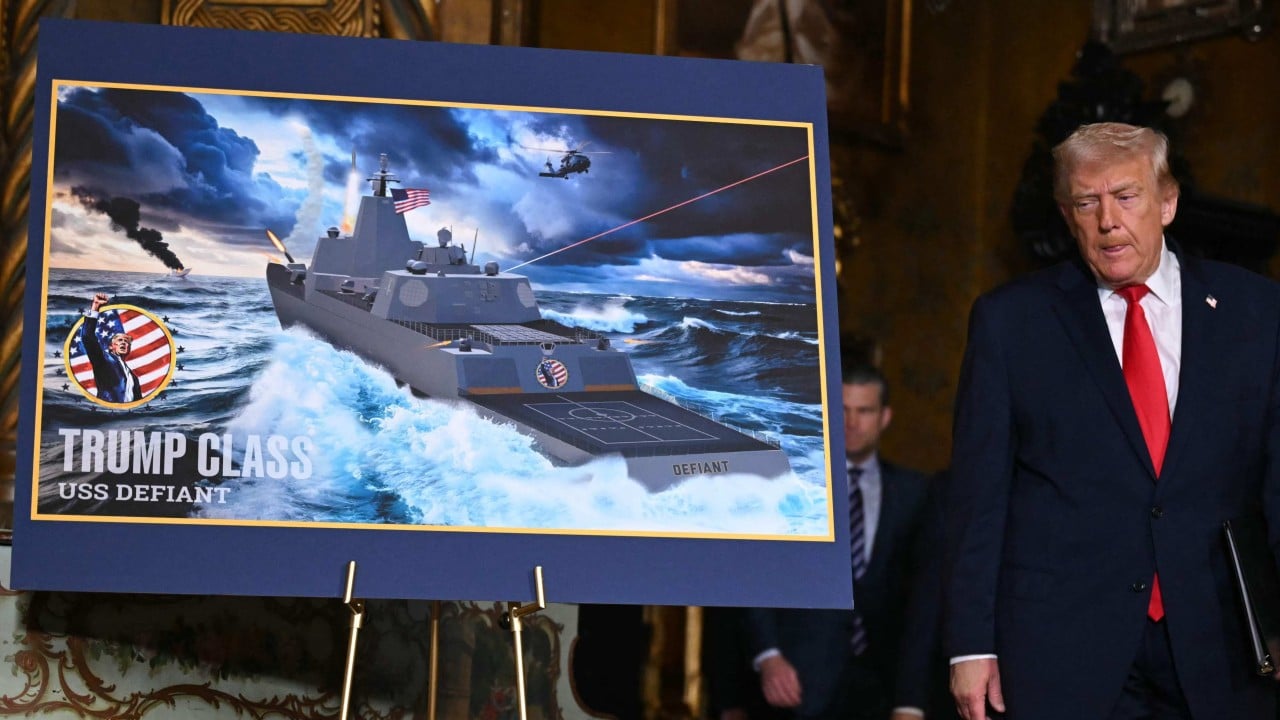
The United States Navy is attempting its largest conceptual pivot since the dawn of the carrier era by proposing a 35,000-ton nuclear-powered leviathan known as the Trump-class battleship. This colossal vessel, led by the projected USS Defiant (BBG-1), is intended to anchor a newly proclaimed Golden Fleet designed to check China expansion in the Indo-Pacific. However, the multi-billion-dollar surface combatant risks entering the water as an immediate casualty of modern missile geometry. Rather than projecting absolute power, concentrated hulls of this magnitude present a massive, centralized target for China advanced inventory of anti-ship ballistic missiles, including the operational DF-21D and the long-range hypersonic DF-27.
The strategic mathematics of the Pacific theater have fundamentally transformed over the past two decades. The core vulnerability of any large surface combatant does not stem from its armor thickness or its internal missile capacity, but from the radical disparity in cost between offensive precision weaponry and defensive interception systems.
The Illusion of the Floating Fortress
The Navy envisions the Trump-class as a definitive solution to a shrinking fleet capacity, blending strategic nuclear-capable cruise missiles, Conventional Prompt Strike (CPS) hypersonics, and a 128-cell Mark 41 Vertical Launch System into a single hull. Proponents argue that the ship immense electrical generation capacity, driven by an A1B nuclear reactor, will eventually support electromagnetic railguns and high-output directed-energy weapons capable of burning incoming threats out of the sky.
This design philosophy relies on a highly dangerous assumption: that defensive technology can outpace the volume of a saturated missile strike. Beijing state media and naval researchers have already labeled the 850-foot warship an easy target, a assessment that aligned with independent Western naval analysis.
The primary threat comes from the People's Liberation Army Rocket Force (PLARF), which has spent decades perfecting the anti-access/area-denial (A2/AD) envelope. The DF-21D, frequently called the carrier killer, possesses a maneuverable re-entry vehicle designed to slam through traditional carrier strike group air defenses from over 1,500 kilometers away. More threatening still is the DF-27, a hypersonic glide vehicle platform tested successfully and now deemed fully operational by the Pentagon. With an estimated range stretching up to 8,000 kilometers, the DF-27 allows China to hold massive surface ships at risk long before they close within range to use their own tactical weapons.
The Cost Asymmetry Problem
Defending a single 35,000-ton asset creates an economic and tactical bottleneck. The Congressional Budget Office projects the lead ship of this class could cost upwards of $22 billion, with subsequent hulls demanding over $12 billion each. When a single asset concentrates such a massive percentage of the shipbuilding budget, its survival becomes a prerequisite for operational success.
To protect a $22 billion investment, the Navy must surround it with a screen of Arleigh Burke-class destroyers, converting offensive assets into purely defensive bodyguards. The math of intercepting ballistic and hypersonic missiles is brutally stacked against the defender. A standard fleet interceptor, like the SM-6, costs millions of dollars per shot, and doctrines typically require firing multiple interceptors at a single incoming threat to ensure a kill.
- Target Acquisition: China utilizes an expanding constellation of ocean-surveillance satellites, long-range over-the-horizon radars, and unmanned aerial vehicles to maintain persistent tracking of large surface vessels. A 35,000-ton ship cannot hide in the open ocean.
- Magazine Depletion: A coordinated strike combining land-based ballistic missiles, air-launched cruise missiles from H-6J bombers, and ship-borne YJ-21 hypersonics can quickly overwhelm the vertical launch cells of a defending fleet. Once the interceptors are spent, the capital ship is defenseless.
- Kinetic Destruction: Unlike World War II-era battleships shielded by feet of steel armor, modern warships rely on thin-skinned, weight-saving configurations. A single hit from a hypersonic warhead carrying massive kinetic energy would likely cause a mission kill, knocking out the radar arrays, communications antennas, and integrated power systems required to fight.
The Death of Distributed Firepower
The decision to pursue the Trump-class represents a stark departure from the Navy own stated doctrine of distributed lethality. For years, naval strategists argued that the safest way to survive in a high-threat environment was to scatter offensive capability across dozens of smaller, cheaper platforms. By placing vertical launch tubes on numerous smaller frigates, destroyers, and unmanned surface vessels, the fleet forces an adversary to split its surveillance and targeting resources.
Killing a distributed fleet requires hundreds of coordinated, high-end strikes against independent targets. Killing a concentrated fleet built around a Trump-class battleship requires hitting just one massive hull.
Replacing the next-generation DDG(X) destroyer program with a sprawling super-combatant concentrates vulnerability. If the USS Defiant is forced to operate thousands of miles away from the theater just to remain outside the envelope of China hypersonic glide vehicles, its multi-billion-dollar arsenal of short-to-medium-range weapons is effectively neutralized. The ship becomes a strategic liability, dictating the movements of the fleet based on fear of its loss rather than the execution of offensive operations.
The reality of modern naval engagement is that large hulls cannot compensate for a fundamentally compromised defensive equation. Pouring tens of billions of dollars into a handful of massive surface ships hands an adversary a clear blueprint for containment. True maritime deterrence in the Pacific cannot be bought with concentrated spectacles of tonnage; it requires a resilient, distributed architecture that refuses to give an enemy a single, definitive target to destroy.