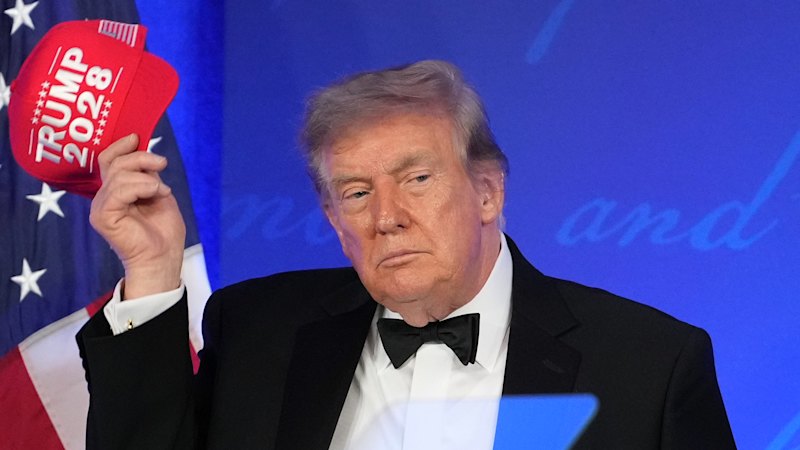
The persistent whispers, merchandise drops, and provocative statements regarding a potential third presidential run by Donald Trump for 2028 are more than mere political theater, though they ultimately crash against an absolute constitutional wall. Donald Trump is constitutionally barred from running for re-election in 2028 under the Twenty-second Amendment, which prohibits any individual from being elected to the office of the President more than twice. Despite periodic trial balloons floated by allies and rhetorical gamesmanship from the administration, the mechanics of American law leave zero ambiguity for a direct campaign. Yet the real story for 2028 is not whether a third term is legally possible—it is not—but rather how the illusion of it warps the early planning of every ambitious Republican eyeing the post-Trump landscape.
The Constitutional Dead End
To understand why the third-term conversation persists, one must examine the precise architecture of the Twenty-second Amendment. Ratified in 1951 following Franklin D. Roosevelt's four-term presidency, the text explicitly declares that no person shall be elected to the office of the President more than twice. Because Trump secured a non-consecutive second term, his eligibility clock has run out.
Amending the Constitution to carve out an exception requires a two-thirds vote in both the House of Representatives and the Senate, followed by ratification from three-fourths of state legislatures. Alternatively, it requires a constitutional convention called by two-thirds of the states. In a polarized nation with sharply divided legislative bodies, achieving this threshold is a mathematical impossibility.
Even creative legal maneuvers, such as a hypothetical vice-presidential run intended to maneuver through succession loopholes, collide with the Twelfth Amendment. The Twelfth Amendment stipulates that no person constitutionally ineligible to the office of president shall be eligible to that of vice president. Trump himself acknowledged these realities aboard Air Force One, noting that the text is clear and that he is not allowed to run again. The legal barriers are absolute, leaving no hidden backdoor for a literal repeat candidacy.
The Psychological Utility of the Speculation
If the path is closed, why keep the door cracked open? Political survival demands a strategy against premature lame-duck status. When an incumbent administration enters its final years without a clear continuation narrative, power immediately begins to bleed toward prospective successors.
By keeping the political waters murky, the White House maintains leverage over the entire party apparatus. Lawmakers, donors, and party operatives hesitate to pledge allegiance to an emerging 2028 contender for fear of alienating the current power center. It is a classic exercise in political containment. The chatter forces potential successors to tread carefully, publicly declaring loyalty while privately building shadow campaign operations across early-voting states like Iowa and New Hampshire.
This dynamic creates a peculiar stasis within the Republican ecosystem. While grassroots donors happily scoop up commemorative merchandise, serious strategists are forced to run two parallel tracks of thought. Track one involves publicly supporting the notion of enduring leadership. Track two involves quietly positioning candidates for the first truly open Republican primary since 2016.
The Real 2028 Battlefield
With Trump exiting the ballot in 2028, the Republican primary will transform into a wide-open brawl for the future of the conservative movement. The field is already shaping up to include heavyweights who have spent years navigating the populist shift of the party. Figures closely aligned with the current administration, including Vice President JD Vance and Secretary of State Marco Rubio, naturally inherit a strong baseline of institutional support. At the same time, regional executives like governors and veteran senators are positioning themselves as the ideal bridge to the post-Trump era.
The central friction point of that upcoming primary will not be about breaking constitutional amendments, but about coalition maintenance. Can a successor hold together the working-class, rust-belt alliance that redefined Republican geography, or will the party fracture back into traditional economic conservatism? The answer depends entirely on how cleanly the party manages the transition away from its dominant modern figurehead.
The Succession Vacuum
When an anchor tenant leaves a shopping center, foot traffic shifts overnight. The shadow cast by the 2028 third-term narrative functions precisely as that anchor tenant, obscuring the structural vulnerability facing the Republican field. Without an incumbent on the ticket for the first time in over a decade, the party faces a steep test of candidate quality and message discipline.
State-level resistance is already organizing against any perceived attempt to challenge term limits, with preemptive ballot-access bills introduced in states like California. These legislative moves are largely precautionary or symbolic, yet they underscore how deeply the topic polarizes institutional actors.
The political class spends hours dissecting off-hand remarks about staying past the finish line, ignoring the ticking clock on the real transition. The era of personalized electoral gravity is drawing to a mandatory close, leaving an immense vacuum that cannot be filled by nostalgic legal theories. The future of the conservative coalition will be decided not by rewriting the rules of the past, but by winning an open field where the rules are absolute.