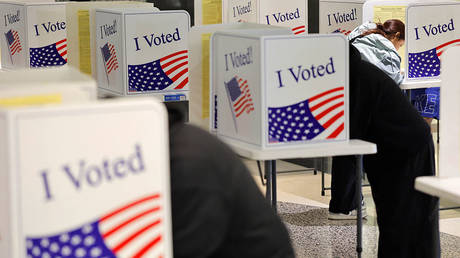
Most foreign policy pundits spent the months leading up to November 2026 obsessing over polling margins in Pennsylvania and Arizona, completely missing the bigger story unfolding in Brussels, Beijing, and Tokyo. The 2026 US midterms didn't just reshuffle committee chairs on Capitol Hill—they exposed the raw mechanics of a changing world order where American domestic polarization is now the primary driver of global instability.
If you look closely at how foreign capitals reacted to the November 2026 results, one thing becomes painfully clear. Allies and adversaries alike no longer view Washington as a steady anchor. Instead, they treat US election cycles like severe weather events that require constant hedging, redundant supply chains, and independent security arrangements.
Why Domestic Gridlock Now Dictates Foreign Policy
For decades, a predictable rule governed Washington. Politics stopped at the water's edge. Even during fierce domestic battles, both parties generally agreed on the basics of NATO, Pacific alliances, and global trade architecture. That consensus is dead.
In the 2026 cycle, foreign policy became a pure proxy for domestic culture wars and economic grievances. Voters didn't cast ballots based on grand strategy, yet their choices immediately froze multibillion-dollar appropriations for overseas defense and development. When Congress splits or operates on razor-thin margins, the executive branch loses its ability to make credible long-term promises.
Foreign diplomats I've spoken with over the past two years share a blunt assessment. They don't care which party holds a three-seat majority in the House. They care that every two years, the entire trajectory of US trade tariffs, sanctions enforcement, and security guarantees can whiplash in the opposite direction.
The Death of the Four-Year Horizon
Think about what happens when you run a sovereign nation or a multinational corporation. You plan in ten-year and twenty-year cycles. Building a semiconductor fabrication plant or negotiating a mutual defense treaty takes years of sustained political backing.
The 2026 midterms confirmed that Washington can barely guarantee policy continuity for twenty-four months. When an administration struggles to pass routine funding bills without government shutdown threats, foreign leaders quietly stop waiting for American leadership. They start cutting side deals.
- Trade agreements stall: Without fast-track authority or bipartisan congressional backing, the US remains largely sidelined from major regional trade pacts in the Indo-Pacific.
- Sanctions lose their bite: Adversaries know that enforcement priorities shift depending on which faction controls key oversight committees.
- Aid becomes transactional: Foreign assistance is no longer viewed as a long-term investment in global stability, but as a short-term bargaining chip in domestic budget fights.
How Allies Are Hedging Against Washington
You can measure the true impact of the 2026 US midterms by watching what America's closest partners are doing with their own budgets. Nobody is issuing press releases announcing they've lost faith in the United States. They're simply acting like insurance underwriters preparing for a worst-case scenario.
Take Europe. Following the 2024 presidential race and the subsequent 2026 midterm gridlock, European Union defense spending hit post-Cold War highs. Countries like Poland, Germany, and France aren't just buying American hardware anymore—they're aggressively subsidizing domestic European arms manufacturing. Why? Because they watched congressional paralysis delay critical military aid packages earlier in the decade, and they refuse to leave their territorial security entirely dependent on a swing district in the American Midwest.
Strategic Autonomy Isn't a Slogan Anymore
In Asia, the hedging looks slightly different, though the underlying anxiety is identical. Japan and South Korea have deepened their bilateral security cooperation while simultaneously keeping diplomatic channels open with Beijing. They want the US nuclear umbrella, sure. They just don't trust Washington's economic commitment.
When American politicians from both sides of the aisle campaign on protectionism and tariffs, export-driven economies in East Asia take the hint. They are diversifying their trade dependencies rapidly, strengthening intra-Asian supply chains that bypass North America altogether.
Beijing and Moscow Are Playing a Different Game
Authoritarian regimes love watching messy democratic elections, mostly because they can weaponize the chaos for domestic propaganda. Yet behind closed doors, analysts in Beijing and Moscow aren't celebrating a sudden American collapse. They're calculating how to exploit Washington's distraction.
China's leadership views the 2026 midterm dynamics as proof of its core thesis—that Western democracies are structurally incapable of long-term strategic focus. While American lawmakers spend months locked in partisan investigations and budget standoffs, Beijing methodically expands its influence across the Global South through infrastructure financing, green energy dominance, and diplomatic mediation.
The Global South Isn't Picking Sides
Here is what most Western commentary gets completely wrong about the changing world order. Countries like Brazil, India, Indonesia, and Saudi Arabia aren't lining up to join an anti-American bloc. They're simply refusing to choose between Washington and Beijing.
The 2026 midterms reinforced their belief that non-alignment is the smartest play. When the US political system looks volatile, middle powers gain massive bargaining power. They buy drones from Turkey, oil from Russia, telecom gear from China, and advanced fighter jets from the United States. They play the superpowers off each other while focusing relentlessly on their own national development.
The Economic Reality Behind the Geopolitical Shift
Strip away the diplomatic jargon, and the shifting world order comes down to money and industrial capacity. Voters in 2026 were angry about the cost of living, housing affordability, and the lingering effects of inflation. That domestic economic frustration directly fuels the inward turn in American foreign policy.
You cannot project overwhelming global power when your domestic manufacturing base is hollowed out and your national debt service costs rival your entire defense budget. The Congressional Budget Office has repeatedly warned about the trajectory of federal debt, and foreign bondholders are paying close attention.
Tariffs as a Blunt Instrument
Both major US political parties have embraced economic nationalism to varying degrees. Whether it's blanket tariffs on foreign imports or strict domestic content requirements for green energy subsidies, the message to the rest of the world is clear. America is prioritizing its own industrial revival over the free-trade rules it wrote after World War II.
This creates a massive ripple effect:
- Supply chains fragment: Companies are forced to build duplicate factories—one set to serve the US market, and another to serve the rest of the world.
- Global growth slows: Trade barriers raise costs for consumers everywhere and reduce efficiency across global markets.
- The dollar's dominance faces quiet pressure: While no currency is close to replacing the US dollar, more bilateral trade between countries like China, Brazil, and Gulf states is being settled in local currencies to insulate against US sanctions and financial volatility.
What Most Analysts Miss About American Resilience
It's easy to look at the polarization surrounding the 2026 US midterms and declare the end of the American century. People have been making that exact prediction since the 1970s, and they've been wrong every single time.
If you bet against the United States based solely on the dysfunction in Washington, you're ignoring the actual engines of American power. The US still possesses the world's deepest capital markets, unmatched energy independence, favorable demographics compared to aging rivals like China and Russia, and an innovation ecosystem that dominates artificial intelligence and biotechnology.
The Decoupling of Washington and the US Economy
What we're actually witnessing isn't American decline—it's a decoupling between the federal government's political dysfunction and the raw economic strength of the private sector. American tech firms, energy producers, and financial institutions continue to set global standards regardless of who controls the Senate.
Even so, private sector strength cannot fully compensate for diplomatic paralysis. Corporations can build global networks, but they can't deter military aggression or negotiate nuclear arms control treaties. That requires a functioning, credible state.
How to Read Global Markets and Geopolitics Now
If you're an investor, a business leader, or just someone trying to make sense of the news without getting swept up in partisan noise, you need to adjust how you filter political events. Stop treating US elections as simple binary outcomes where one party saves the world and the other destroys it.
Watch the structural trends instead. Look at defense spending allocations in Europe and Asia, track where multinational corporations are actually building new physical plants, and pay attention to trade volumes between middle powers that don't involve the United States at all.
The 2026 midterms proved that the old, unipolar world where Washington dictated the rules and everyone else followed is gone for good. We live in a messier, multipolar reality where American domestic politics is just one volatile variable among many. Keep your eyes on the capital flows and the supply chains—they will always tell you the truth long before a politician steps up to a microphone.