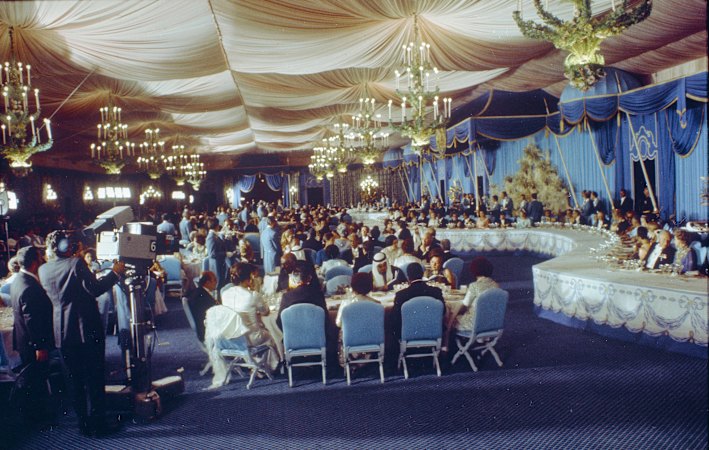
The 2,500-year celebration of the Persian Empire in 1971 wasn't the spark that lit the Iranian Revolution. To suggest that a single party—no matter how many truckloads of Maxim’s de Paris truffles were involved—toppled a 2,500-year-old monarchy is historical laziness. It’s a convenient myth for Western journalists who want a "let them eat cake" narrative without doing the actual math on Iranian sociology or 20th-century geopolitics.
The party at Persepolis wasn't the cause of the Shah's downfall. It was a failed rebranding exercise that, ironically, became the only reason the Pahlavi legacy survived in the global imagination as something sophisticated rather than merely authoritarian.
The Cost of Admission was a Rounding Error
Critics love to scream about the price tag. Estimates usually hover around $100 million to $200 million in 1971 dollars. Adjusted for inflation, we’re looking at roughly $700 million to $1.2 billion today.
In the context of a developing nation’s budget, that sounds like a crime. But let’s look at the ledger. In 1971, Iran's oil revenue was exploding. The "Great Civilization" the Shah envisioned was being built on a GDP growth rate that rivaled Japan’s. The cost of the party was less than 1% of the annual oil revenue at the time. If Jeff Bezos spends $500 million on a yacht, we call it an ego trip; we don't say it’s going to collapse the American economy.
The "extravagance" wasn't the problem. The lack of a "Plus One" for the Iranian people was.
The Marketing Failure of the Century
The Shah didn’t throw a party for Iranians. He threw a party for the history books, and that was his fatal strategic error. He was trying to bypass the Islamic identity of his country by leapfrogging back to Cyrus the Great.
From a branding perspective, this was a masterclass in how to alienate your core demographic.
- Target Audience: European royalty and Cold War power players.
- Excluded Stakeholders: The merchant class (Bazaaris) and the clergy.
- The Messaging: "We are Western, secular, and ancient," in a country that was increasingly religious, nationalistic, and young.
The competitor narrative says the party proved the Shah was out of touch. I argue it proved he was a visionary with a broken mirror. He saw an Iran that could lead the world, but he forgot that a leader needs a following. You don't build a national identity by flying in 50,000 bottles of Champagne to a desert where the locals are struggling with basic infrastructure in the surrounding villages.
The "Foreigner" Fallacy
The most stinging critique of the event—and the one that actually fueled the revolution—wasn't the wealth. It was the "foreignness."
The Shah didn't hire Iranian caterers. He hired Maxim’s. He didn't use Iranian architects for the "Tent City." He hired Maison Jansen from Paris. He didn't even use Iranian silk. By outsourcing the glory of the Persian Empire to French decorators, he signaled that Persian excellence was a relic of the past, and only Europe could provide a modern version of it.
This is where the "insider" view differs from the "tourist" view. The tourist sees a lavish party. The insider sees a massive vote of no confidence in his own people. The Revolution wasn't just about poverty; it was about dignity. When Ayatollah Khomeini called it the "Devil’s Festival" from exile, he wasn't just talking about the cost of the wine. He was pointing out that the Shah had become a stranger in his own land.
Why the "Path to Ruin" Narrative is Wrong
If the party was the catalyst, the revolution would have happened in 1972. It didn't. It happened in 1979.
The seven-year gap is filled with far more significant systemic failures:
- The 1973 Oil Shock: Which flooded Iran with more cash than its infrastructure could absorb, leading to hyperinflation.
- SAVAK Overreach: The brutal secret police made the "extravagant party" look like a minor grievance compared to the torture of political dissidents.
- The White Revolution’s Backfire: Land reforms that were supposed to help peasants ended up driving them into urban slums, creating a massive, disgruntled underclass.
The Persepolis party is the "easy" answer. It’s the visual aid for a complex systemic collapse. It’s the B-roll footage used by every documentary filmmaker because it’s easier to show a clip of Prince Philip shaking hands with the Shah than it is to explain the nuances of the Dutch Disease in a petro-state economy.
The Accidental Legacy
Here is the counter-intuitive truth: The 1971 celebration is the only reason many people today view the Pahlavi era with any sense of nostalgia.
By creating a spectacle of such high-caliber sophistication—even if it was imported—the Shah successfully associated his reign with a level of global prestige that the current regime hasn't touched in forty years. He created a "Golden Age" mythos that is currently being consumed by millions of young Iranians on satellite TV and social media.
They don't see the $200 million bill. They see a version of their country that was the center of the world, where leaders of every superpower came to pay homage to a Persian king. In his failure to secure his throne, the Shah accidentally secured his place as a symbol of "what could have been."
Stop Asking if the Party was Too Expensive
The question itself is a distraction. If the Shah had spent $200 million on low-income housing in 1971, he still would have been overthrown. Why? Because the housing wouldn't have solved the fundamental crisis of legitimacy.
You cannot buy a national identity with social programs any more than you can buy it with a French-catered banquet. The Shah’s downfall wasn't a matter of economics; it was a matter of narrative. He tried to tell a story about a secular, imperial future to a people who were increasingly looking for a spiritual, populist present.
The party wasn't the "path to ruin." It was the final, glittering curtain call for an elite that had already lost the room. If you’re looking for the moment the monarchy died, don't look at the caviar. Look at the fact that not a single ordinary Iranian was invited to the table.
Build a tent city for the world, and your own people will burn it down just to feel the heat.