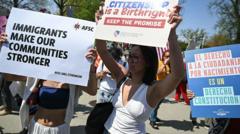
Executive orders don't rewrite the United States Constitution. That simple, unyielding reality just derailed the White House's most aggressive immigration policy of the decade.
In a massive blow to the administration, the US Supreme Court struck down Executive Order 14160, Donald Trump's day-one directive aimed at ending birthright citizenship for the children of undocumented immigrants and temporary visa holders. The 6-3 decision in Trump v. Barbara didn't just halt a policy; it cemented a legal principle that has defined the American identity since the aftermath of the Civil War.
If you are trying to understand what this means for immigration law, your family, or the upcoming legislative battles, you need to ignore the political spin and look at what actually happened inside the courtroom.
The Alliance that Saved the 14th Amendment
The biggest surprise for casual observers wasn't the result itself, but who delivered it. This wasn't a predictable, partisan split. Chief Justice John Roberts authored the majority opinion, and he was joined by Justice Amy Coney Barrett alongside the court's three liberal justices.
The legal breakdown shows two distinct paths that led to the same destination:
- The Constitutional Core: Five justices—Roberts, Barrett, Sonia Sotomayor, Elena Kagan, and Ketanji Brown Jackson—ruled that the executive order directly violates the 14th Amendment.
- The Statutory Route: Justice Brett Kavanaugh concurred with the final outcome but wrote separately, arguing that the president's order violates existing federal law without reaching the constitutional question.
Conservatives Clarence Thomas, Samuel Alito, and Neil Gorsuch formed the dissenting block. Thomas argued that the court took an extraordinary step by holding the order unconstitutional, claiming the original intent of the 14th Amendment was designed for freed slaves, not the children of foreign visitors. Alito added that maintaining birthright citizenship acts as a powerful incentive for people to enter the country illegally.
But the majority completely rejected those arguments. Roberts blasted the government's attempts to rewrite history, noting there was scant evidence for their revisionist view of the law.
Deciphering Subject to the Jurisdiction
The entire government case rested on four words in the 14th Amendment: "subject to the jurisdiction".
The administration’s legal team, led by Solicitor General D. John Sauer, tried to sell a highly restrictive interpretation. They argued that the phrase requires a formal political allegiance to the United States. Under their theory, if a child is born to parents on temporary work visas, student visas, or without legal status, that child owes allegiance elsewhere and shouldn't get automatic citizenship.
The court didn't buy it. The legal consensus for over a century has been that if you are physically present on US soil, you are subject to its laws and its jurisdiction. The only classic exceptions are the children of foreign diplomats or invading armies.
Roberts anchored his opinion heavily on United States v. Wong Kim Ark, an 1898 landmark case. In that historic battle, the court ruled that a child born in San Francisco to Chinese immigrants was a citizen at birth. By upholding that precedent, the modern court confirmed that the status of citizenship is fixed by the place of birth, irrespective of parentage.
What Happens to Families and Workers Now
The administrative fallout of this ruling is immediate. Because multiple lower courts had kept Executive Order 14160 on ice while the legal challenge wound its way through the system, the policy never actually took effect.
For immigrant families, temporary workers, and employers, the practical takeaway is simple: the status quo remains completely unchanged.
- For Parents: Any child born on US soil continues to receive automatic, unquestioned US citizenship, regardless of the parents' legal status. Hospitals and vital statistics offices will continue issuing birth certificates and processing social security numbers exactly as they did before 2025.
- For Employers: You don't need to audit your I-9 verification processes or change how you track employee documentation based on this case. A valid US birth certificate remains definitive proof of work authorization, full stop.
The decision represents the third major high-court defeat for the administration's economic and border agenda this term, following rulings that struck down sweeping global tariffs and blocked the removal of a Federal Reserve governor. Predictably, the response from the White House was furious, with the president taking to Truth Social to call the decision "too bad for our country" while demanding that Congress step in.
The Real Next Battleground
Don't expect the immigration debate to quiet down just because the Supreme Court drew a hard line. The battle is already shifting to Capitol Hill. While the administration maintained that the president could end birthright citizenship with the stroke of a pen, they are now urging Congress to pass legislation to achieve the same goal.
This sets up an incredibly messy legislative showdown. Most constitutional scholars agree that changing birthright citizenship requires a full constitutional amendment—a massive hurdle requiring a two-thirds majority in both chambers of Congress and ratification by 38 states. However, hardline immigration opponents are already drafting statutory bills designed to test whether a future, slightly altered court might allow Congress to limit citizenship rights by law rather than executive fiat.
For now, the legal landscape is secure. The Supreme Court made it clear that the executive branch cannot unilaterally shrink the definition of an American. If you are tracking immigration compliance or managing visa holders within your organization, you can safely disregard the administration's original day-one order. Keep your current onboarding and verification processes intact, but keep a close eye on Congress, because the legislative maneuvering over who qualifies as an American citizen is just getting started.


